

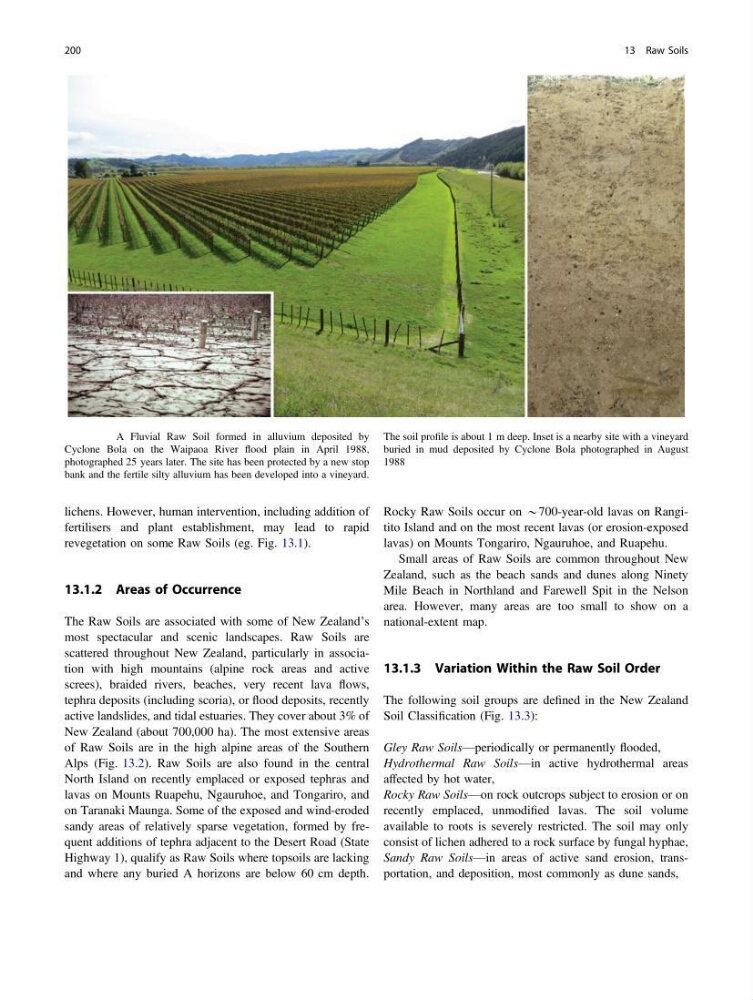
lichens. However, human intervention, including addition of
fertilisers and plant establishment, may lead to rapid
revegetation on some Raw Soils (eg. Fig. 13.1).
13.1.2 Areas of Occurrence
The Raw Soils are associated with some of New Zealand’s
most spectacular and scenic landscapes. Raw Soils are
scattered throughout New Zealand, particularly in association with high mountains (alpine rock areas and active
screes), braided rivers, beaches, very recent lava flows,
tephra deposits (including scoria), or flood deposits, recently
active landslides, and tidal estuaries. They cover about 3% of
New Zealand (about 700,000 ha). The most extensive areas
of Raw Soils are in the high alpine areas of the Southern
Alps (Fig. 13.2). Raw Soils are also found in the central
North Island on recently emplaced or exposed tephras and
lavas on Mounts Ruapehu, Ngauruhoe, and Tongariro, and
on Taranaki Maunga. Some of the exposed and wind-eroded
sandy areas of relatively sparse vegetation, formed by frequent additions of tephra adjacent to the Desert Road (State
Highway 1), qualify as Raw Soils where topsoils are lacking
and where any buried A horizons are below 60 cm depth.
Rocky Raw Soils occur on *700-year-old lavas on Rangitito Island and on the most recent lavas (or erosion-exposed
lavas) on Mounts Tongariro, Ngauruhoe, and Ruapehu.
Small areas of Raw Soils are common throughout New
Zealand, such as the beach sands and dunes along Ninety
Mile Beach in Northland and Farewell Spit in the Nelson
area. However, many areas are too small to show on a
national-extent map.
13.1.3 Variation Within the Raw Soil Order
The following soil groups are defined in the New Zealand
Soil Classification (Fig. 13.3):
Gley Raw Soils—periodically or permanently flooded,
Hydrothermal Raw Soils—in active hydrothermal areas
affected by hot water,
Rocky Raw Soils—on rock outcrops subject to erosion or on
recently emplaced, unmodified lavas. The soil volume
available to roots is severely restricted. The soil may only
consist of lichen adhered to a rock surface by fungal hyphae,
Sandy Raw Soils—in areas of active sand erosion, transportation, and deposition, most commonly as dune sands,
Fig. 13.1 A Fluvial Raw Soil formed in alluvium deposited by
Cyclone Bola on the Waipaoa River flood plain in April 1988,
photographed 25 years later. The site has been protected by a new stop
bank and the fertile silty alluvium has been developed into a vineyard.
The soil profile is about 1 m deep. Inset is a nearby site with a vineyard
buried in mud deposited by Cyclone Bola photographed in August
1988
200
13 Raw Soils
fertilisers and plant establishment, may lead to rapid
revegetation on some Raw Soils (eg. Fig. 13.1).
13.1.2 Areas of Occurrence
The Raw Soils are associated with some of New Zealand’s
most spectacular and scenic landscapes. Raw Soils are
scattered throughout New Zealand, particularly in association with high mountains (alpine rock areas and active
screes), braided rivers, beaches, very recent lava flows,
tephra deposits (including scoria), or flood deposits, recently
active landslides, and tidal estuaries. They cover about 3% of
New Zealand (about 700,000 ha). The most extensive areas
of Raw Soils are in the high alpine areas of the Southern
Alps (Fig. 13.2). Raw Soils are also found in the central
North Island on recently emplaced or exposed tephras and
lavas on Mounts Ruapehu, Ngauruhoe, and Tongariro, and
on Taranaki Maunga. Some of the exposed and wind-eroded
sandy areas of relatively sparse vegetation, formed by frequent additions of tephra adjacent to the Desert Road (State
Highway 1), qualify as Raw Soils where topsoils are lacking
and where any buried A horizons are below 60 cm depth.
Rocky Raw Soils occur on *700-year-old lavas on Rangitito Island and on the most recent lavas (or erosion-exposed
lavas) on Mounts Tongariro, Ngauruhoe, and Ruapehu.
Small areas of Raw Soils are common throughout New
Zealand, such as the beach sands and dunes along Ninety
Mile Beach in Northland and Farewell Spit in the Nelson
area. However, many areas are too small to show on a
national-extent map.
13.1.3 Variation Within the Raw Soil Order
The following soil groups are defined in the New Zealand
Soil Classification (Fig. 13.3):
Gley Raw Soils—periodically or permanently flooded,
Hydrothermal Raw Soils—in active hydrothermal areas
affected by hot water,
Rocky Raw Soils—on rock outcrops subject to erosion or on
recently emplaced, unmodified lavas. The soil volume
available to roots is severely restricted. The soil may only
consist of lichen adhered to a rock surface by fungal hyphae,
Sandy Raw Soils—in areas of active sand erosion, transportation, and deposition, most commonly as dune sands,
Fig. 13.1 A Fluvial Raw Soil formed in alluvium deposited by
Cyclone Bola on the Waipaoa River flood plain in April 1988,
photographed 25 years later. The site has been protected by a new stop
bank and the fertile silty alluvium has been developed into a vineyard.
The soil profile is about 1 m deep. Inset is a nearby site with a vineyard
buried in mud deposited by Cyclone Bola photographed in August
1988
200
13 Raw Soils