

called a pyroclastic density current) that looks like grey,
incandescent billowing clouds.
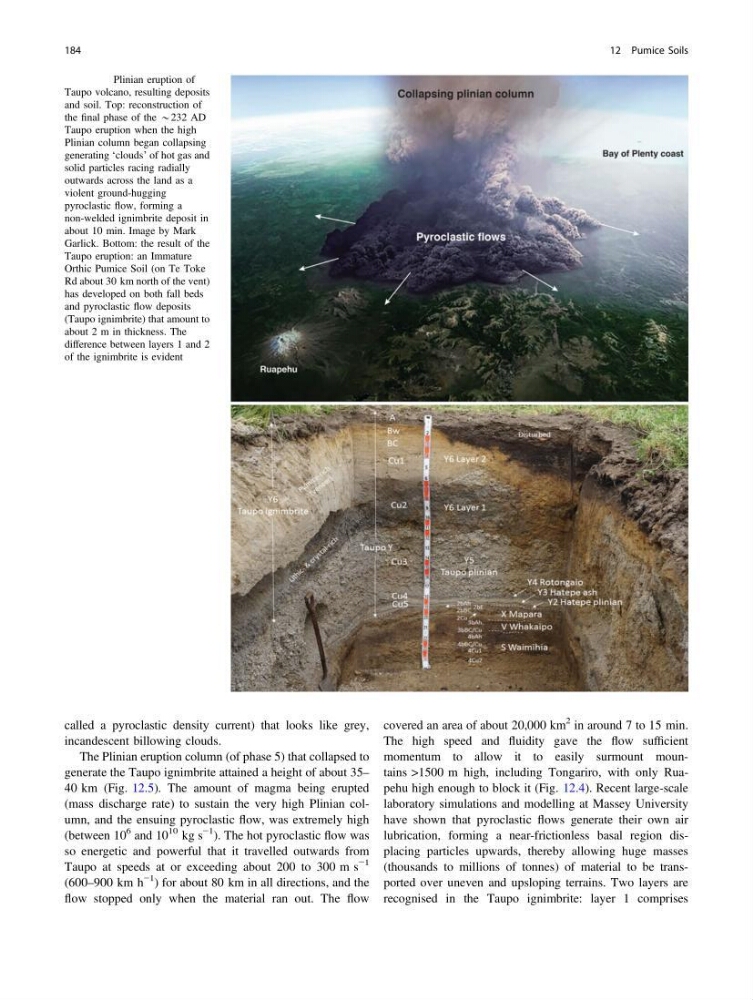
The Plinian eruption column (of phase 5) that collapsed to
generate the Taupo ignimbrite attained a height of about 35–
40 km (Fig. 12.5). The amount of magma being erupted
(mass discharge rate) to sustain the very high Plinian column, and the ensuing pyroclastic flow, was extremely high
(between 10
6 and 10
10 kg s
−1 ). The hot pyroclastic flow was
so energetic and powerful that it travelled outwards from
Taupo at speeds at or exceeding about 200 to 300 m s
−1
(600–900 km h
−1 ) for about 80 km in all directions, and the
flow stopped only when the material ran out. The flow
covered an area of about 20,000 km
2 in around 7 to 15 min.
The high speed and fluidity gave the flow sufficient
momentum to allow it to easily surmount mountains >1500 m high, including Tongariro, with only Ruapehu high enough to block it (Fig. 12.4). Recent large-scale
laboratory simulations and modelling at Massey University
have shown that pyroclastic flows generate their own air
lubrication, forming a near-frictionless basal region displacing particles upwards, thereby allowing huge masses
(thousands to millions of tonnes) of material to be transported over uneven and upsloping terrains. Two layers are
recognised in the Taupo ignimbrite: layer 1 comprises
Fig. 12.5 Plinian eruption of
Taupo volcano, resulting deposits
and soil. Top: reconstruction of
the final phase of the *232 AD
Taupo eruption when the high
Plinian column began collapsing
generating ‘clouds’ of hot gas and
solid particles racing radially
outwards across the land as a
violent ground-hugging
pyroclastic flow, forming a
non-welded ignimbrite deposit in
about 10 min. Image by Mark
Garlick. Bottom: the result of the
Taupo eruption: an Immature
Orthic Pumice Soil (on Te Toke
Rd about 30 km north of the vent)
has developed on both fall beds
and pyroclastic flow deposits
(Taupo ignimbrite) that amount to
about 2 m in thickness. The
difference between layers 1 and 2
of the ignimbrite is evident
184
12 Pumice Soils
incandescent billowing clouds.
The Plinian eruption column (of phase 5) that collapsed to
generate the Taupo ignimbrite attained a height of about 35–
40 km (Fig. 12.5). The amount of magma being erupted
(mass discharge rate) to sustain the very high Plinian column, and the ensuing pyroclastic flow, was extremely high
(between 10
6 and 10
10 kg s
−1 ). The hot pyroclastic flow was
so energetic and powerful that it travelled outwards from
Taupo at speeds at or exceeding about 200 to 300 m s
−1
(600–900 km h
−1 ) for about 80 km in all directions, and the
flow stopped only when the material ran out. The flow
covered an area of about 20,000 km
2 in around 7 to 15 min.
The high speed and fluidity gave the flow sufficient
momentum to allow it to easily surmount mountains >1500 m high, including Tongariro, with only Ruapehu high enough to block it (Fig. 12.4). Recent large-scale
laboratory simulations and modelling at Massey University
have shown that pyroclastic flows generate their own air
lubrication, forming a near-frictionless basal region displacing particles upwards, thereby allowing huge masses
(thousands to millions of tonnes) of material to be transported over uneven and upsloping terrains. Two layers are
recognised in the Taupo ignimbrite: layer 1 comprises
Fig. 12.5 Plinian eruption of
Taupo volcano, resulting deposits
and soil. Top: reconstruction of
the final phase of the *232 AD
Taupo eruption when the high
Plinian column began collapsing
generating ‘clouds’ of hot gas and
solid particles racing radially
outwards across the land as a
violent ground-hugging
pyroclastic flow, forming a
non-welded ignimbrite deposit in
about 10 min. Image by Mark
Garlick. Bottom: the result of the
Taupo eruption: an Immature
Orthic Pumice Soil (on Te Toke
Rd about 30 km north of the vent)
has developed on both fall beds
and pyroclastic flow deposits
(Taupo ignimbrite) that amount to
about 2 m in thickness. The
difference between layers 1 and 2
of the ignimbrite is evident
184
12 Pumice Soils