

A third mechanism, the so-called rock-eating fungi theory, has also been suggested. The rock-eating fungi theory is
associated with mycorrhizal fungi found in many soils under
pines and heaths commonly in parts of Europe, Scandinavia,
Indonesia, and elsewhere. Dutch researchers, Antoine
Jongmans, Nico van Breemen, and others, showed that the
fungal hyphal tips, which produce organic acids (e.g. citric
and oxalic acids), effectively ‘drill’ directly into mineral
grains including feldspars and hornblendes in podzols,
bypassing the external acid soil solution and enhancing
weathering by forming complexes with aluminium. Thus,
the E horizon in this model is regarded as the fungal ‘eaten’
part of the soil. The plant-ectomycorrhizal combination is
seen by its proponents as a major driving force in podzolization that integrates the two mechanisms above. However, van Breemen and others, in the year 2000, suggested
there was no evidence for mycorrhizal fungi facilitating
weathering and podzolization under kauri in New Zealand.
Podzol Soils can form rapidly where conditions are
favourable and the distinctive profile form can be seen
within a few hundred years as shown by podzolized soil
horizons on dated pumiceous tephras in the central North
Island (e.g. Fig. 12.7).
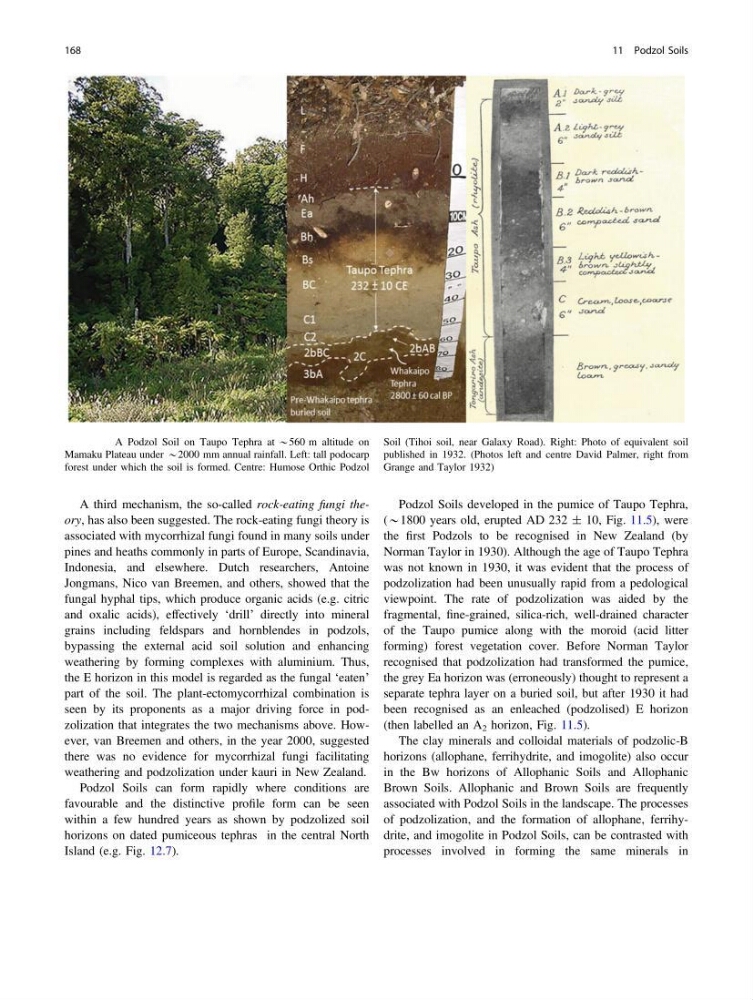
Podzol Soils developed in the pumice of Taupo Tephra,
(*1800 years old, erupted AD 232 ± 10, Fig. 11.5), were
the first Podzols to be recognised in New Zealand (by
Norman Taylor in 1930). Although the age of Taupo Tephra
was not known in 1930, it was evident that the process of
podzolization had been unusually rapid from a pedological
viewpoint. The rate of podzolization was aided by the
fragmental, fine-grained, silica-rich, well-drained character
of the Taupo pumice along with the moroid (acid litter
forming) forest vegetation cover. Before Norman Taylor
recognised that podzolization had transformed the pumice,
the grey Ea horizon was (erroneously) thought to represent a
separate tephra layer on a buried soil, but after 1930 it had
been recognised as an enleached (podzolised) E horizon
(then labelled an A 2 horizon, Fig. 11.5).
The clay minerals and colloidal materials of podzolic-B
horizons (allophane, ferrihydrite, and imogolite) also occur
in the Bw horizons of Allophanic Soils and Allophanic
Brown Soils. Allophanic and Brown Soils are frequently
associated with Podzol Soils in the landscape. The processes
of podzolization, and the formation of allophane, ferrihydrite, and imogolite in Podzol Soils, can be contrasted with
processes involved in forming the same minerals in
Fig. 11.5 A Podzol Soil on Taupo Tephra at *560 m altitude on
Mamaku Plateau under *2000 mm annual rainfall. Left: tall podocarp
forest under which the soil is formed. Centre: Humose Orthic Podzol
Soil (Tihoi soil, near Galaxy Road). Right: Photo of equivalent soil
published in 1932. (Photos left and centre David Palmer, right from
Grange and Taylor 1932)
168
11 Podzol Soils
associated with mycorrhizal fungi found in many soils under
pines and heaths commonly in parts of Europe, Scandinavia,
Indonesia, and elsewhere. Dutch researchers, Antoine
Jongmans, Nico van Breemen, and others, showed that the
fungal hyphal tips, which produce organic acids (e.g. citric
and oxalic acids), effectively ‘drill’ directly into mineral
grains including feldspars and hornblendes in podzols,
bypassing the external acid soil solution and enhancing
weathering by forming complexes with aluminium. Thus,
the E horizon in this model is regarded as the fungal ‘eaten’
part of the soil. The plant-ectomycorrhizal combination is
seen by its proponents as a major driving force in podzolization that integrates the two mechanisms above. However, van Breemen and others, in the year 2000, suggested
there was no evidence for mycorrhizal fungi facilitating
weathering and podzolization under kauri in New Zealand.
Podzol Soils can form rapidly where conditions are
favourable and the distinctive profile form can be seen
within a few hundred years as shown by podzolized soil
horizons on dated pumiceous tephras in the central North
Island (e.g. Fig. 12.7).
Podzol Soils developed in the pumice of Taupo Tephra,
(*1800 years old, erupted AD 232 ± 10, Fig. 11.5), were
the first Podzols to be recognised in New Zealand (by
Norman Taylor in 1930). Although the age of Taupo Tephra
was not known in 1930, it was evident that the process of
podzolization had been unusually rapid from a pedological
viewpoint. The rate of podzolization was aided by the
fragmental, fine-grained, silica-rich, well-drained character
of the Taupo pumice along with the moroid (acid litter
forming) forest vegetation cover. Before Norman Taylor
recognised that podzolization had transformed the pumice,
the grey Ea horizon was (erroneously) thought to represent a
separate tephra layer on a buried soil, but after 1930 it had
been recognised as an enleached (podzolised) E horizon
(then labelled an A 2 horizon, Fig. 11.5).
The clay minerals and colloidal materials of podzolic-B
horizons (allophane, ferrihydrite, and imogolite) also occur
in the Bw horizons of Allophanic Soils and Allophanic
Brown Soils. Allophanic and Brown Soils are frequently
associated with Podzol Soils in the landscape. The processes
of podzolization, and the formation of allophane, ferrihydrite, and imogolite in Podzol Soils, can be contrasted with
processes involved in forming the same minerals in
Fig. 11.5 A Podzol Soil on Taupo Tephra at *560 m altitude on
Mamaku Plateau under *2000 mm annual rainfall. Left: tall podocarp
forest under which the soil is formed. Centre: Humose Orthic Podzol
Soil (Tihoi soil, near Galaxy Road). Right: Photo of equivalent soil
published in 1932. (Photos left and centre David Palmer, right from
Grange and Taylor 1932)
168
11 Podzol Soils