

Allophanic Soils, but concentrated in Bs horizons, the
Podzols key out in the New Zealand Soil Classification
immediately before the Allophanic Soils.
11.1.4 Origin of the Soil Order Name
‘Podzol’ is derived from a Russian word meaning ‘ashes
underneath’ (pod, under, zola, ash) from the way the
ash-grey (bleached) E horizon resembles an underlying layer
of burnt ash (from a fire) when turned over by a plough. The
name ‘podzol’ is in wide use internationally for similar soils.
In Soil Taxonomy, the podzol soils are named ‘Spodosols’
from a Greek word, spodos, wood ash.
11.2 Soil Profile Genesis
Vegetation that has acid-rich litter, along with a moderate to
high annual rainfall (greater than about 1250 mm), and
moderate or well-drained conditions, provides the acidic,
strongly leaching environment that leads to the formation of
Podzol Soils. The major acid-forming native trees that lead to
podzol development are rimu (Dacrydium cupressinum) and
kauri. Podzol Soils also form under kamahi (Weinmannia
racemosa), mountain or Hall’s totara (Podocarpus laetus),
kaikawaka (Libocedrus bidwillii), monoao (Halocarpus kirkii), and four species of southern beech (Nothofagus sp.)
forests in higher rainfall areas. Some introduced conifers,
such as Pinus radiata, also have acidic litter under which
there is potential, if they were to remain in place for centuries,
to also contribute to Podzol Soil development.
In addition to the high leaching environment and
acid-litter-forming (moroid) vegetation, a siliceous and
free-draining parent material, and site stability, also help
explain the distribution of Podzol Soils. High leaching is not
easily defined just in terms of precipitation (rain and
snowfall) because the effects of vegetation, parent material,
topography, site stability, and temperature interact. Nevertheless, in the South Island most Podzol Soils occur in areas
with more than 1250 mm mean annual precipitation,
including extensive areas in Westland exceeding
2000 mm yr
−1 . In the Northland region, where Podzol Soils
occur on relatively old, stable, aeolian sand deposits (usually
on terraces in the landscape), the mean annual rainfall may
be around, or possibly a little less than, *1250 mm. Elsewhere a high annual rainfall ( *1800 mm yr
−1 ) together
with podocarp- or beech-dominated vegetation, and typically
free drainage in unconsolidated, silica-rich (quartzofeldspathic or pumice-rich) parent materials, can largely account
for the development of most Podzols.
Rainwater is acidified as it moves from tree foliage and
stems down through acid-litter-forming vegetation in the
form of organic acids, including fulvic and humic acid. The
mor (L, F, and H) horizons contain water-soluble organic
molecules, especially polyphenols, derived from both the
partial decomposition of the litter and from leachates formed
on the tree’s foliage, stems, and bark. Under confers,
podocarps such as rimu, kauri, kamahi, and beeches, the
polyphenols are coated in tannins that, together with strongly
acid conditions, help protect organic material from microbial
decomposition (in contrast to deciduous foliage which
decomposes readily). Thus the organic materials are moved
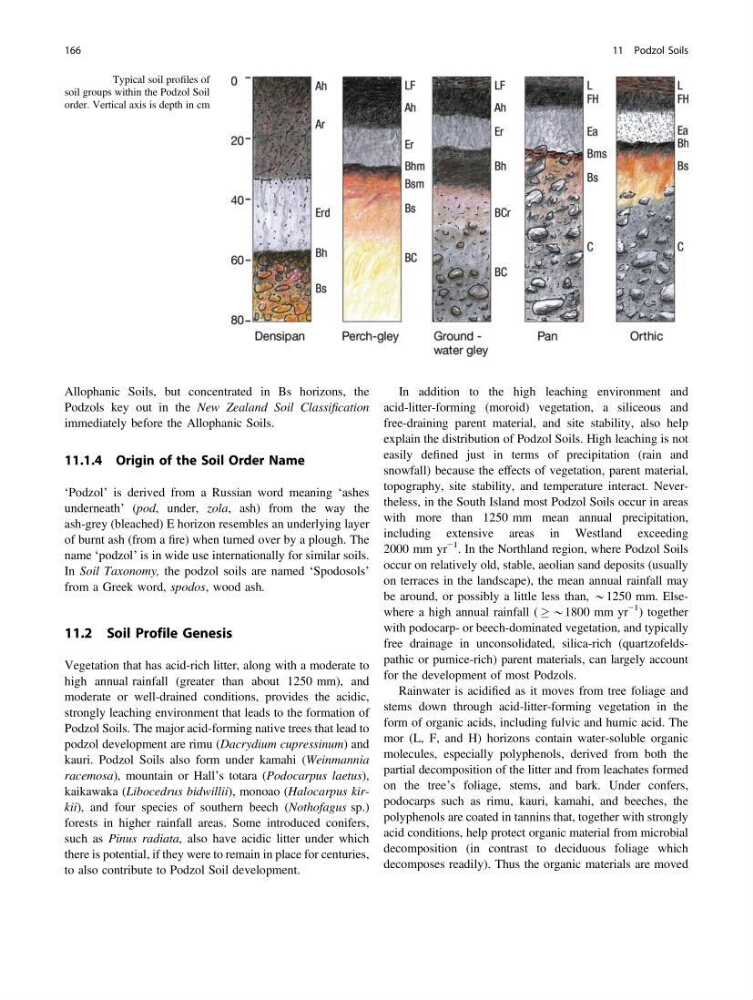
Fig. 11.3 Typical soil profiles of
soil groups within the Podzol Soil
order. Vertical axis is depth in cm
166
11 Podzol Soils
Podzols key out in the New Zealand Soil Classification
immediately before the Allophanic Soils.
11.1.4 Origin of the Soil Order Name
‘Podzol’ is derived from a Russian word meaning ‘ashes
underneath’ (pod, under, zola, ash) from the way the
ash-grey (bleached) E horizon resembles an underlying layer
of burnt ash (from a fire) when turned over by a plough. The
name ‘podzol’ is in wide use internationally for similar soils.
In Soil Taxonomy, the podzol soils are named ‘Spodosols’
from a Greek word, spodos, wood ash.
11.2 Soil Profile Genesis
Vegetation that has acid-rich litter, along with a moderate to
high annual rainfall (greater than about 1250 mm), and
moderate or well-drained conditions, provides the acidic,
strongly leaching environment that leads to the formation of
Podzol Soils. The major acid-forming native trees that lead to
podzol development are rimu (Dacrydium cupressinum) and
kauri. Podzol Soils also form under kamahi (Weinmannia
racemosa), mountain or Hall’s totara (Podocarpus laetus),
kaikawaka (Libocedrus bidwillii), monoao (Halocarpus kirkii), and four species of southern beech (Nothofagus sp.)
forests in higher rainfall areas. Some introduced conifers,
such as Pinus radiata, also have acidic litter under which
there is potential, if they were to remain in place for centuries,
to also contribute to Podzol Soil development.
In addition to the high leaching environment and
acid-litter-forming (moroid) vegetation, a siliceous and
free-draining parent material, and site stability, also help
explain the distribution of Podzol Soils. High leaching is not
easily defined just in terms of precipitation (rain and
snowfall) because the effects of vegetation, parent material,
topography, site stability, and temperature interact. Nevertheless, in the South Island most Podzol Soils occur in areas
with more than 1250 mm mean annual precipitation,
including extensive areas in Westland exceeding
2000 mm yr
−1 . In the Northland region, where Podzol Soils
occur on relatively old, stable, aeolian sand deposits (usually
on terraces in the landscape), the mean annual rainfall may
be around, or possibly a little less than, *1250 mm. Elsewhere a high annual rainfall ( *1800 mm yr
−1 ) together
with podocarp- or beech-dominated vegetation, and typically
free drainage in unconsolidated, silica-rich (quartzofeldspathic or pumice-rich) parent materials, can largely account
for the development of most Podzols.
Rainwater is acidified as it moves from tree foliage and
stems down through acid-litter-forming vegetation in the
form of organic acids, including fulvic and humic acid. The
mor (L, F, and H) horizons contain water-soluble organic
molecules, especially polyphenols, derived from both the
partial decomposition of the litter and from leachates formed
on the tree’s foliage, stems, and bark. Under confers,
podocarps such as rimu, kauri, kamahi, and beeches, the
polyphenols are coated in tannins that, together with strongly
acid conditions, help protect organic material from microbial
decomposition (in contrast to deciduous foliage which
decomposes readily). Thus the organic materials are moved
Fig. 11.3 Typical soil profiles of
soil groups within the Podzol Soil
order. Vertical axis is depth in cm
166
11 Podzol Soils