

1. evidence of soil development in the form of a weatheredB horizon;
2. evidence of a pale colour based on a soil colour chart,
which can be used in conjunction with P retention and a
test for reactive-Al, to separate Pallic from Brown Soils;
and
3. features that typify Pallic Soil morphology— potentially
including a fragipan, duripan, argillic horizon, clay
laminations, or humus and/or clay coatings on aggregate
surfaces (cutanic features).
10.6 Correlation with Other Classification
Systems
The Pallic Soil groups mainly correlate with the Alfisols or
Inceptisols of Soil Taxonomy and were formerly classified as
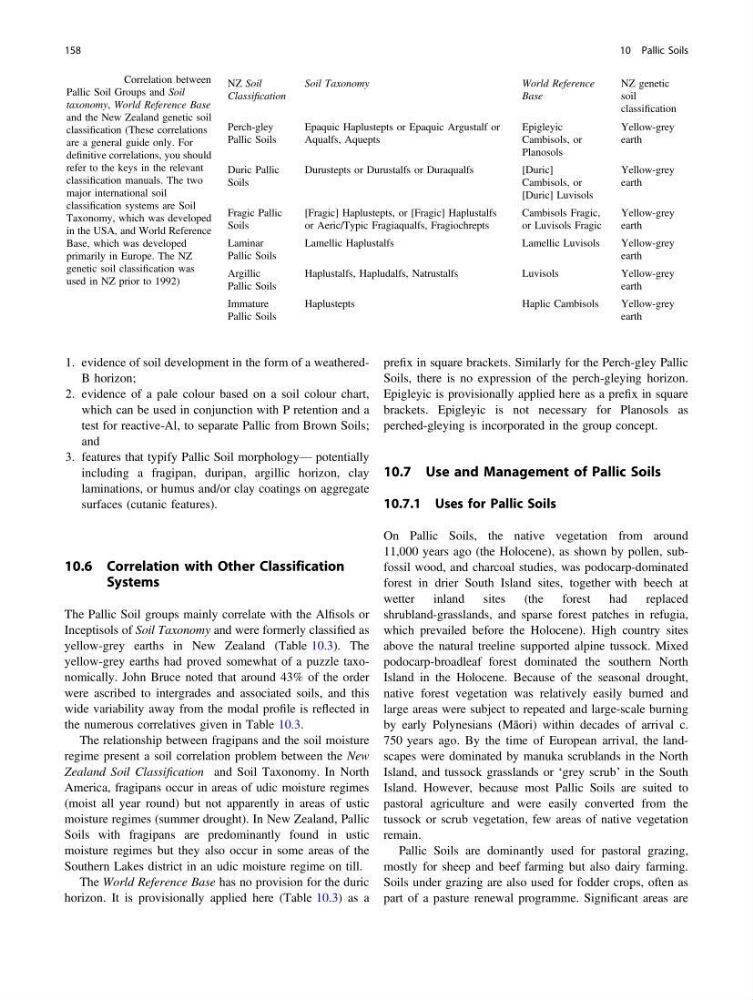
yellow-grey earths in New Zealand (Table 10.3). The
yellow-grey earths had proved somewhat of a puzzle taxonomically. John Bruce noted that around 43% of the order
were ascribed to intergrades and associated soils, and this
wide variability away from the modal profile is reflected in
the numerous correlatives given in Table 10.3.
The relationship between fragipans and the soil moisture
regime present a soil correlation problem between the New
Zealand Soil Classification and Soil Taxonomy. In North
America, fragipans occur in areas of udic moisture regimes
(moist all year round) but not apparently in areas of ustic
moisture regimes (summer drought). In New Zealand, Pallic
Soils with fragipans are predominantly found in ustic
moisture regimes but they also occur in some areas of the
Southern Lakes district in an udic moisture regime on till.
The World Reference Base has no provision for the duric
horizon. It is provisionally applied here (Table 10.3) as a
prefix in square brackets. Similarly for the Perch-gley Pallic
Soils, there is no expression of the perch-gleying horizon.
Epigleyic is provisionally applied here as a prefix in square
brackets. Epigleyic is not necessary for Planosols as
perched-gleying is incorporated in the group concept.
10.7 Use and Management of Pallic Soils
10.7.1 Uses for Pallic Soils
On Pallic Soils, the native vegetation from around
11,000 years ago (the Holocene), as shown by pollen, subfossil wood, and charcoal studies, was podocarp-dominated
forest in drier South Island sites, together with beech at
wetter inland sites (the forest had replaced
shrubland-grasslands, and sparse forest patches in refugia,
which prevailed before the Holocene). High country sites
above the natural treeline supported alpine tussock. Mixed
podocarp-broadleaf forest dominated the southern North
Island in the Holocene. Because of the seasonal drought,
native forest vegetation was relatively easily burned and
large areas were subject to repeated and large-scale burning
by early Polynesians (Māori) within decades of arrival c.
750 years ago. By the time of European arrival, the landscapes were dominated by manuka scrublands in the North
Island, and tussock grasslands or ‘grey scrub’ in the South
Island. However, because most Pallic Soils are suited to
pastoral agriculture and were easily converted from the
tussock or scrub vegetation, few areas of native vegetation
remain.
Pallic Soils are dominantly used for pastoral grazing,
mostly for sheep and beef farming but also dairy farming.
Soils under grazing are also used for fodder crops, often as
part of a pasture renewal programme. Significant areas are
Table 10.3 Correlation between
Pallic Soil Groups and Soil
taxonomy, World Reference Base
and the New Zealand genetic soil
classification (These correlations
are a general guide only. For
definitive correlations, you should
refer to the keys in the relevant
classification manuals. The two
major international soil
classification systems are Soil
Taxonomy, which was developed
in the USA, and World Reference
Base, which was developed
primarily in Europe. The NZ
genetic soil classification was
used in NZ prior to 1992)
NZ Soil
Classification
Soil Taxonomy
World Reference
Base
NZ genetic
soil
classification
Perch-gley
Pallic Soils
Epaquic Haplustepts or Epaquic Argustalf or
Aqualfs, Aquepts
Epigleyic
Cambisols, or
Planosols
Yellow-grey
earth
Duric Pallic
Soils
Durustepts or Durustalfs or Duraqualfs
[Duric]
Cambisols, or
[Duric] Luvisols
Yellow-grey
earth
Fragic Pallic
Soils
[Fragic] Haplustepts, or [Fragic] Haplustalfs
or Aeric/Typic Fragiaqualfs, Fragiochrepts
Cambisols Fragic,
or Luvisols Fragic
Yellow-grey
earth
Laminar
Pallic Soils
Lamellic Haplustalfs
Lamellic Luvisols
Yellow-grey
earth
Argillic
Pallic Soils
Haplustalfs, Hapludalfs, Natrustalfs
Luvisols
Yellow-grey
earth
Immature
Pallic Soils
Haplustepts
Haplic Cambisols
Yellow-grey
earth
158
10 Pallic Soils
2. evidence of a pale colour based on a soil colour chart,
which can be used in conjunction with P retention and a
test for reactive-Al, to separate Pallic from Brown Soils;
and
3. features that typify Pallic Soil morphology— potentially
including a fragipan, duripan, argillic horizon, clay
laminations, or humus and/or clay coatings on aggregate
surfaces (cutanic features).
10.6 Correlation with Other Classification
Systems
The Pallic Soil groups mainly correlate with the Alfisols or
Inceptisols of Soil Taxonomy and were formerly classified as
yellow-grey earths in New Zealand (Table 10.3). The
yellow-grey earths had proved somewhat of a puzzle taxonomically. John Bruce noted that around 43% of the order
were ascribed to intergrades and associated soils, and this
wide variability away from the modal profile is reflected in
the numerous correlatives given in Table 10.3.
The relationship between fragipans and the soil moisture
regime present a soil correlation problem between the New
Zealand Soil Classification and Soil Taxonomy. In North
America, fragipans occur in areas of udic moisture regimes
(moist all year round) but not apparently in areas of ustic
moisture regimes (summer drought). In New Zealand, Pallic
Soils with fragipans are predominantly found in ustic
moisture regimes but they also occur in some areas of the
Southern Lakes district in an udic moisture regime on till.
The World Reference Base has no provision for the duric
horizon. It is provisionally applied here (Table 10.3) as a
prefix in square brackets. Similarly for the Perch-gley Pallic
Soils, there is no expression of the perch-gleying horizon.
Epigleyic is provisionally applied here as a prefix in square
brackets. Epigleyic is not necessary for Planosols as
perched-gleying is incorporated in the group concept.
10.7 Use and Management of Pallic Soils
10.7.1 Uses for Pallic Soils
On Pallic Soils, the native vegetation from around
11,000 years ago (the Holocene), as shown by pollen, subfossil wood, and charcoal studies, was podocarp-dominated
forest in drier South Island sites, together with beech at
wetter inland sites (the forest had replaced
shrubland-grasslands, and sparse forest patches in refugia,
which prevailed before the Holocene). High country sites
above the natural treeline supported alpine tussock. Mixed
podocarp-broadleaf forest dominated the southern North
Island in the Holocene. Because of the seasonal drought,
native forest vegetation was relatively easily burned and
large areas were subject to repeated and large-scale burning
by early Polynesians (Māori) within decades of arrival c.
750 years ago. By the time of European arrival, the landscapes were dominated by manuka scrublands in the North
Island, and tussock grasslands or ‘grey scrub’ in the South
Island. However, because most Pallic Soils are suited to
pastoral agriculture and were easily converted from the
tussock or scrub vegetation, few areas of native vegetation
remain.
Pallic Soils are dominantly used for pastoral grazing,
mostly for sheep and beef farming but also dairy farming.
Soils under grazing are also used for fodder crops, often as
part of a pasture renewal programme. Significant areas are
Table 10.3 Correlation between
Pallic Soil Groups and Soil
taxonomy, World Reference Base
and the New Zealand genetic soil
classification (These correlations
are a general guide only. For
definitive correlations, you should
refer to the keys in the relevant
classification manuals. The two
major international soil
classification systems are Soil
Taxonomy, which was developed
in the USA, and World Reference
Base, which was developed
primarily in Europe. The NZ
genetic soil classification was
used in NZ prior to 1992)
NZ Soil
Classification
Soil Taxonomy
World Reference
Base
NZ genetic
soil
classification
Perch-gley
Pallic Soils
Epaquic Haplustepts or Epaquic Argustalf or
Aqualfs, Aquepts
Epigleyic
Cambisols, or
Planosols
Yellow-grey
earth
Duric Pallic
Soils
Durustepts or Durustalfs or Duraqualfs
[Duric]
Cambisols, or
[Duric] Luvisols
Yellow-grey
earth
Fragic Pallic
Soils
[Fragic] Haplustepts, or [Fragic] Haplustalfs
or Aeric/Typic Fragiaqualfs, Fragiochrepts
Cambisols Fragic,
or Luvisols Fragic
Yellow-grey
earth
Laminar
Pallic Soils
Lamellic Haplustalfs
Lamellic Luvisols
Yellow-grey
earth
Argillic
Pallic Soils
Haplustalfs, Hapludalfs, Natrustalfs
Luvisols
Yellow-grey
earth
Immature
Pallic Soils
Haplustepts
Haplic Cambisols
Yellow-grey
earth
158
10 Pallic Soils