

reduced during summer when the worms burrow deep to
escape summer drought. Saturated soil conditions in winter
may also be detrimental to earthworms.
Why were Pallic Soils regarded as “extremely
peculiar”?
The Russian pedologist Glazovskaya made an extensive study of world soils and visited New Zealand.
After examining the Pallic Soils she reported in her
subsequent (1984) book “Soils of the World” that the
yellowish grey (Pallic) soils of New Zealand were
‘extremely peculiar’. This statement made after a
survey of world soils strongly suggests that the New
Zealand Pallic Soils are unique. What was it that
Glazovskaya found so unusual? We cannot recover her
reasoning, but we can search for factors that might
point to uniqueness.
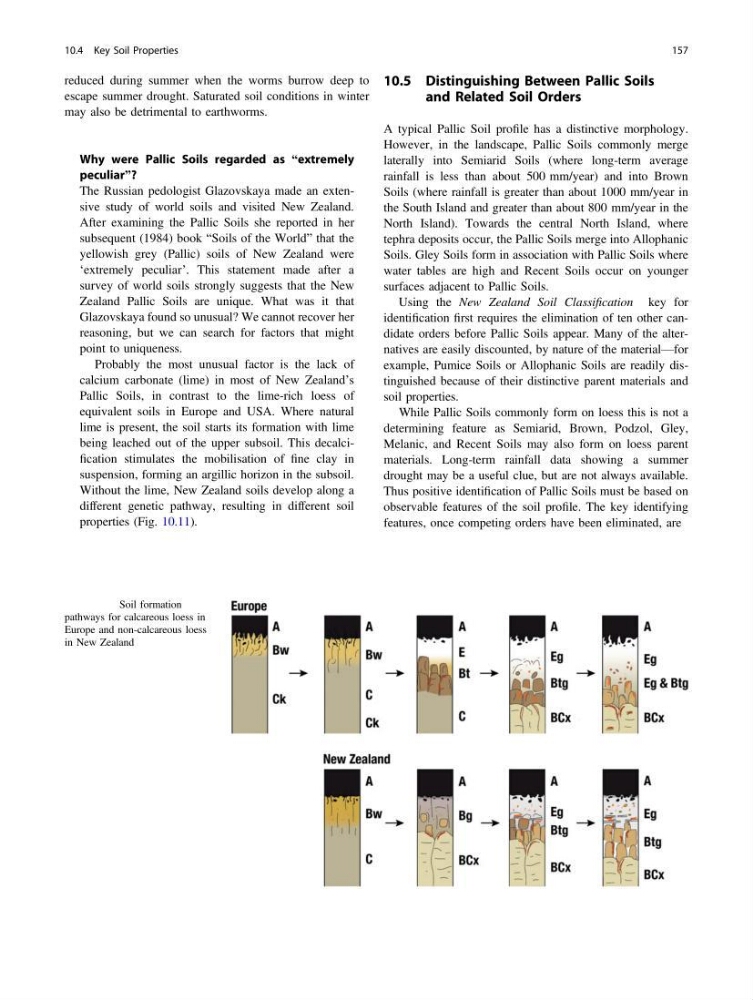
Probably the most unusual factor is the lack of
calcium carbonate (lime) in most of New Zealand’s
Pallic Soils, in contrast to the lime-rich loess of
equivalent soils in Europe and USA. Where natural
lime is present, the soil starts its formation with lime
being leached out of the upper subsoil. This decalcification stimulates the mobilisation of fine clay in
suspension, forming an argillic horizon in the subsoil.
Without the lime, New Zealand soils develop along a
different genetic pathway, resulting in different soil
properties (Fig. 10.11).
10.5 Distinguishing Between Pallic Soils
and Related Soil Orders
A typical Pallic Soil profile has a distinctive morphology.
However, in the landscape, Pallic Soils commonly merge
laterally into Semiarid Soils (where long-term average
rainfall is less than about 500 mm/year) and into Brown
Soils (where rainfall is greater than about 1000 mm/year in
the South Island and greater than about 800 mm/year in the
North Island). Towards the central North Island, where
tephra deposits occur, the Pallic Soils merge into Allophanic
Soils. Gley Soils form in association with Pallic Soils where
water tables are high and Recent Soils occur on younger
surfaces adjacent to Pallic Soils.
Using the New Zealand Soil Classification key for
identification first requires the elimination of ten other candidate orders before Pallic Soils appear. Many of the alternatives are easily discounted, by nature of the material—for
example, Pumice Soils or Allophanic Soils are readily distinguished because of their distinctive parent materials and
soil properties.
While Pallic Soils commonly form on loess this is not a
determining feature as Semiarid, Brown, Podzol, Gley,
Melanic, and Recent Soils may also form on loess parent
materials. Long-term rainfall data showing a summer
drought may be a useful clue, but are not always available.
Thus positive identification of Pallic Soils must be based on
observable features of the soil profile. The key identifying
features, once competing orders have been eliminated, are
Fig. 10.11 Soil formation
pathways for calcareous loess in
Europe and non-calcareous loess
in New Zealand
10.4 Key Soil Properties
157
escape summer drought. Saturated soil conditions in winter
may also be detrimental to earthworms.
Why were Pallic Soils regarded as “extremely
peculiar”?
The Russian pedologist Glazovskaya made an extensive study of world soils and visited New Zealand.
After examining the Pallic Soils she reported in her
subsequent (1984) book “Soils of the World” that the
yellowish grey (Pallic) soils of New Zealand were
‘extremely peculiar’. This statement made after a
survey of world soils strongly suggests that the New
Zealand Pallic Soils are unique. What was it that
Glazovskaya found so unusual? We cannot recover her
reasoning, but we can search for factors that might
point to uniqueness.
Probably the most unusual factor is the lack of
calcium carbonate (lime) in most of New Zealand’s
Pallic Soils, in contrast to the lime-rich loess of
equivalent soils in Europe and USA. Where natural
lime is present, the soil starts its formation with lime
being leached out of the upper subsoil. This decalcification stimulates the mobilisation of fine clay in
suspension, forming an argillic horizon in the subsoil.
Without the lime, New Zealand soils develop along a
different genetic pathway, resulting in different soil
properties (Fig. 10.11).
10.5 Distinguishing Between Pallic Soils
and Related Soil Orders
A typical Pallic Soil profile has a distinctive morphology.
However, in the landscape, Pallic Soils commonly merge
laterally into Semiarid Soils (where long-term average
rainfall is less than about 500 mm/year) and into Brown
Soils (where rainfall is greater than about 1000 mm/year in
the South Island and greater than about 800 mm/year in the
North Island). Towards the central North Island, where
tephra deposits occur, the Pallic Soils merge into Allophanic
Soils. Gley Soils form in association with Pallic Soils where
water tables are high and Recent Soils occur on younger
surfaces adjacent to Pallic Soils.
Using the New Zealand Soil Classification key for
identification first requires the elimination of ten other candidate orders before Pallic Soils appear. Many of the alternatives are easily discounted, by nature of the material—for
example, Pumice Soils or Allophanic Soils are readily distinguished because of their distinctive parent materials and
soil properties.
While Pallic Soils commonly form on loess this is not a
determining feature as Semiarid, Brown, Podzol, Gley,
Melanic, and Recent Soils may also form on loess parent
materials. Long-term rainfall data showing a summer
drought may be a useful clue, but are not always available.
Thus positive identification of Pallic Soils must be based on
observable features of the soil profile. The key identifying
features, once competing orders have been eliminated, are
Fig. 10.11 Soil formation
pathways for calcareous loess in
Europe and non-calcareous loess
in New Zealand
10.4 Key Soil Properties
157