

Manawatu and Rangitikei rivers to about 3 m on the
south-eastern banks of the rivers (the down-wind side from
prevailing nor’westerly winds). The particle size was also
greater in the deeper loess deposits nearer the rivers. Cowie
recognised a connection between the timing of loess deposition, the formation of river terraces, and the cold climate
intervals of the last glaciation (as had been suggested by
Hardcastle, 1889, in Timaru).
The Rangitikei River region is unique as it is being
uplifted relatively rapidly and was also subject to changes in
river morphology in response to the stadials (cooler periods)
and interstadials (warmer periods) within the last glaciation
dating from about 75,000 years ago. During cooler periods
there was less vegetation, and high rates of erosion, in the
upland river headwaters. Thus the rivers carried high
bed-loads and became wide, energetic, braided rivers,
depositing gravel, sand and silt sediments in the river valley
and building (aggrading) a wide, flat, flood plain. The rivers
have been described as ‘dust engines’. The fine silt sediments were blown off the sparsely vegetated wide riverbeds
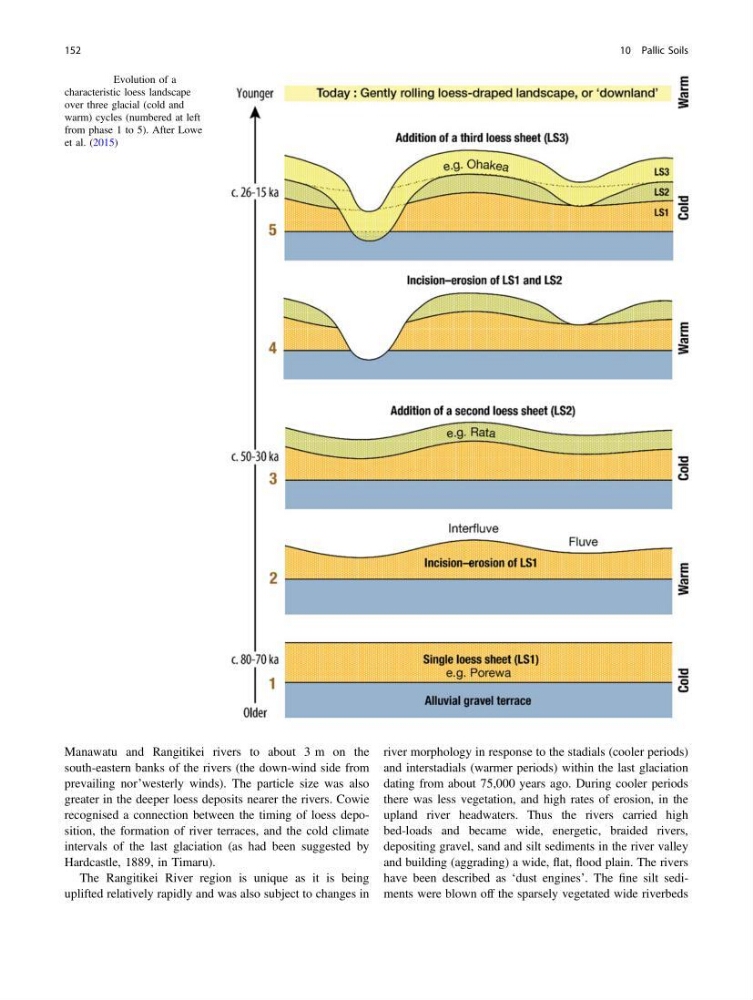
Fig. 10.7 Evolution of a
characteristic loess landscape
over three glacial (cold and
warm) cycles (numbered at left
from phase 1 to 5). After Lowe
et al. (2015)
152
10 Pallic Soils
south-eastern banks of the rivers (the down-wind side from
prevailing nor’westerly winds). The particle size was also
greater in the deeper loess deposits nearer the rivers. Cowie
recognised a connection between the timing of loess deposition, the formation of river terraces, and the cold climate
intervals of the last glaciation (as had been suggested by
Hardcastle, 1889, in Timaru).
The Rangitikei River region is unique as it is being
uplifted relatively rapidly and was also subject to changes in
river morphology in response to the stadials (cooler periods)
and interstadials (warmer periods) within the last glaciation
dating from about 75,000 years ago. During cooler periods
there was less vegetation, and high rates of erosion, in the
upland river headwaters. Thus the rivers carried high
bed-loads and became wide, energetic, braided rivers,
depositing gravel, sand and silt sediments in the river valley
and building (aggrading) a wide, flat, flood plain. The rivers
have been described as ‘dust engines’. The fine silt sediments were blown off the sparsely vegetated wide riverbeds
Fig. 10.7 Evolution of a
characteristic loess landscape
over three glacial (cold and
warm) cycles (numbered at left
from phase 1 to 5). After Lowe
et al. (2015)
152
10 Pallic Soils