

strong pigmenting power, derived from the weathering of
dark-coloured basaltic volcanic parent materials. Oxidic
Soils are also generally more porous and more permeable
than Ultic Soils, which do not have oxidic horizons, and
Oxidic soils lack the pale uppermost subhorizons of Ultic
Soils. Oxidic Soils differ from Allophanic Soils by their
limited content of allophanic minerals as evidenced by lack
of greasy texture, and absence of a positive reaction to the
sodium fluoride test for allophane. The soil material in
Oxidic Soils does not meet the requirements of ‘allophanic
soil material’ .
9.6 Correlation with Other Classification
Systems
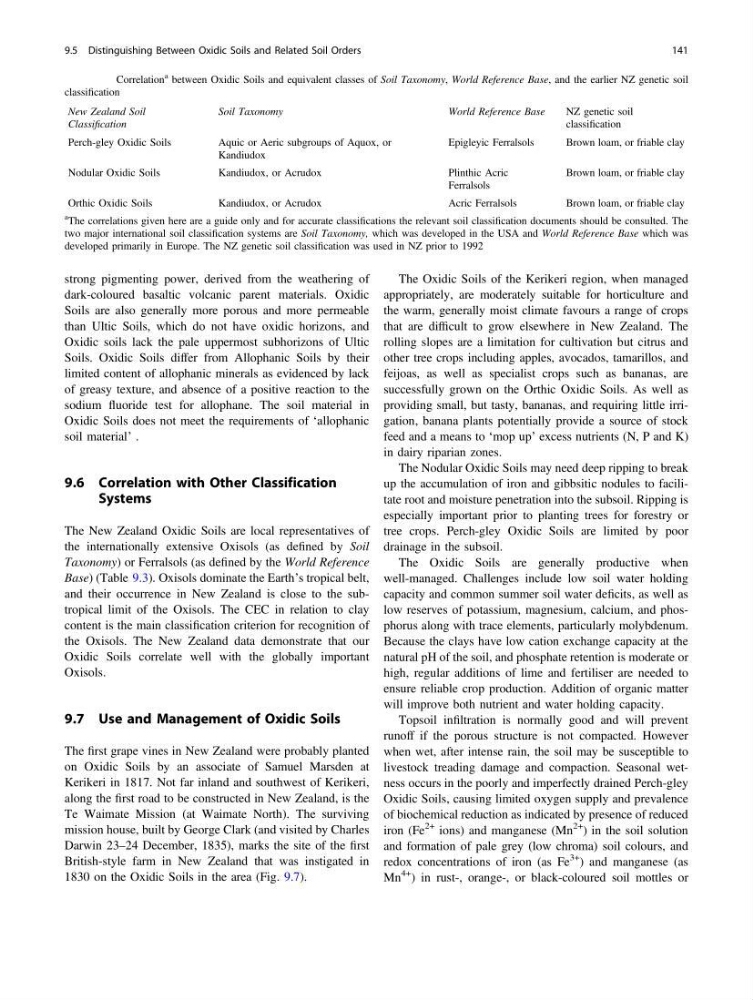
The New Zealand Oxidic Soils are local representatives of
the internationally extensive Oxisols (as defined by Soil
Taxonomy) or Ferralsols (as defined by the World Reference
Base) (Table 9.3). Oxisols dominate the Earth’s tropical belt,
and their occurrence in New Zealand is close to the subtropical limit of the Oxisols. The CEC in relation to clay
content is the main classification criterion for recognition of
the Oxisols. The New Zealand data demonstrate that our
Oxidic Soils correlate well with the globally important
Oxisols.
9.7 Use and Management of Oxidic Soils
The first grape vines in New Zealand were probably planted
on Oxidic Soils by an associate of Samuel Marsden at
Kerikeri in 1817. Not far inland and southwest of Kerikeri,
along the first road to be constructed in New Zealand, is the
Te Waimate Mission (at Waimate North). The surviving
mission house, built by George Clark (and visited by Charles
Darwin 23–24 December, 1835), marks the site of the first
British-style farm in New Zealand that was instigated in
1830 on the Oxidic Soils in the area (Fig. 9.7).
The Oxidic Soils of the Kerikeri region, when managed
appropriately, are moderately suitable for horticulture and
the warm, generally moist climate favours a range of crops
that are difficult to grow elsewhere in New Zealand. The
rolling slopes are a limitation for cultivation but citrus and
other tree crops including apples, avocados, tamarillos, and
feijoas, as well as specialist crops such as bananas, are
successfully grown on the Orthic Oxidic Soils. As well as
providing small, but tasty, bananas, and requiring little irrigation, banana plants potentially provide a source of stock
feed and a means to ‘mop up’ excess nutrients (N, P and K)
in dairy riparian zones.
The Nodular Oxidic Soils may need deep ripping to break
up the accumulation of iron and gibbsitic nodules to facilitate root and moisture penetration into the subsoil. Ripping is
especially important prior to planting trees for forestry or
tree crops. Perch-gley Oxidic Soils are limited by poor
drainage in the subsoil.
The Oxidic Soils are generally productive when
well-managed. Challenges include low soil water holding
capacity and common summer soil water deficits, as well as
low reserves of potassium, magnesium, calcium, and phosphorus along with trace elements, particularly molybdenum.
Because the clays have low cation exchange capacity at the
natural pH of the soil, and phosphate retention is moderate or
high, regular additions of lime and fertiliser are needed to
ensure reliable crop production. Addition of organic matter
will improve both nutrient and water holding capacity.
Topsoil infiltration is normally good and will prevent
runoff if the porous structure is not compacted. However
when wet, after intense rain, the soil may be susceptible to
livestock treading damage and compaction. Seasonal wetness occurs in the poorly and imperfectly drained Perch-gley
Oxidic Soils, causing limited oxygen supply and prevalence
of biochemical reduction as indicated by presence of reduced
iron (Fe
2+ ions) and manganese (Mn
2+ ) in the soil solution
and formation of pale grey (low chroma) soil colours, and
redox concentrations of iron (as Fe
3+ ) and manganese (as
Mn
4+ ) in rust-, orange-, or black-coloured soil mottles or
Table 9.3 Correlation
a between Oxidic Soils and equivalent classes of Soil Taxonomy, World Reference Base, and the earlier NZ genetic soil
classification
New Zealand Soil
Classification
Soil Taxonomy
World Reference Base
NZ genetic soil
classification
Perch-gley Oxidic Soils
Aquic or Aeric subgroups of Aquox, or
Kandiudox
Epigleyic Ferralsols
Brown loam, or friable clay
Nodular Oxidic Soils
Kandiudox, or Acrudox
Plinthic Acric
Ferralsols
Brown loam, or friable clay
Orthic Oxidic Soils
Kandiudox, or Acrudox
Acric Ferralsols
Brown loam, or friable clay
a The correlations given here are a guide only and for accurate classifications the relevant soil classification documents should be consulted. The
two major international soil classification systems are Soil Taxonomy, which was developed in the USA and World Reference Base which was
developed primarily in Europe. The NZ genetic soil classification was used in NZ prior to 1992
9.5 Distinguishing Between Oxidic Soils and Related Soil Orders
141
dark-coloured basaltic volcanic parent materials. Oxidic
Soils are also generally more porous and more permeable
than Ultic Soils, which do not have oxidic horizons, and
Oxidic soils lack the pale uppermost subhorizons of Ultic
Soils. Oxidic Soils differ from Allophanic Soils by their
limited content of allophanic minerals as evidenced by lack
of greasy texture, and absence of a positive reaction to the
sodium fluoride test for allophane. The soil material in
Oxidic Soils does not meet the requirements of ‘allophanic
soil material’ .
9.6 Correlation with Other Classification
Systems
The New Zealand Oxidic Soils are local representatives of
the internationally extensive Oxisols (as defined by Soil
Taxonomy) or Ferralsols (as defined by the World Reference
Base) (Table 9.3). Oxisols dominate the Earth’s tropical belt,
and their occurrence in New Zealand is close to the subtropical limit of the Oxisols. The CEC in relation to clay
content is the main classification criterion for recognition of
the Oxisols. The New Zealand data demonstrate that our
Oxidic Soils correlate well with the globally important
Oxisols.
9.7 Use and Management of Oxidic Soils
The first grape vines in New Zealand were probably planted
on Oxidic Soils by an associate of Samuel Marsden at
Kerikeri in 1817. Not far inland and southwest of Kerikeri,
along the first road to be constructed in New Zealand, is the
Te Waimate Mission (at Waimate North). The surviving
mission house, built by George Clark (and visited by Charles
Darwin 23–24 December, 1835), marks the site of the first
British-style farm in New Zealand that was instigated in
1830 on the Oxidic Soils in the area (Fig. 9.7).
The Oxidic Soils of the Kerikeri region, when managed
appropriately, are moderately suitable for horticulture and
the warm, generally moist climate favours a range of crops
that are difficult to grow elsewhere in New Zealand. The
rolling slopes are a limitation for cultivation but citrus and
other tree crops including apples, avocados, tamarillos, and
feijoas, as well as specialist crops such as bananas, are
successfully grown on the Orthic Oxidic Soils. As well as
providing small, but tasty, bananas, and requiring little irrigation, banana plants potentially provide a source of stock
feed and a means to ‘mop up’ excess nutrients (N, P and K)
in dairy riparian zones.
The Nodular Oxidic Soils may need deep ripping to break
up the accumulation of iron and gibbsitic nodules to facilitate root and moisture penetration into the subsoil. Ripping is
especially important prior to planting trees for forestry or
tree crops. Perch-gley Oxidic Soils are limited by poor
drainage in the subsoil.
The Oxidic Soils are generally productive when
well-managed. Challenges include low soil water holding
capacity and common summer soil water deficits, as well as
low reserves of potassium, magnesium, calcium, and phosphorus along with trace elements, particularly molybdenum.
Because the clays have low cation exchange capacity at the
natural pH of the soil, and phosphate retention is moderate or
high, regular additions of lime and fertiliser are needed to
ensure reliable crop production. Addition of organic matter
will improve both nutrient and water holding capacity.
Topsoil infiltration is normally good and will prevent
runoff if the porous structure is not compacted. However
when wet, after intense rain, the soil may be susceptible to
livestock treading damage and compaction. Seasonal wetness occurs in the poorly and imperfectly drained Perch-gley
Oxidic Soils, causing limited oxygen supply and prevalence
of biochemical reduction as indicated by presence of reduced
iron (Fe
2+ ions) and manganese (Mn
2+ ) in the soil solution
and formation of pale grey (low chroma) soil colours, and
redox concentrations of iron (as Fe
3+ ) and manganese (as
Mn
4+ ) in rust-, orange-, or black-coloured soil mottles or
Table 9.3 Correlation
a between Oxidic Soils and equivalent classes of Soil Taxonomy, World Reference Base, and the earlier NZ genetic soil
classification
New Zealand Soil
Classification
Soil Taxonomy
World Reference Base
NZ genetic soil
classification
Perch-gley Oxidic Soils
Aquic or Aeric subgroups of Aquox, or
Kandiudox
Epigleyic Ferralsols
Brown loam, or friable clay
Nodular Oxidic Soils
Kandiudox, or Acrudox
Plinthic Acric
Ferralsols
Brown loam, or friable clay
Orthic Oxidic Soils
Kandiudox, or Acrudox
Acric Ferralsols
Brown loam, or friable clay
a The correlations given here are a guide only and for accurate classifications the relevant soil classification documents should be consulted. The
two major international soil classification systems are Soil Taxonomy, which was developed in the USA and World Reference Base which was
developed primarily in Europe. The NZ genetic soil classification was used in NZ prior to 1992
9.5 Distinguishing Between Oxidic Soils and Related Soil Orders
141