

most of the areas the water is supplied solely from rainfall.
In marked contrast to the Central Otago dry lands further
west, the upland landscapes are well watered from frequent
cloud, rain, and snow.
Throughout the Otago upland landscape, there are extensive Organic Soils associated with hollows at the heads of
first-order streams in the head waters of the Waipori River,
Deep Stream, and other major streams. The sites qualify as
fens because they comprise peat, receive water from the
surrounding land, and have water tables near the land surface. The boundary between the bog soils and the fen soils,
in terms of the nature of the wetland water source is fuzzy.
However, a boundary can be defined using downslope curvature, where the bog has convex curvature and the fen has
concave curvature.
Sphagnum is the prominent wetland species where the
plateau rises above about 600 m altitude. However, sedges
and tussock are also common along with a range of other
plants. Tony Davoren and co-workers reported a number of
sites that generally had 1–2 m of peat over bedrock. The
peat tended to be formed predominantly from sphagnum
moss, often with an increasing portion of sedge material at
depth. Tussocks (Chinochloa rubra and others) were more
dominant near the edges and on better-drained sites.
8.3.5 Pakihi Environments on the West Coast
of the South Island
The term ‘pakihi’ is used to describe generally flat, naturally
open, spaces in Westland beech forest. The Māori word
‘pakihi’ means ‘open or barren land’. The pakihi soils form
in conditions of extreme high (several metres per year)
rainfall in the Westland region of the South Island and
support an impoverished vegetation that is tolerant of wet,
low nutrient conditions. Pakihi soils often have a hard pan,
restricting tree growth, and are extremely wet. Much of the
pakihi land comprises Perch-Gley Podzol Soils (Chap. 11).
However, where saturated conditions predominate, Organic
Soils develop mainly from sphagnum moss, and
Gleichina/Empodisma minus with manuka, rushes (Baumea
sp), Schoenus, Orobolus, red tussock (Chionochloa rubra),
and Dracophyllum sp. also often present. Many pakihi
contain areas of Organic Soil dominated by the restiad rush
Empodisma minus.
8.4 Key Soil Properties
8.4.1 Introduction
The properties of Organic Soils, being dominated by organic
matter, are decidedly different from those of any other Soil
Order. Consequently, such soils are always separated from
the mineral or ‘inorganic’ soils in soil classification systems.
Organic Soils have been mapped and sampled but data are
limited, except in areas of research interest such as the
Waikato and Hauraki lowlands. A national survey of organic
soil resources was undertaken for the National Soil and
Water Conservation Authority in 1978 by Tony Davoren
together with John McCraw and Keith Thompson. More
recently, organic resources have been investigated as part of
New Zealand’s national carbon accounting project by the
Ministry for the Environment.
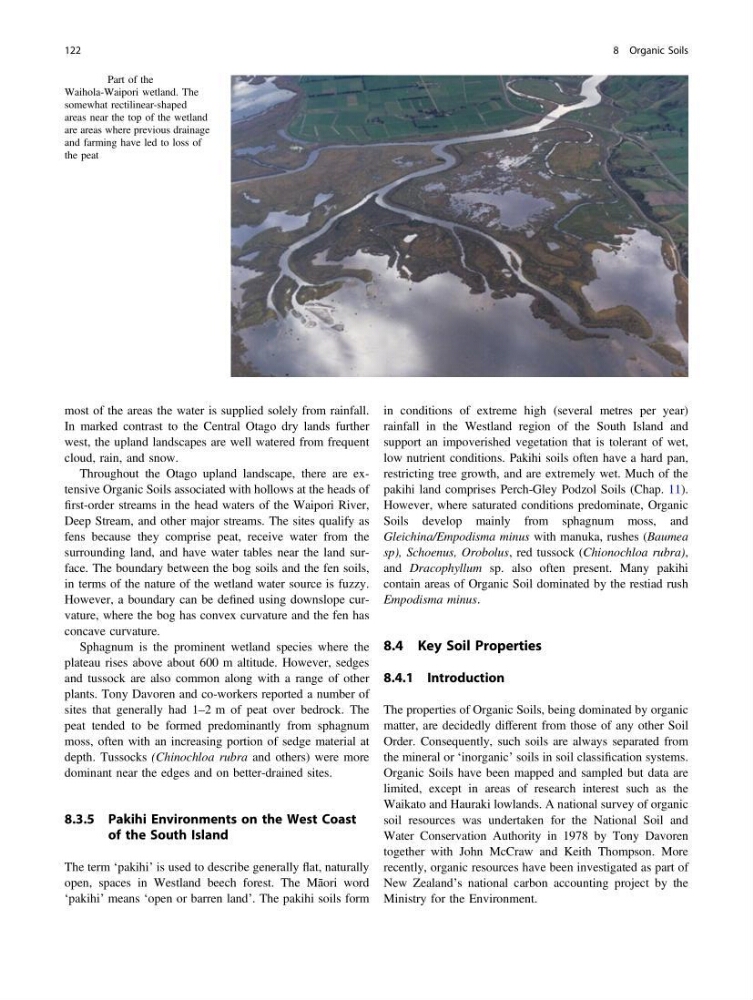
Fig. 8.8 Part of the
Waihola-Waipori wetland. The
somewhat rectilinear-shaped
areas near the top of the wetland
are areas where previous drainage
and farming have led to loss of
the peat
122
8 Organic Soils
In marked contrast to the Central Otago dry lands further
west, the upland landscapes are well watered from frequent
cloud, rain, and snow.
Throughout the Otago upland landscape, there are extensive Organic Soils associated with hollows at the heads of
first-order streams in the head waters of the Waipori River,
Deep Stream, and other major streams. The sites qualify as
fens because they comprise peat, receive water from the
surrounding land, and have water tables near the land surface. The boundary between the bog soils and the fen soils,
in terms of the nature of the wetland water source is fuzzy.
However, a boundary can be defined using downslope curvature, where the bog has convex curvature and the fen has
concave curvature.
Sphagnum is the prominent wetland species where the
plateau rises above about 600 m altitude. However, sedges
and tussock are also common along with a range of other
plants. Tony Davoren and co-workers reported a number of
sites that generally had 1–2 m of peat over bedrock. The
peat tended to be formed predominantly from sphagnum
moss, often with an increasing portion of sedge material at
depth. Tussocks (Chinochloa rubra and others) were more
dominant near the edges and on better-drained sites.
8.3.5 Pakihi Environments on the West Coast
of the South Island
The term ‘pakihi’ is used to describe generally flat, naturally
open, spaces in Westland beech forest. The Māori word
‘pakihi’ means ‘open or barren land’. The pakihi soils form
in conditions of extreme high (several metres per year)
rainfall in the Westland region of the South Island and
support an impoverished vegetation that is tolerant of wet,
low nutrient conditions. Pakihi soils often have a hard pan,
restricting tree growth, and are extremely wet. Much of the
pakihi land comprises Perch-Gley Podzol Soils (Chap. 11).
However, where saturated conditions predominate, Organic
Soils develop mainly from sphagnum moss, and
Gleichina/Empodisma minus with manuka, rushes (Baumea
sp), Schoenus, Orobolus, red tussock (Chionochloa rubra),
and Dracophyllum sp. also often present. Many pakihi
contain areas of Organic Soil dominated by the restiad rush
Empodisma minus.
8.4 Key Soil Properties
8.4.1 Introduction
The properties of Organic Soils, being dominated by organic
matter, are decidedly different from those of any other Soil
Order. Consequently, such soils are always separated from
the mineral or ‘inorganic’ soils in soil classification systems.
Organic Soils have been mapped and sampled but data are
limited, except in areas of research interest such as the
Waikato and Hauraki lowlands. A national survey of organic
soil resources was undertaken for the National Soil and
Water Conservation Authority in 1978 by Tony Davoren
together with John McCraw and Keith Thompson. More
recently, organic resources have been investigated as part of
New Zealand’s national carbon accounting project by the
Ministry for the Environment.
Fig. 8.8 Part of the
Waihola-Waipori wetland. The
somewhat rectilinear-shaped
areas near the top of the wetland
are areas where previous drainage
and farming have led to loss of
the peat
122
8 Organic Soils