

23.1.4 Properties of p
R
t
23.1.4.1 Solubility
The solubility properties of p
R
t is like as follows: Forms Colloidal solutions in
water (because of its enormous size), Solubility depends on electrostatic charges:
identity net charge depends on number, pH of solvent, location of A m
a and pH of
solvent. It depends upon isoelectric point (range 5–8.5): Isoelectric point depends
on seven-charge A m
a , example aspartate (b-carboxyl group), glutamate (d-carboxyl
group), cysteine (thiol group), H IS
td (imidazole side chains), tyrosine (phenol
group), arginine (guanidinium group) and lysine (ammonium group).
23.1.4.2 Molecular Weight
p
R
t molecular weight variation depends on the number of A m
a residues. Each A m
a
contributes 110 value increases in a p
R
t ′ molecular weight e.g., Myoglobin—1700;
Insulin—5700; Hemoglobin—64,450. p
R
t shape varies as globular (insulin), F
b
R
s or
elongated (fibrinogen), oval (A L
B
M ). For identification of A m
a present in p
R
t the
below given in Table 23.6 is recommended;
23.1.4.3 Chemical Nature of p
R
t
Most of the p
R
t fold up to form a unique 3-D structure and the shape in order to
which a p
R
t naturally folds is its native conformation. Depending upon the chemical
properties of A m
a , most of the p
R
t fold up accordingly while others fold up in to
their native states with the help of molecular chaperones. Four original structure of
p
R
t have been introduced by the biochemists: (A) Primary, (B) Secondary,
(C) Tertiary & (D) Quaternary.
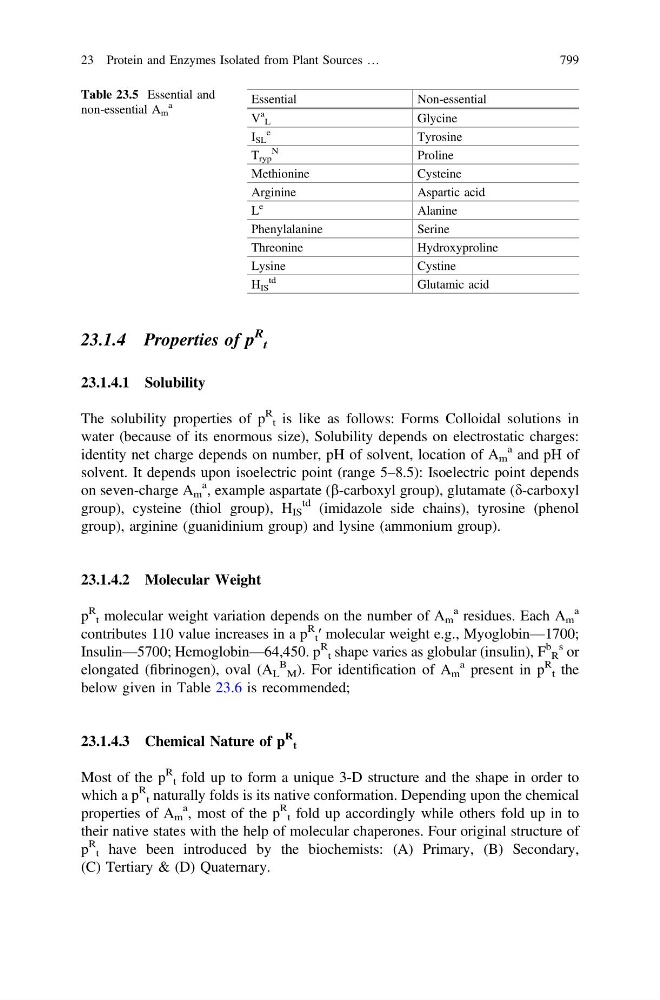
Table 23.5 Essential and
non-essential A m
a
Essential
Non-essential
V
a
L
Glycine
I SL
e
Tyrosine
T ryp
N
Proline
Methionine
Cysteine
Arginine
Aspartic acid
L
e
Alanine
Phenylalanine
Serine
Threonine
Hydroxyproline
Lysine
Cystine
H IS
td
Glutamic acid
23 Protein and Enzymes Isolated from Plant Sources …
799
R
t
23.1.4.1 Solubility
The solubility properties of p
R
t is like as follows: Forms Colloidal solutions in
water (because of its enormous size), Solubility depends on electrostatic charges:
identity net charge depends on number, pH of solvent, location of A m
a and pH of
solvent. It depends upon isoelectric point (range 5–8.5): Isoelectric point depends
on seven-charge A m
a , example aspartate (b-carboxyl group), glutamate (d-carboxyl
group), cysteine (thiol group), H IS
td (imidazole side chains), tyrosine (phenol
group), arginine (guanidinium group) and lysine (ammonium group).
23.1.4.2 Molecular Weight
p
R
t molecular weight variation depends on the number of A m
a residues. Each A m
a
contributes 110 value increases in a p
R
t ′ molecular weight e.g., Myoglobin—1700;
Insulin—5700; Hemoglobin—64,450. p
R
t shape varies as globular (insulin), F
b
R
s or
elongated (fibrinogen), oval (A L
B
M ). For identification of A m
a present in p
R
t the
below given in Table 23.6 is recommended;
23.1.4.3 Chemical Nature of p
R
t
Most of the p
R
t fold up to form a unique 3-D structure and the shape in order to
which a p
R
t naturally folds is its native conformation. Depending upon the chemical
properties of A m
a , most of the p
R
t fold up accordingly while others fold up in to
their native states with the help of molecular chaperones. Four original structure of
p
R
t have been introduced by the biochemists: (A) Primary, (B) Secondary,
(C) Tertiary & (D) Quaternary.
Table 23.5 Essential and
non-essential A m
a
Essential
Non-essential
V
a
L
Glycine
I SL
e
Tyrosine
T ryp
N
Proline
Methionine
Cysteine
Arginine
Aspartic acid
L
e
Alanine
Phenylalanine
Serine
Threonine
Hydroxyproline
Lysine
Cystine
H IS
td
Glutamic acid
23 Protein and Enzymes Isolated from Plant Sources …
799