

23.1.3 Classification A m
a
They are classified on the basis of carbon chains present, nutritional requirement
and polarity. Based on carbon chain present A m
a are of three types: Aliphatic A m
a
:
These are further classified in to Neutral (Monoamine-Monocarboxylic Acid) for
example, Glycine, Alanine, Serine, Threonine, Valine (V
a
L ), Leucine (L
e ) and
Isoleucine (I SL
e ). Acidic (Monoamine-Dicarboxylic Acids) for example, Aspartic
acid, Asparagine, Glutamic acid and Glutamine. Basic: for example, Arginine,
Lysine and Hydroxyl sine. Sulphur containing A m
a for Example, Cysteine, Cystine
(di cysteine) and Methionine, Aromatic A m
a for example, Phenylalanine, Tyrosine
and Thyroxine. Heterocyclic A m
a : for example, Proline, hydroxy Proline, T ryp
N ,
Histidine (H IS
td ). Based on nutritional requirements amino A m
a are two types:
Essential A m
a : they are essentials for the body and these A m
a are also indispensable
A m
a . They are not synthesized in the B
D
Y and are obtained from dietary sources.
Examples; V
a
L I SL
e , T ryp
N , Methionine, L
e
, Phenylalanine, Threonine and lysine.
Exceptionally H IS
td and Arginine are indicated as semi-essential A m
a as a little
amount of them are synthesized in the B
D
Y . Deficiency of these A m
a may give
adverse effects like retarded growth, weak immunity, early ageing, etc.
Non-Essential A m
a : These A m
a are also termed as dispensable A m
a and are synthesized in the B
D
Y . Examples; Glycine, Serine, Threonine, Glutamate, Cysteine,
Glutamine, Proline, etc. (Table 23.5) (Fink et al.2012).
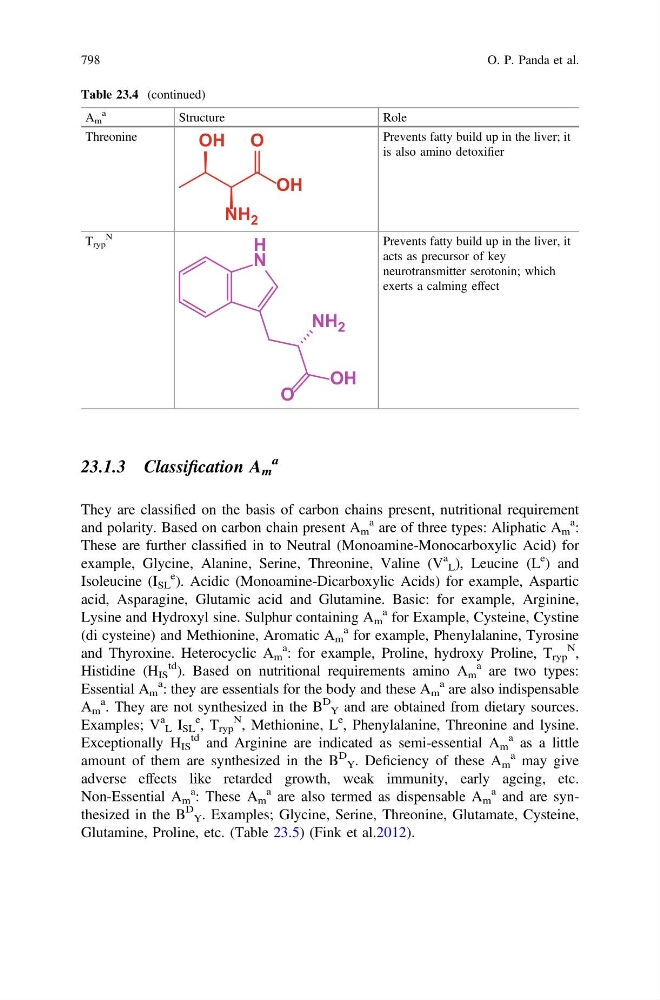
Table 23.4 (continued)
A m
a
Structure
Role
Threonine
NH 2
OH O
OH
Prevents fatty build up in the liver; it
is also amino detoxifier
T ryp
N
NH 2
H
N
O
OH
Prevents fatty build up in the liver, it
acts as precursor of key
neurotransmitter serotonin; which
exerts a calming effect
798
O. P. Panda et al.
a
They are classified on the basis of carbon chains present, nutritional requirement
and polarity. Based on carbon chain present A m
a are of three types: Aliphatic A m
a
:
These are further classified in to Neutral (Monoamine-Monocarboxylic Acid) for
example, Glycine, Alanine, Serine, Threonine, Valine (V
a
L ), Leucine (L
e ) and
Isoleucine (I SL
e ). Acidic (Monoamine-Dicarboxylic Acids) for example, Aspartic
acid, Asparagine, Glutamic acid and Glutamine. Basic: for example, Arginine,
Lysine and Hydroxyl sine. Sulphur containing A m
a for Example, Cysteine, Cystine
(di cysteine) and Methionine, Aromatic A m
a for example, Phenylalanine, Tyrosine
and Thyroxine. Heterocyclic A m
a : for example, Proline, hydroxy Proline, T ryp
N ,
Histidine (H IS
td ). Based on nutritional requirements amino A m
a are two types:
Essential A m
a : they are essentials for the body and these A m
a are also indispensable
A m
a . They are not synthesized in the B
D
Y and are obtained from dietary sources.
Examples; V
a
L I SL
e , T ryp
N , Methionine, L
e
, Phenylalanine, Threonine and lysine.
Exceptionally H IS
td and Arginine are indicated as semi-essential A m
a as a little
amount of them are synthesized in the B
D
Y . Deficiency of these A m
a may give
adverse effects like retarded growth, weak immunity, early ageing, etc.
Non-Essential A m
a : These A m
a are also termed as dispensable A m
a and are synthesized in the B
D
Y . Examples; Glycine, Serine, Threonine, Glutamate, Cysteine,
Glutamine, Proline, etc. (Table 23.5) (Fink et al.2012).
Table 23.4 (continued)
A m
a
Structure
Role
Threonine
NH 2
OH O
OH
Prevents fatty build up in the liver; it
is also amino detoxifier
T ryp
N
NH 2
H
N
O
OH
Prevents fatty build up in the liver, it
acts as precursor of key
neurotransmitter serotonin; which
exerts a calming effect
798
O. P. Panda et al.