

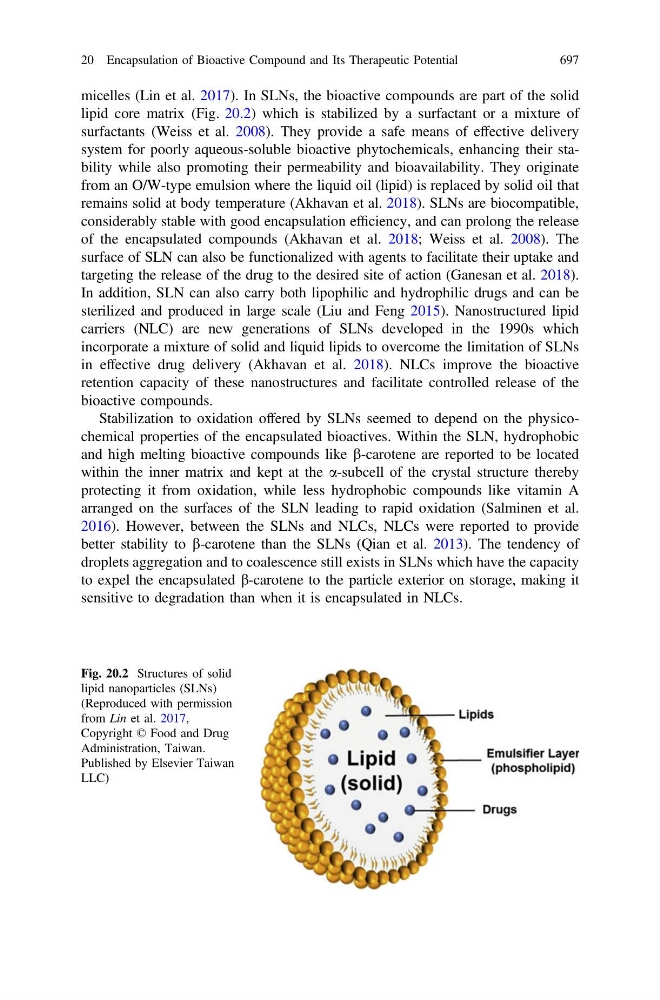
micelles (Lin et al. 2017). In SLNs, the bioactive compounds are part of the solid
lipid core matrix (Fig. 20.2) which is stabilized by a surfactant or a mixture of
surfactants (Weiss et al. 2008). They provide a safe means of effective delivery
system for poorly aqueous-soluble bioactive phytochemicals, enhancing their stability while also promoting their permeability and bioavailability. They originate
from an O/W-type emulsion where the liquid oil (lipid) is replaced by solid oil that
remains solid at body temperature (Akhavan et al. 2018). SLNs are biocompatible,
considerably stable with good encapsulation efficiency, and can prolong the release
of the encapsulated compounds (Akhavan et al. 2018; Weiss et al. 2008). The
surface of SLN can also be functionalized with agents to facilitate their uptake and
targeting the release of the drug to the desired site of action (Ganesan et al. 2018).
In addition, SLN can also carry both lipophilic and hydrophilic drugs and can be
sterilized and produced in large scale (Liu and Feng 2015). Nanostructured lipid
carriers (NLC) are new generations of SLNs developed in the 1990s which
incorporate a mixture of solid and liquid lipids to overcome the limitation of SLNs
in effective drug delivery (Akhavan et al. 2018). NLCs improve the bioactive
retention capacity of these nanostructures and facilitate controlled release of the
bioactive compounds.
Stabilization to oxidation offered by SLNs seemed to depend on the physicochemical properties of the encapsulated bioactives. Within the SLN, hydrophobic
and high melting bioactive compounds like b-carotene are reported to be located
within the inner matrix and kept at the a-subcell of the crystal structure thereby
protecting it from oxidation, while less hydrophobic compounds like vitamin A
arranged on the surfaces of the SLN leading to rapid oxidation (Salminen et al.
2016). However, between the SLNs and NLCs, NLCs were reported to provide
better stability to b-carotene than the SLNs (Qian et al. 2013). The tendency of
droplets aggregation and to coalescence still exists in SLNs which have the capacity
to expel the encapsulated b-carotene to the particle exterior on storage, making it
sensitive to degradation than when it is encapsulated in NLCs.
Fig. 20.2 Structures of solid
lipid nanoparticles (SLNs)
(Reproduced with permission
from Lin et al. 2017,
Copyright © Food and Drug
Administration, Taiwan.
Published by Elsevier Taiwan
LLC)
20 Encapsulation of Bioactive Compound and Its Therapeutic Potential
697