

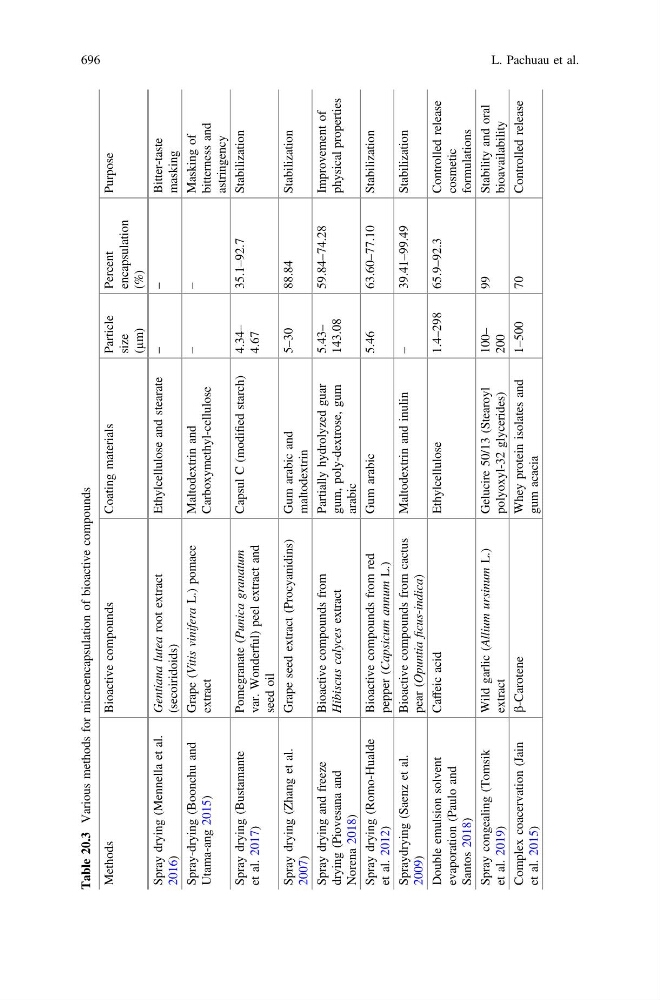
Table 20.3
Various methods for microencapsulation of bioactive compounds
Methods
Bioactive compounds
Coating materials
Particle
size
(µm)
Percent
encapsulation
(%)
Purpose
Spray drying (Mennella et al.
2016)
Gentiana lutea
root extract
(secoiridoids)
Ethylcellulose and stearate
–
–
Bitter-taste
masking
Spray-drying (Boonchu and
Utama-ang 2015)
Grape (Vitis vinifera
L.) pomace
extract
Maltodextrin and
Carboxymethyl-cellulose
–
–
Masking of
bitterness and
astringency
Spray drying (Bustamante
et al. 2017)
Pomegranate (Punica granatum
var. Wonderful) peel extract and
seed oil
Capsul C (modified starch)
4.34–
4.67
35.1–92.7
Stabilization
Spray drying (Zhang et al.
2007)
Grape seed extract (Procyanidins)
Gum arabic and
maltodextrin
5–30
88.84
Stabilization
Spray drying and freeze
drying (Piovesana and
Norena 2018)
Bioactive compounds from
Hibiscus calyces
extract
Partially hydrolyzed guar
gum, poly-dextrose, gum
arabic
5.43–
143.08
59.84–74.28
Improvement of
physical properties
Spray drying (Romo-Hualde
et al. 2012)
Bioactive compounds from red
pepper (Capsicum annum
L.)
Gum arabic
5.46
63.60–77.10
Stabilization
Spraydrying (Saenz et al.
2009)
Bioactive compounds from cactus
pear (Opuntia
ficus-indica)
Maltodextrin and inulin
–
39.41–99.49
Stabilization
Double emulsion solvent
evaporation (Paulo and
Santos 2018)
Caffeic acid
Ethylcellulose
1.4–298
65.9–92.3
Controlled release
cosmetic
formulations
Spray congealing (Tomsik
et al. 2019)
Wild garlic (Allium ursinum
L.)
extract
Gelucire 50/13 (Stearoyl
polyoxyl-32 glycerides)
100–
200
99
Stability and oral
bioavailability
Complex coacervation (Jain
et al. 2015)
b-Carotene
Whey protein isolates and
gum acacia
1–500
70
Controlled release
696
L. Pachuau et al.