

Compound 328 exhibited a dose-dependent inhibition (IC 50 = 49.2 µM), while 329
did not exhibit any inhibition in NO production at 50 µM.
14.3.11 Phytochemistry and Pharmacological Activities
of A. Penangiana
14.3.11.1 Cytotoxic Activities
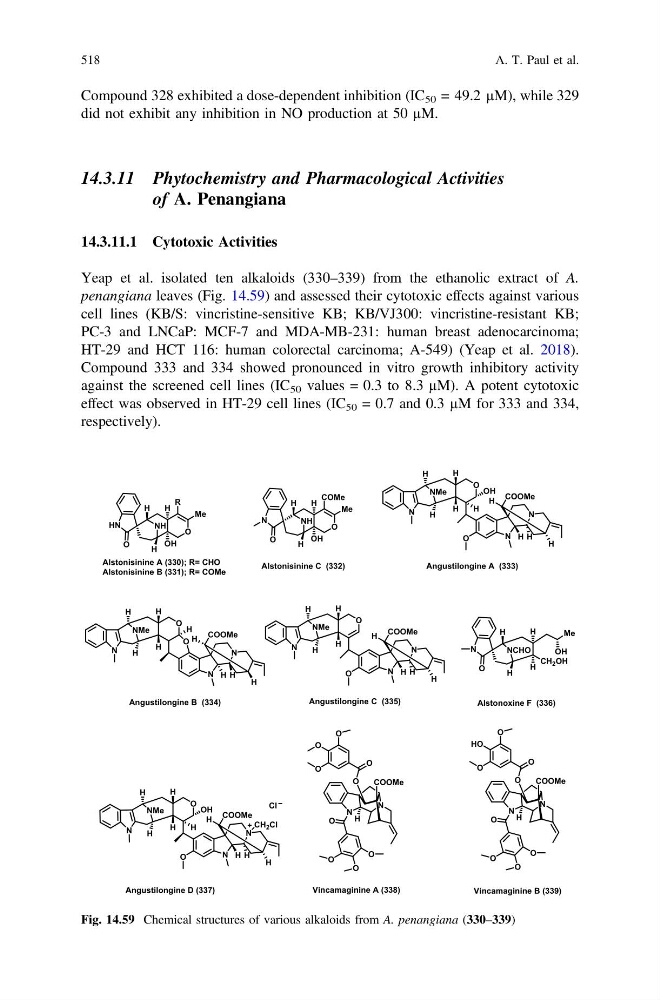
Yeap et al. isolated ten alkaloids (330–339) from the ethanolic extract of A.
penangiana leaves (Fig. 14.59) and assessed their cytotoxic effects against various
cell lines (KB/S: vincristine-sensitive KB; KB/VJ300: vincristine-resistant KB;
PC-3 and LNCaP: MCF-7 and MDA-MB-231: human breast adenocarcinoma;
HT-29 and HCT 116: human colorectal carcinoma; A-549) (Yeap et al. 2018).
Compound 333 and 334 showed pronounced in vitro growth inhibitory activity
against the screened cell lines (IC 50 values = 0.3 to 8.3 µM). A potent cytotoxic
effect was observed in HT-29 cell lines (IC 50 = 0.7 and 0.3 µM for 333 and 334,
respectively).
Alstonisinine A (330); R= CHO
Alstonisinine B (331); R= COMe
Alstonisinine C (332)
Alstonoxine F (336)
Angustilongine A (333)
Angustilongine B (334)
Angustilongine C (335)
Vincamaginine A (338)
Vincamaginine B (339)
NH
H
O
HN
O
H
H
OH
Me
R
NH
H
O
N
O
H
H
OH
Me
COMe
O
O
O
O
O
N
N
O
O
O
O
H
COOMe
O
HO
O
O
O
N
N
O
O
O
O
H
COOMe
NCHO
H
CH 2 OH
N
O
H
H
H
Me
OH
NMe
H
H
H
H
O
N
N
N
O
H
COOMe
H
H
H
OH
H
NMe
H
H
H
H
O
N
N
N
H
COOMe
H
H
H
O
H
NMe
H
H
H
H
O
N
N
N
O
H
COOMe
H
H
H
Angustilongine D (337)
NMe
H
H
H
H
O
N
N
N
O
H
COOMe
H
H
H
OH
H
CH 2 Cl
Cl
Fig. 14.59 Chemical structures of various alkaloids from A. penangiana (330–339)
518
A. T. Paul et al.
did not exhibit any inhibition in NO production at 50 µM.
14.3.11 Phytochemistry and Pharmacological Activities
of A. Penangiana
14.3.11.1 Cytotoxic Activities
Yeap et al. isolated ten alkaloids (330–339) from the ethanolic extract of A.
penangiana leaves (Fig. 14.59) and assessed their cytotoxic effects against various
cell lines (KB/S: vincristine-sensitive KB; KB/VJ300: vincristine-resistant KB;
PC-3 and LNCaP: MCF-7 and MDA-MB-231: human breast adenocarcinoma;
HT-29 and HCT 116: human colorectal carcinoma; A-549) (Yeap et al. 2018).
Compound 333 and 334 showed pronounced in vitro growth inhibitory activity
against the screened cell lines (IC 50 values = 0.3 to 8.3 µM). A potent cytotoxic
effect was observed in HT-29 cell lines (IC 50 = 0.7 and 0.3 µM for 333 and 334,
respectively).
Alstonisinine A (330); R= CHO
Alstonisinine B (331); R= COMe
Alstonisinine C (332)
Alstonoxine F (336)
Angustilongine A (333)
Angustilongine B (334)
Angustilongine C (335)
Vincamaginine A (338)
Vincamaginine B (339)
NH
H
O
HN
O
H
H
OH
Me
R
NH
H
O
N
O
H
H
OH
Me
COMe
O
O
O
O
O
N
N
O
O
O
O
H
COOMe
O
HO
O
O
O
N
N
O
O
O
O
H
COOMe
NCHO
H
CH 2 OH
N
O
H
H
H
Me
OH
NMe
H
H
H
H
O
N
N
N
O
H
COOMe
H
H
H
OH
H
NMe
H
H
H
H
O
N
N
N
H
COOMe
H
H
H
O
H
NMe
H
H
H
H
O
N
N
N
O
H
COOMe
H
H
H
Angustilongine D (337)
NMe
H
H
H
H
O
N
N
N
O
H
COOMe
H
H
H
OH
H
CH 2 Cl
Cl
Fig. 14.59 Chemical structures of various alkaloids from A. penangiana (330–339)
518
A. T. Paul et al.