

Among that 288, 293, and 296 showed selective inhibition of COX-II (96.4, 95.5,
and 92.0%) comparable with the positive control, NS-398 (97.1%). Remaining
compounds exhibited a poor COX-II inhibition (<50% inhibition). The screened
compounds exhibited a poor activity toward COX-I (<45% inhibition).
14.3.9 Phytochemistry and Pharmacological Activities
of A. Rostrata
14.3.9.1 Cytotoxic Activities
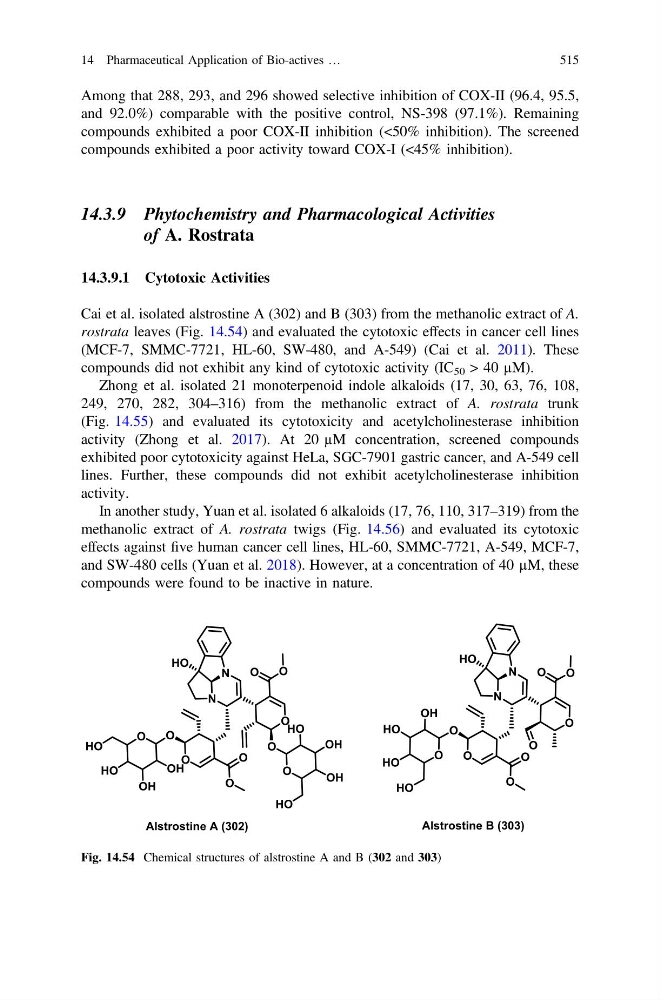
Cai et al. isolated alstrostine A (302) and B (303) from the methanolic extract of A.
rostrata leaves (Fig. 14.54) and evaluated the cytotoxic effects in cancer cell lines
(MCF-7, SMMC-7721, HL-60, SW-480, and A-549) (Cai et al. 2011). These
compounds did not exhibit any kind of cytotoxic activity (IC 50 > 40 µM).
Zhong et al. isolated 21 monoterpenoid indole alkaloids (17, 30, 63, 76, 108,
249, 270, 282, 304–316) from the methanolic extract of A. rostrata trunk
(Fig. 14.55) and evaluated its cytotoxicity and acetylcholinesterase inhibition
activity (Zhong et al. 2017). At 20 µM concentration, screened compounds
exhibited poor cytotoxicity against HeLa, SGC-7901 gastric cancer, and A-549 cell
lines. Further, these compounds did not exhibit acetylcholinesterase inhibition
activity.
In another study, Yuan et al. isolated 6 alkaloids (17, 76, 110, 317–319) from the
methanolic extract of A. rostrata twigs (Fig. 14.56) and evaluated its cytotoxic
effects against five human cancer cell lines, HL-60, SMMC-7721, A-549, MCF-7,
and SW-480 cells (Yuan et al. 2018). However, at a concentration of 40 µM, these
compounds were found to be inactive in nature.
Alstrostine A (302)
O
O
O
N
N
HO
O
O
O
O
O
HO
OH
OH
HO
O
O
HO
HO
OH
OH
O
O
O
N
N
O
O
O
O
O
HO
HO
HO
OH
HO
O
Alstrostine B (303)
Fig. 14.54 Chemical structures of alstrostine A and B (302 and 303)
14 Pharmaceutical Application of Bio-actives …
515
and 92.0%) comparable with the positive control, NS-398 (97.1%). Remaining
compounds exhibited a poor COX-II inhibition (<50% inhibition). The screened
compounds exhibited a poor activity toward COX-I (<45% inhibition).
14.3.9 Phytochemistry and Pharmacological Activities
of A. Rostrata
14.3.9.1 Cytotoxic Activities
Cai et al. isolated alstrostine A (302) and B (303) from the methanolic extract of A.
rostrata leaves (Fig. 14.54) and evaluated the cytotoxic effects in cancer cell lines
(MCF-7, SMMC-7721, HL-60, SW-480, and A-549) (Cai et al. 2011). These
compounds did not exhibit any kind of cytotoxic activity (IC 50 > 40 µM).
Zhong et al. isolated 21 monoterpenoid indole alkaloids (17, 30, 63, 76, 108,
249, 270, 282, 304–316) from the methanolic extract of A. rostrata trunk
(Fig. 14.55) and evaluated its cytotoxicity and acetylcholinesterase inhibition
activity (Zhong et al. 2017). At 20 µM concentration, screened compounds
exhibited poor cytotoxicity against HeLa, SGC-7901 gastric cancer, and A-549 cell
lines. Further, these compounds did not exhibit acetylcholinesterase inhibition
activity.
In another study, Yuan et al. isolated 6 alkaloids (17, 76, 110, 317–319) from the
methanolic extract of A. rostrata twigs (Fig. 14.56) and evaluated its cytotoxic
effects against five human cancer cell lines, HL-60, SMMC-7721, A-549, MCF-7,
and SW-480 cells (Yuan et al. 2018). However, at a concentration of 40 µM, these
compounds were found to be inactive in nature.
Alstrostine A (302)
O
O
O
N
N
HO
O
O
O
O
O
HO
OH
OH
HO
O
O
HO
HO
OH
OH
O
O
O
N
N
O
O
O
O
O
HO
HO
HO
OH
HO
O
Alstrostine B (303)
Fig. 14.54 Chemical structures of alstrostine A and B (302 and 303)
14 Pharmaceutical Application of Bio-actives …
515