

against all tested cell lines with IC 50 values less than 20 µM, while remaining compounds were found to be inactive.
14.3.8.2 Antibacterial and Antifungal Activities
Wang et al. further screened antifungal activity of (288–297) against five species of
fungi [Alternaria alternata (TX-8025), Colletotrichum nicotianae (SACC-1922),
Gibberella pulicaris (KZN 4207), Gonatopyricularia amomi (MB-9671),
Phytophthora capsici (KACC-40157)] (Wang et al. 2013). Compounds 288, 289,
290, and 295 exhibited antifungal activity against C. nicotianae and G. pulicaris
wherein MIC values were ranging from 0.69 to 1.7 and 0.64 to 1.55 mM. Nystatin
(positive control) exhibited a MIC value of 0.006 mM.
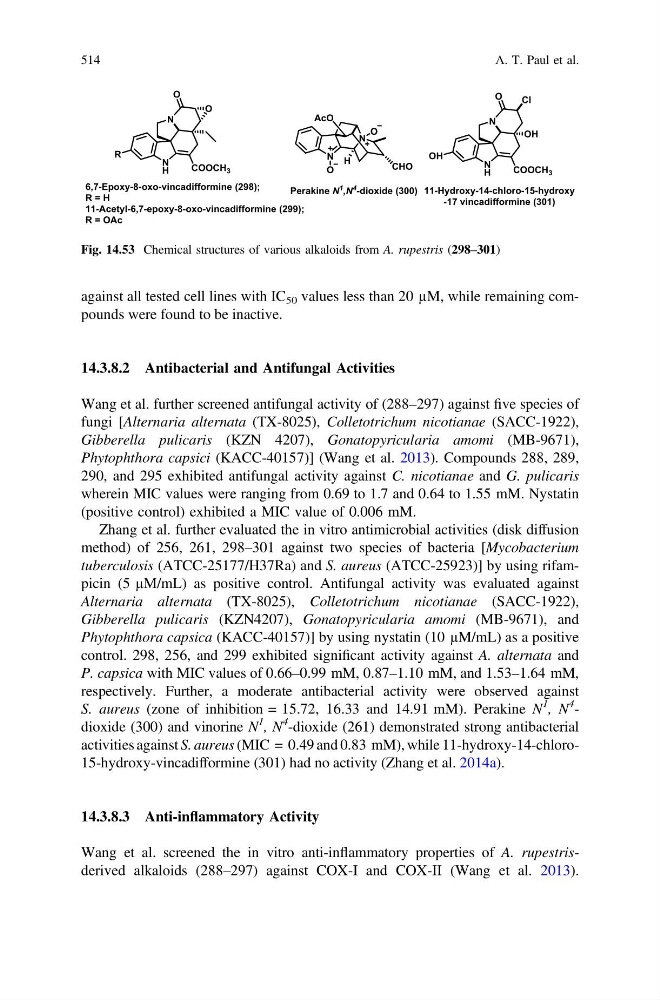
Zhang et al. further evaluated the in vitro antimicrobial activities (disk diffusion
method) of 256, 261, 298–301 against two species of bacteria [Mycobacterium
tuberculosis (ATCC-25177/H37Ra) and S. aureus (ATCC-25923)] by using rifampicin (5 µM/mL) as positive control. Antifungal activity was evaluated against
Alternaria alternata (TX-8025), Colletotrichum nicotianae (SACC-1922),
Gibberella pulicaris (KZN4207), Gonatopyricularia amomi (MB-9671), and
Phytophthora capsica (KACC-40157)] by using nystatin (10 µM/mL) as a positive
control. 298, 256, and 299 exhibited significant activity against A. alternata and
P. capsica with MIC values of 0.66–0.99 mM, 0.87–1.10 mM, and 1.53–1.64 mM,
respectively. Further, a moderate antibacterial activity were observed against
S. aureus (zone of inhibition = 15.72, 16.33 and 14.91 mM). Perakine N
1 , N
4 -
dioxide (300) and vinorine N
1 , N
4 -dioxide (261) demonstrated strong antibacterial
activities against S. aureus (MIC = 0.49 and 0.83 mM), while 11-hydroxy-14-chloro15-hydroxy-vincadifformine (301) had no activity (Zhang et al. 2014a).
14.3.8.3 Anti-inflammatory Activity
Wang et al. screened the in vitro anti-inflammatory properties of A. rupestrisderived alkaloids (288–297) against COX-I and COX-II (Wang et al. 2013).
6,7-Epoxy-8-oxo-vincadifformine (298);
R = H
11-Acetyl-6,7-epoxy-8-oxo-vincadifformine (299);
R = OAc
11-Hydroxy-14-chloro-15-hydroxy
-17 vincadifformine (301)
Perakine N
1 ,N
4 -dioxide (300)
N
H
N
COOCH 3
O
O
N
H
N
COOCH 3
OH
O
OH
Cl
N
O
N
H
O
AcO
CHO
R
Fig. 14.53 Chemical structures of various alkaloids from A. rupestris (298–301)
514
A. T. Paul et al.
14.3.8.2 Antibacterial and Antifungal Activities
Wang et al. further screened antifungal activity of (288–297) against five species of
fungi [Alternaria alternata (TX-8025), Colletotrichum nicotianae (SACC-1922),
Gibberella pulicaris (KZN 4207), Gonatopyricularia amomi (MB-9671),
Phytophthora capsici (KACC-40157)] (Wang et al. 2013). Compounds 288, 289,
290, and 295 exhibited antifungal activity against C. nicotianae and G. pulicaris
wherein MIC values were ranging from 0.69 to 1.7 and 0.64 to 1.55 mM. Nystatin
(positive control) exhibited a MIC value of 0.006 mM.
Zhang et al. further evaluated the in vitro antimicrobial activities (disk diffusion
method) of 256, 261, 298–301 against two species of bacteria [Mycobacterium
tuberculosis (ATCC-25177/H37Ra) and S. aureus (ATCC-25923)] by using rifampicin (5 µM/mL) as positive control. Antifungal activity was evaluated against
Alternaria alternata (TX-8025), Colletotrichum nicotianae (SACC-1922),
Gibberella pulicaris (KZN4207), Gonatopyricularia amomi (MB-9671), and
Phytophthora capsica (KACC-40157)] by using nystatin (10 µM/mL) as a positive
control. 298, 256, and 299 exhibited significant activity against A. alternata and
P. capsica with MIC values of 0.66–0.99 mM, 0.87–1.10 mM, and 1.53–1.64 mM,
respectively. Further, a moderate antibacterial activity were observed against
S. aureus (zone of inhibition = 15.72, 16.33 and 14.91 mM). Perakine N
1 , N
4 -
dioxide (300) and vinorine N
1 , N
4 -dioxide (261) demonstrated strong antibacterial
activities against S. aureus (MIC = 0.49 and 0.83 mM), while 11-hydroxy-14-chloro15-hydroxy-vincadifformine (301) had no activity (Zhang et al. 2014a).
14.3.8.3 Anti-inflammatory Activity
Wang et al. screened the in vitro anti-inflammatory properties of A. rupestrisderived alkaloids (288–297) against COX-I and COX-II (Wang et al. 2013).
6,7-Epoxy-8-oxo-vincadifformine (298);
R = H
11-Acetyl-6,7-epoxy-8-oxo-vincadifformine (299);
R = OAc
11-Hydroxy-14-chloro-15-hydroxy
-17 vincadifformine (301)
Perakine N
1 ,N
4 -dioxide (300)
N
H
N
COOCH 3
O
O
N
H
N
COOCH 3
OH
O
OH
Cl
N
O
N
H
O
AcO
CHO
R
Fig. 14.53 Chemical structures of various alkaloids from A. rupestris (298–301)
514
A. T. Paul et al.