

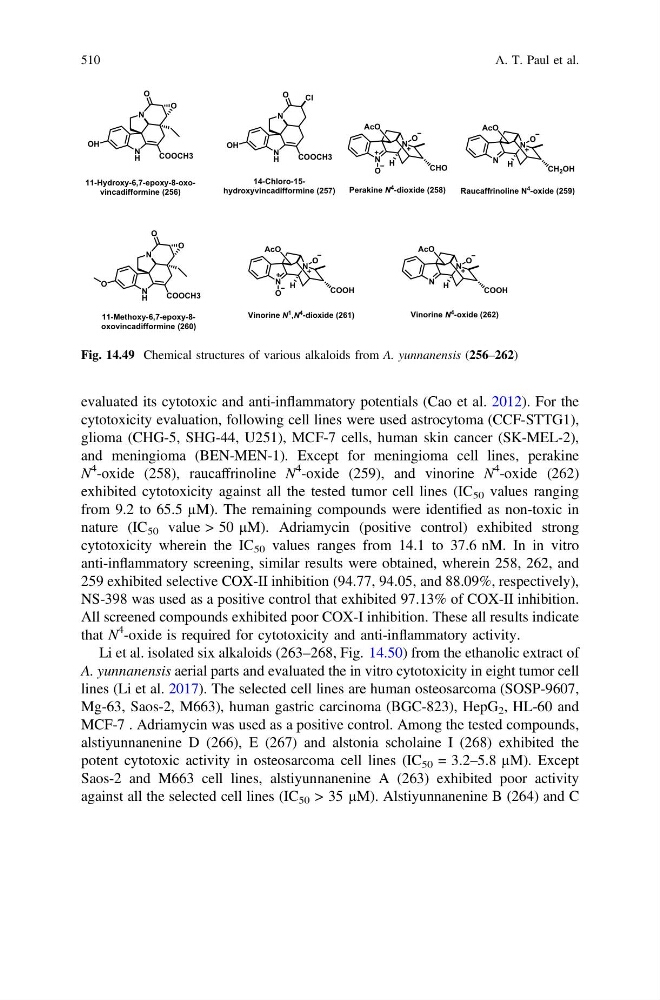
evaluated its cytotoxic and anti-inflammatory potentials (Cao et al. 2012). For the
cytotoxicity evaluation, following cell lines were used astrocytoma (CCF-STTG1),
glioma (CHG-5, SHG-44, U251), MCF-7 cells, human skin cancer (SK-MEL-2),
and meningioma (BEN-MEN-1). Except for meningioma cell lines, perakine
N
4 -oxide (258), raucaffrinoline N
4 -oxide (259), and vinorine N
4 -oxide (262)
exhibited cytotoxicity against all the tested tumor cell lines (IC 50 values ranging
from 9.2 to 65.5 µM). The remaining compounds were identified as non-toxic in
nature (IC 50 value > 50 µM). Adriamycin (positive control) exhibited strong
cytotoxicity wherein the IC 50 values ranges from 14.1 to 37.6 nM. In in vitro
anti-inflammatory screening, similar results were obtained, wherein 258, 262, and
259 exhibited selective COX-II inhibition (94.77, 94.05, and 88.09%, respectively),
NS-398 was used as a positive control that exhibited 97.13% of COX-II inhibition.
All screened compounds exhibited poor COX-I inhibition. These all results indicate
that N
4 -oxide is required for cytotoxicity and anti-inflammatory activity.
Li et al. isolated six alkaloids (263–268, Fig. 14.50) from the ethanolic extract of
A. yunnanensis aerial parts and evaluated the in vitro cytotoxicity in eight tumor cell
lines (Li et al. 2017). The selected cell lines are human osteosarcoma (SOSP-9607,
Mg-63, Saos-2, M663), human gastric carcinoma (BGC-823), HepG 2 , HL-60 and
MCF-7 . Adriamycin was used as a positive control. Among the tested compounds,
alstiyunnanenine D (266), E (267) and alstonia scholaine I (268) exhibited the
potent cytotoxic activity in osteosarcoma cell lines (IC 50 = 3.2–5.8 µM). Except
Saos-2 and M663 cell lines, alstiyunnanenine A (263) exhibited poor activity
against all the selected cell lines (IC 50 > 35 µM). Alstiyunnanenine B (264) and C
11-Hydroxy-6,7-epoxy-8-oxovincadifformine (256)
14-Chloro-15hydroxyvincadifformine (257)
Raucaffrinoline N
4 -oxide (259)
11-Methoxy-6,7-epoxy-8oxovincadifformine (260)
Vinorine N
4
-oxide (262)
Perakine N
4 -dioxide (258)
N
O
N
H
O
AcO
CHO
N
N
H
O
AcO
COOH
Vinorine N
1 ,N
4 -dioxide (261)
N
O
N
H
O
AcO
COOH
N
H
N
COOCH3
OH
O
O
N
H
N
COOCH3
OH
O
Cl
N
H
N
COOCH3
O
O
O
N
N
H
O
AcO
CH 2 OH
Fig. 14.49 Chemical structures of various alkaloids from A. yunnanensis (256–262)
510
A. T. Paul et al.
cytotoxicity evaluation, following cell lines were used astrocytoma (CCF-STTG1),
glioma (CHG-5, SHG-44, U251), MCF-7 cells, human skin cancer (SK-MEL-2),
and meningioma (BEN-MEN-1). Except for meningioma cell lines, perakine
N
4 -oxide (258), raucaffrinoline N
4 -oxide (259), and vinorine N
4 -oxide (262)
exhibited cytotoxicity against all the tested tumor cell lines (IC 50 values ranging
from 9.2 to 65.5 µM). The remaining compounds were identified as non-toxic in
nature (IC 50 value > 50 µM). Adriamycin (positive control) exhibited strong
cytotoxicity wherein the IC 50 values ranges from 14.1 to 37.6 nM. In in vitro
anti-inflammatory screening, similar results were obtained, wherein 258, 262, and
259 exhibited selective COX-II inhibition (94.77, 94.05, and 88.09%, respectively),
NS-398 was used as a positive control that exhibited 97.13% of COX-II inhibition.
All screened compounds exhibited poor COX-I inhibition. These all results indicate
that N
4 -oxide is required for cytotoxicity and anti-inflammatory activity.
Li et al. isolated six alkaloids (263–268, Fig. 14.50) from the ethanolic extract of
A. yunnanensis aerial parts and evaluated the in vitro cytotoxicity in eight tumor cell
lines (Li et al. 2017). The selected cell lines are human osteosarcoma (SOSP-9607,
Mg-63, Saos-2, M663), human gastric carcinoma (BGC-823), HepG 2 , HL-60 and
MCF-7 . Adriamycin was used as a positive control. Among the tested compounds,
alstiyunnanenine D (266), E (267) and alstonia scholaine I (268) exhibited the
potent cytotoxic activity in osteosarcoma cell lines (IC 50 = 3.2–5.8 µM). Except
Saos-2 and M663 cell lines, alstiyunnanenine A (263) exhibited poor activity
against all the selected cell lines (IC 50 > 35 µM). Alstiyunnanenine B (264) and C
11-Hydroxy-6,7-epoxy-8-oxovincadifformine (256)
14-Chloro-15hydroxyvincadifformine (257)
Raucaffrinoline N
4 -oxide (259)
11-Methoxy-6,7-epoxy-8oxovincadifformine (260)
Vinorine N
4
-oxide (262)
Perakine N
4 -dioxide (258)
N
O
N
H
O
AcO
CHO
N
N
H
O
AcO
COOH
Vinorine N
1 ,N
4 -dioxide (261)
N
O
N
H
O
AcO
COOH
N
H
N
COOCH3
OH
O
O
N
H
N
COOCH3
OH
O
Cl
N
H
N
COOCH3
O
O
O
N
N
H
O
AcO
CH 2 OH
Fig. 14.49 Chemical structures of various alkaloids from A. yunnanensis (256–262)
510
A. T. Paul et al.