

activity and sedation was resulted by the administration of 229 (50 mg/kg, i.p.).
However, at 100 mg/kg (higher dose), a sedative effect was observed in animals. In
the case of 230, a central stimulation in rats and mice was observed. However, in
the later phase, a central depression had occurred. All the tested compounds
(100 mg/kg, i.p.) potentiated the hexobarbitone hypnosis. Both 228 and 230
antagonized reserpine induced sedation, ptosis at 1 and 2.5 mg/kg, i.p. respectively.
However, 229 (100 mg/kg, i.p.) synergistically enhance the ptosis and sedation.
Further, 228 and 230 (1 and 2.5 mg/kg, i.p., respectively) potentiated the lethal
effects of amphetamine (10 mg/kg, i.p.) in aggregated mice. Furthermore, these
compounds potentiated the behavioral effects of DOPA and 5-HTP. In contrary,
229 did not exhibit any kind of activity. The analgesic activity of a subanalgesic
dose of morphine (2 mg/kg, i.p.) was potentiated by 228 (a latent period of tail-flick
response from 9.2 to 22.3 s.) and 230 (a latent period of tail-flick response from
10.3 to 25.3 s). While 229 had antagonizing effects on the analgesic activity (a
latent period of tail-flick response from 28.6 to 16.2 s.). Diphenylhydantoin
(2.5 mg/kg, i.p.) did not exhibit any anti-convulsant activity. However,
pre-treatment with 228 and 230 (1 and 2.5 mg/kg, i.p., respectively) resulted in
60% of anti-convulsant activity. Compound 229 antagonized the anti-convulsant
activity (effective dose—25 mg/kg, i.p. of diphenylhydantoin exhibited a 100%
inhibition, while pre-treatment resulted in a 40% anti-convulsant activity).
Compounds 228 and 230 potentiated the tryptamine induced convulsions (tryptamine control group—10% animals having convulsion, whereas 228 group—70%
animal; 230 group—60% animals). 229 did not exhibit any kind of
tryptamine-related activities. A transient depressor response along with a stimulation of respiration was produced by 228 in anaesthetized dog’s blood pressure,
while 230 exhibited the same kind of activity without respiratory stimulation.
229 produced a moderate depressor response. LD 50 of the compounds was found to
be 8.7, 126, and 176 mg/kg, respectively for 228, 230, and 229. These all results
indicated the potential of 228 and 230 as an inhibitor of monoamine oxidase.
14.3.5.3 Antifungal Activities
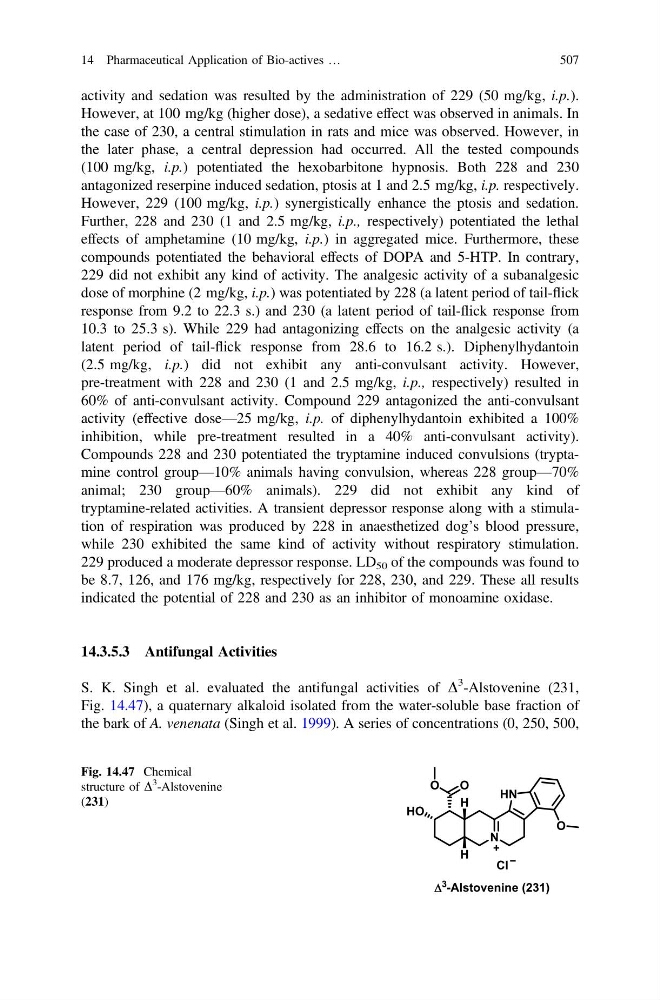
S. K. Singh et al. evaluated the antifungal activities of D
3 -Alstovenine (231,
Fig. 14.47), a quaternary alkaloid isolated from the water-soluble base fraction of
the bark of A. venenata (Singh et al. 1999). A series of concentrations (0, 250, 500,
-Alstovenine (231)
O
HN
O
O
HO
N
H
H
Cl
Fig. 14.47 Chemical
structure of D
3
-Alstovenine
(231)
14 Pharmaceutical Application of Bio-actives …
507
However, at 100 mg/kg (higher dose), a sedative effect was observed in animals. In
the case of 230, a central stimulation in rats and mice was observed. However, in
the later phase, a central depression had occurred. All the tested compounds
(100 mg/kg, i.p.) potentiated the hexobarbitone hypnosis. Both 228 and 230
antagonized reserpine induced sedation, ptosis at 1 and 2.5 mg/kg, i.p. respectively.
However, 229 (100 mg/kg, i.p.) synergistically enhance the ptosis and sedation.
Further, 228 and 230 (1 and 2.5 mg/kg, i.p., respectively) potentiated the lethal
effects of amphetamine (10 mg/kg, i.p.) in aggregated mice. Furthermore, these
compounds potentiated the behavioral effects of DOPA and 5-HTP. In contrary,
229 did not exhibit any kind of activity. The analgesic activity of a subanalgesic
dose of morphine (2 mg/kg, i.p.) was potentiated by 228 (a latent period of tail-flick
response from 9.2 to 22.3 s.) and 230 (a latent period of tail-flick response from
10.3 to 25.3 s). While 229 had antagonizing effects on the analgesic activity (a
latent period of tail-flick response from 28.6 to 16.2 s.). Diphenylhydantoin
(2.5 mg/kg, i.p.) did not exhibit any anti-convulsant activity. However,
pre-treatment with 228 and 230 (1 and 2.5 mg/kg, i.p., respectively) resulted in
60% of anti-convulsant activity. Compound 229 antagonized the anti-convulsant
activity (effective dose—25 mg/kg, i.p. of diphenylhydantoin exhibited a 100%
inhibition, while pre-treatment resulted in a 40% anti-convulsant activity).
Compounds 228 and 230 potentiated the tryptamine induced convulsions (tryptamine control group—10% animals having convulsion, whereas 228 group—70%
animal; 230 group—60% animals). 229 did not exhibit any kind of
tryptamine-related activities. A transient depressor response along with a stimulation of respiration was produced by 228 in anaesthetized dog’s blood pressure,
while 230 exhibited the same kind of activity without respiratory stimulation.
229 produced a moderate depressor response. LD 50 of the compounds was found to
be 8.7, 126, and 176 mg/kg, respectively for 228, 230, and 229. These all results
indicated the potential of 228 and 230 as an inhibitor of monoamine oxidase.
14.3.5.3 Antifungal Activities
S. K. Singh et al. evaluated the antifungal activities of D
3 -Alstovenine (231,
Fig. 14.47), a quaternary alkaloid isolated from the water-soluble base fraction of
the bark of A. venenata (Singh et al. 1999). A series of concentrations (0, 250, 500,
-Alstovenine (231)
O
HN
O
O
HO
N
H
H
Cl
Fig. 14.47 Chemical
structure of D
3
-Alstovenine
(231)
14 Pharmaceutical Application of Bio-actives …
507