

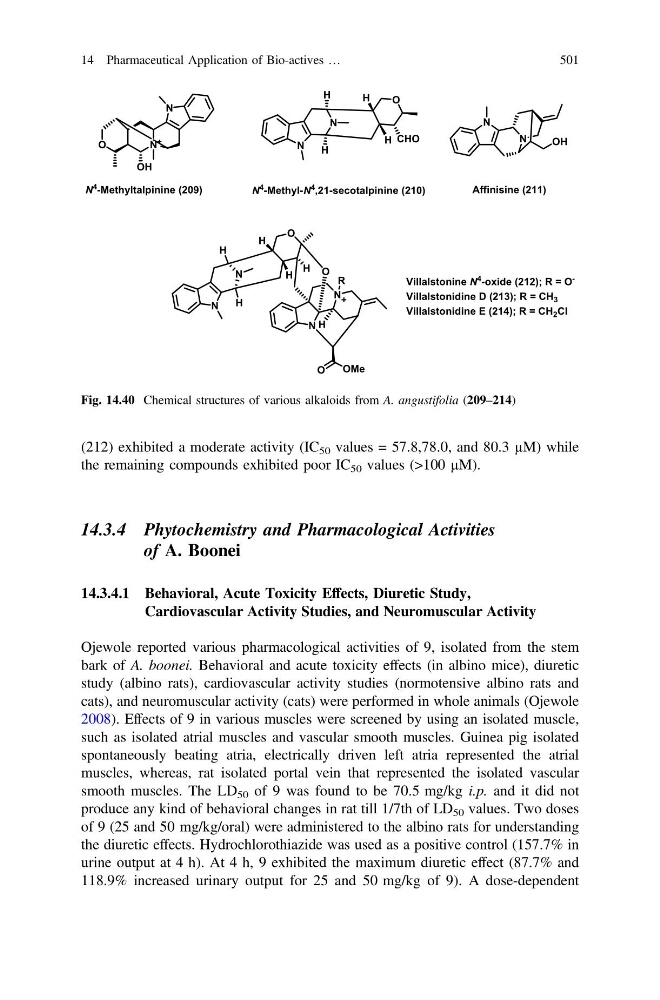
(212) exhibited a moderate activity (IC 50 values = 57.8,78.0, and 80.3 µM) while
the remaining compounds exhibited poor IC 50 values (>100 µM).
14.3.4 Phytochemistry and Pharmacological Activities
of A. Boonei
14.3.4.1 Behavioral, Acute Toxicity Effects, Diuretic Study,
Cardiovascular Activity Studies, and Neuromuscular Activity
Ojewole reported various pharmacological activities of 9, isolated from the stem
bark of A. boonei. Behavioral and acute toxicity effects (in albino mice), diuretic
study (albino rats), cardiovascular activity studies (normotensive albino rats and
cats), and neuromuscular activity (cats) were performed in whole animals (Ojewole
2008). Effects of 9 in various muscles were screened by using an isolated muscle,
such as isolated atrial muscles and vascular smooth muscles. Guinea pig isolated
spontaneously beating atria, electrically driven left atria represented the atrial
muscles, whereas, rat isolated portal vein that represented the isolated vascular
smooth muscles. The LD 50 of 9 was found to be 70.5 mg/kg i.p. and it did not
produce any kind of behavioral changes in rat till 1/7th of LD 50 values. Two doses
of 9 (25 and 50 mg/kg/oral) were administered to the albino rats for understanding
the diuretic effects. Hydrochlorothiazide was used as a positive control (157.7% in
urine output at 4 h). At 4 h, 9 exhibited the maximum diuretic effect (87.7% and
118.9% increased urinary output for 25 and 50 mg/kg of 9). A dose-dependent
N
N
O
H
H
H
H CHO
N
N
O
H
H
H
H
N
N
H
OMe
O
H
O R
Affinisine (211)
N
N
OH
N
4 -Methyl-N
4 ,21-secotalpinine (210)
Villalstonine N
4
-oxide (212); R = O
-
Villalstonidine D (213); R = CH 3
Villalstonidine E (214); R = CH 2 Cl
N
4 -Methyltalpinine (209)
O
N
+
OH
N
Fig. 14.40 Chemical structures of various alkaloids from A. angustifolia (209–214)
14 Pharmaceutical Application of Bio-actives …
501
the remaining compounds exhibited poor IC 50 values (>100 µM).
14.3.4 Phytochemistry and Pharmacological Activities
of A. Boonei
14.3.4.1 Behavioral, Acute Toxicity Effects, Diuretic Study,
Cardiovascular Activity Studies, and Neuromuscular Activity
Ojewole reported various pharmacological activities of 9, isolated from the stem
bark of A. boonei. Behavioral and acute toxicity effects (in albino mice), diuretic
study (albino rats), cardiovascular activity studies (normotensive albino rats and
cats), and neuromuscular activity (cats) were performed in whole animals (Ojewole
2008). Effects of 9 in various muscles were screened by using an isolated muscle,
such as isolated atrial muscles and vascular smooth muscles. Guinea pig isolated
spontaneously beating atria, electrically driven left atria represented the atrial
muscles, whereas, rat isolated portal vein that represented the isolated vascular
smooth muscles. The LD 50 of 9 was found to be 70.5 mg/kg i.p. and it did not
produce any kind of behavioral changes in rat till 1/7th of LD 50 values. Two doses
of 9 (25 and 50 mg/kg/oral) were administered to the albino rats for understanding
the diuretic effects. Hydrochlorothiazide was used as a positive control (157.7% in
urine output at 4 h). At 4 h, 9 exhibited the maximum diuretic effect (87.7% and
118.9% increased urinary output for 25 and 50 mg/kg of 9). A dose-dependent
N
N
O
H
H
H
H CHO
N
N
O
H
H
H
H
N
N
H
OMe
O
H
O R
Affinisine (211)
N
N
OH
N
4 -Methyl-N
4 ,21-secotalpinine (210)
Villalstonine N
4
-oxide (212); R = O
-
Villalstonidine D (213); R = CH 3
Villalstonidine E (214); R = CH 2 Cl
N
4 -Methyltalpinine (209)
O
N
+
OH
N
Fig. 14.40 Chemical structures of various alkaloids from A. angustifolia (209–214)
14 Pharmaceutical Application of Bio-actives …
501