

14.3.1.8 Anti-tubercular Activities
Macabeo et al. isolated various alkaloids (94, 100–104, Fig. 14.24) from the
methanolic extract of A. scholaris leaves. Further, the anti-tubercular activity of the
isolated compounds was evaluated by microplate alamar blue assay (MABA) in
Mycobacterium tuberculosis H37Rv by using rifampicin as a positive control
(Macabeo et al. 2005, 2008). Among the various compounds screened, 20Stubotaiwine (103) only exhibited a potential anti-tubercular activity (MIC—
>100 µg/mL). The remaining compounds exhibited a poor activity toward the
M. tuberculosis (Table 14.11).
14.3.1.9 Antimalarial Activities
Salim et al. isolated seven indole alkaloids (49, 105–110, Fig. 14.25) from the
ethanolic extract of A. scholaris bark (Salim et al. 2004). Isolated compounds are
49, Akuammiginone (105), echitaminic acid (106), echitamidine-N-oxide (107), N
b -
demethyl alstogustine N-oxide (108), akuammicine N-oxide (109), and N
b -demethyl alstogustine (110). Further, in vitro antimalarial activity was evaluated by
hypoxanthine incorporation techniques. Compounds 109 and 110 had an IC 50
values of 63.2 and 6.75 µg/mL, respectively, against Plasmodium falciparum (K1,
multidrug-resistance (MDR) strain).
O
O
O
O
O
O
OH
OH
HO
OH
OH
OH
HO
OH
HO
HO
O
OH
O
O
HO
O
O
OH
OH
OH
OH
O
O
OH
O
O
HO
O
O
OH
OH
OH
OH
O
OH
OH
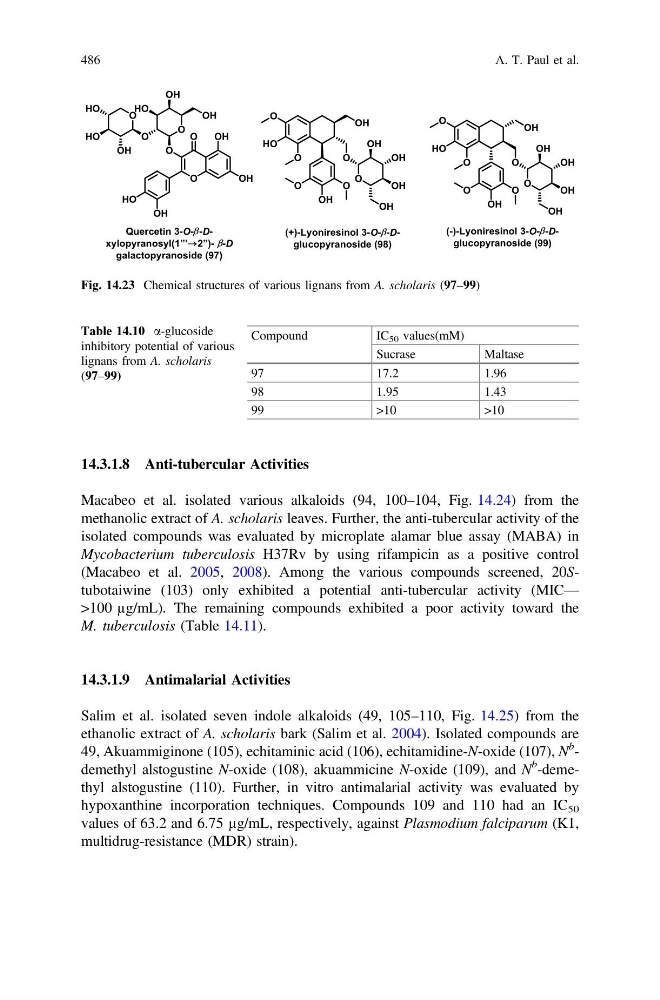
(-)-Lyoniresinol 3-O- -Dglucopyranoside (99)
Quercetin 3-O- -Dxylopyranosyl(1”’ 2”)- -D
galactopyranoside (97)
(+)-Lyoniresinol 3-O- -Dglucopyranoside (98)
Fig. 14.23 Chemical structures of various lignans from A. scholaris (97–99)
Table 14.10 a-glucoside
inhibitory potential of various
lignans from A. scholaris
(97–99)
Compound
IC 50 values(mM)
Sucrase
Maltase
97
17.2
1.96
98
1.95
1.43
99
>10
>10
486
A. T. Paul et al.
Macabeo et al. isolated various alkaloids (94, 100–104, Fig. 14.24) from the
methanolic extract of A. scholaris leaves. Further, the anti-tubercular activity of the
isolated compounds was evaluated by microplate alamar blue assay (MABA) in
Mycobacterium tuberculosis H37Rv by using rifampicin as a positive control
(Macabeo et al. 2005, 2008). Among the various compounds screened, 20Stubotaiwine (103) only exhibited a potential anti-tubercular activity (MIC—
>100 µg/mL). The remaining compounds exhibited a poor activity toward the
M. tuberculosis (Table 14.11).
14.3.1.9 Antimalarial Activities
Salim et al. isolated seven indole alkaloids (49, 105–110, Fig. 14.25) from the
ethanolic extract of A. scholaris bark (Salim et al. 2004). Isolated compounds are
49, Akuammiginone (105), echitaminic acid (106), echitamidine-N-oxide (107), N
b -
demethyl alstogustine N-oxide (108), akuammicine N-oxide (109), and N
b -demethyl alstogustine (110). Further, in vitro antimalarial activity was evaluated by
hypoxanthine incorporation techniques. Compounds 109 and 110 had an IC 50
values of 63.2 and 6.75 µg/mL, respectively, against Plasmodium falciparum (K1,
multidrug-resistance (MDR) strain).
O
O
O
O
O
O
OH
OH
HO
OH
OH
OH
HO
OH
HO
HO
O
OH
O
O
HO
O
O
OH
OH
OH
OH
O
O
OH
O
O
HO
O
O
OH
OH
OH
OH
O
OH
OH
(-)-Lyoniresinol 3-O- -Dglucopyranoside (99)
Quercetin 3-O- -Dxylopyranosyl(1”’ 2”)- -D
galactopyranoside (97)
(+)-Lyoniresinol 3-O- -Dglucopyranoside (98)
Fig. 14.23 Chemical structures of various lignans from A. scholaris (97–99)
Table 14.10 a-glucoside
inhibitory potential of various
lignans from A. scholaris
(97–99)
Compound
IC 50 values(mM)
Sucrase
Maltase
97
17.2
1.96
98
1.95
1.43
99
>10
>10
486
A. T. Paul et al.