

14.3.1.5 Antiviral Activity
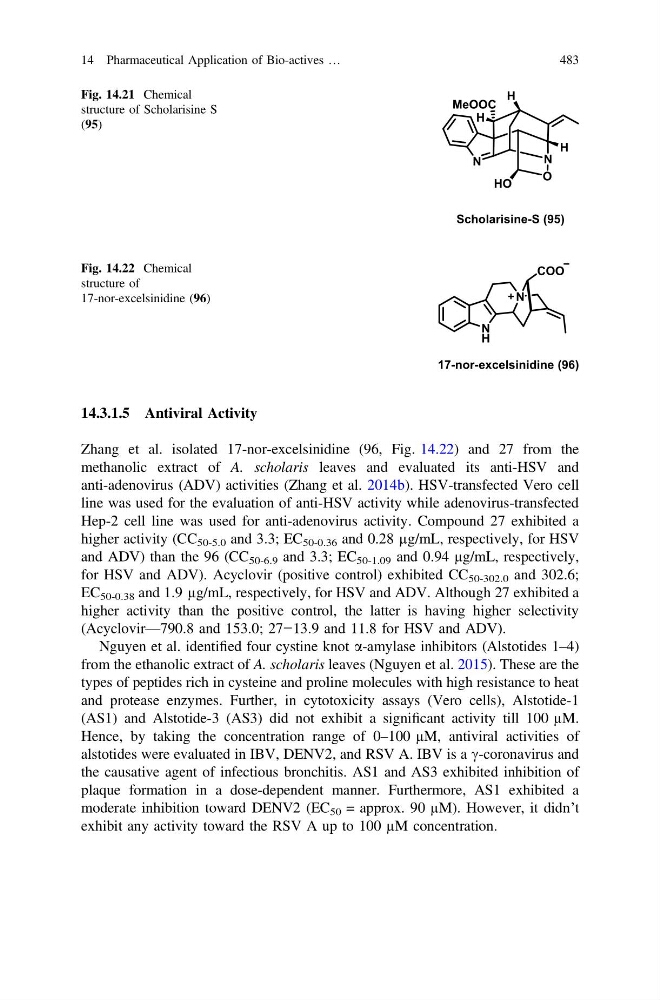
Zhang et al. isolated 17-nor-excelsinidine (96, Fig. 14.22) and 27 from the
methanolic extract of A. scholaris leaves and evaluated its anti-HSV and
anti-adenovirus (ADV) activities (Zhang et al. 2014b). HSV-transfected Vero cell
line was used for the evaluation of anti-HSV activity while adenovirus-transfected
Hep-2 cell line was used for anti-adenovirus activity. Compound 27 exhibited a
higher activity (CC 50-5.0 and 3.3; EC 50-0.36 and 0.28 µg/mL, respectively, for HSV
and ADV) than the 96 (CC 50-6.9 and 3.3; EC 50-1.09 and 0.94 µg/mL, respectively,
for HSV and ADV). Acyclovir (positive control) exhibited CC 50-302.0 and 302.6;
EC 50-0.38 and 1.9 µg/mL, respectively, for HSV and ADV. Although 27 exhibited a
higher activity than the positive control, the latter is having higher selectivity
(Acyclovir—790.8 and 153.0; 27−13.9 and 11.8 for HSV and ADV).
Nguyen et al. identified four cystine knot a-amylase inhibitors (Alstotides 1–4)
from the ethanolic extract of A. scholaris leaves (Nguyen et al. 2015). These are the
types of peptides rich in cysteine and proline molecules with high resistance to heat
and protease enzymes. Further, in cytotoxicity assays (Vero cells), Alstotide-1
(AS1) and Alstotide-3 (AS3) did not exhibit a significant activity till 100 µM.
Hence, by taking the concentration range of 0–100 µM, antiviral activities of
alstotides were evaluated in IBV, DENV2, and RSV A. IBV is a c-coronavirus and
the causative agent of infectious bronchitis. AS1 and AS3 exhibited inhibition of
plaque formation in a dose-dependent manner. Furthermore, AS1 exhibited a
moderate inhibition toward DENV2 (EC 50 = approx. 90 µM). However, it didn’t
exhibit any activity toward the RSV A up to 100 µM concentration.
N
N
H
H
MeOOC
O
HO
H
Scholarisine-S (95)
Fig. 14.21 Chemical
structure of Scholarisine S
(95)
17-nor-excelsinidine (96)
N
H
N
COO
Fig. 14.22 Chemical
structure of
17-nor-excelsinidine (96)
14 Pharmaceutical Application of Bio-actives …
483
Zhang et al. isolated 17-nor-excelsinidine (96, Fig. 14.22) and 27 from the
methanolic extract of A. scholaris leaves and evaluated its anti-HSV and
anti-adenovirus (ADV) activities (Zhang et al. 2014b). HSV-transfected Vero cell
line was used for the evaluation of anti-HSV activity while adenovirus-transfected
Hep-2 cell line was used for anti-adenovirus activity. Compound 27 exhibited a
higher activity (CC 50-5.0 and 3.3; EC 50-0.36 and 0.28 µg/mL, respectively, for HSV
and ADV) than the 96 (CC 50-6.9 and 3.3; EC 50-1.09 and 0.94 µg/mL, respectively,
for HSV and ADV). Acyclovir (positive control) exhibited CC 50-302.0 and 302.6;
EC 50-0.38 and 1.9 µg/mL, respectively, for HSV and ADV. Although 27 exhibited a
higher activity than the positive control, the latter is having higher selectivity
(Acyclovir—790.8 and 153.0; 27−13.9 and 11.8 for HSV and ADV).
Nguyen et al. identified four cystine knot a-amylase inhibitors (Alstotides 1–4)
from the ethanolic extract of A. scholaris leaves (Nguyen et al. 2015). These are the
types of peptides rich in cysteine and proline molecules with high resistance to heat
and protease enzymes. Further, in cytotoxicity assays (Vero cells), Alstotide-1
(AS1) and Alstotide-3 (AS3) did not exhibit a significant activity till 100 µM.
Hence, by taking the concentration range of 0–100 µM, antiviral activities of
alstotides were evaluated in IBV, DENV2, and RSV A. IBV is a c-coronavirus and
the causative agent of infectious bronchitis. AS1 and AS3 exhibited inhibition of
plaque formation in a dose-dependent manner. Furthermore, AS1 exhibited a
moderate inhibition toward DENV2 (EC 50 = approx. 90 µM). However, it didn’t
exhibit any activity toward the RSV A up to 100 µM concentration.
N
N
H
H
MeOOC
O
HO
H
Scholarisine-S (95)
Fig. 14.21 Chemical
structure of Scholarisine S
(95)
17-nor-excelsinidine (96)
N
H
N
COO
Fig. 14.22 Chemical
structure of
17-nor-excelsinidine (96)
14 Pharmaceutical Application of Bio-actives …
483