

the non-toxic concentrations was determined via luciferase reporter assay in TNF-a
induced BEAS-2B cells (5 ng/mL) as compared to dexamethasone (positive control). Although all the tested compounds displayed a good inhibition on TNF-a
induced NF-jB production, 24, 92, and 93 showed significant effects at even low
concentrations (RFU ratio < 10 at 100 µm/L). Apart from that the cytokine release
test (IL-6 and IL-8 expression) was also performed in TNF-a induced BEAS-2B
cells (5 ng/mL). Cells treated with 3, 19, 20, 27, 92, and 93 only resulted in
decreased expression of IL-6 (<500 pg/mL), while all the alkaloids demonstrated
suppression of IL-8 release (<500 pg/mL). Dexamethasone (10 µmol/L) inhibited
IL-6 and IL-8 (200 and 300 pg/mL, respectively).
While in another study, Hou et al. identified several new b 2 adrenergic receptor
agonists (3, 13, 20, 24, 27, 92–94) from an alkaloidal extract of A. scholaris leaves via
bioactivity-based LC/MS analysis (Hou et al. 2012a). b 2 AR agonist activities were
confirmed by performing in vivo relaxant tests on guinea pig tracheal muscles.
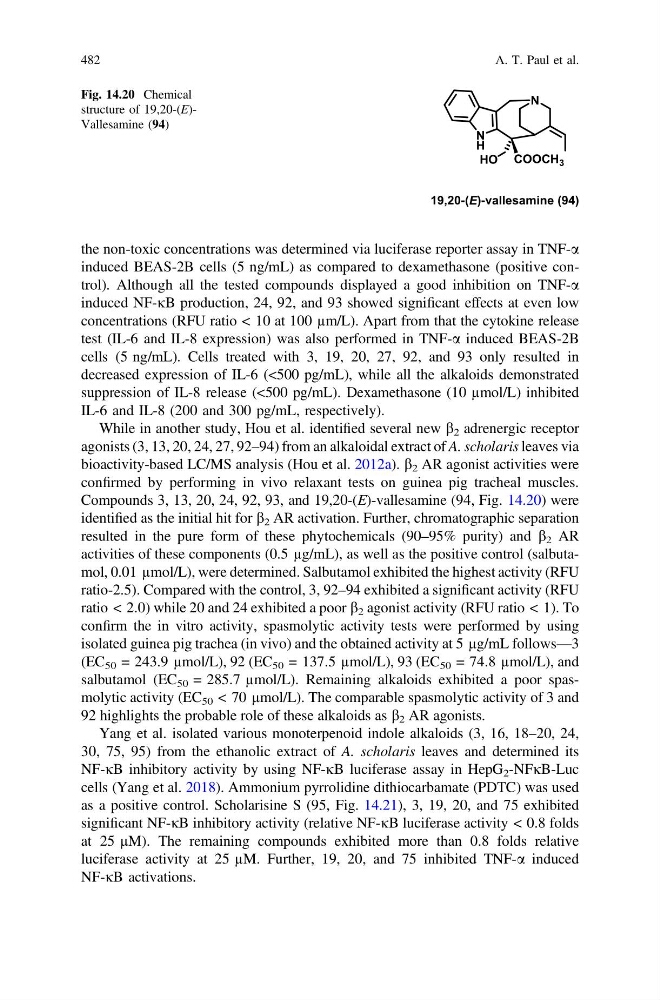
Compounds 3, 13, 20, 24, 92, 93, and 19,20-(E)-vallesamine (94, Fig. 14.20) were
identified as the initial hit for b 2 AR activation. Further, chromatographic separation
resulted in the pure form of these phytochemicals (90–95% purity) and b 2 AR
activities of these components (0.5 µg/mL), as well as the positive control (salbutamol, 0.01 µmol/L), were determined. Salbutamol exhibited the highest activity (RFU
ratio-2.5). Compared with the control, 3, 92–94 exhibited a significant activity (RFU
ratio < 2.0) while 20 and 24 exhibited a poor b 2 agonist activity (RFU ratio < 1). To
confirm the in vitro activity, spasmolytic activity tests were performed by using
isolated guinea pig trachea (in vivo) and the obtained activity at 5 µg/mL follows—3
(EC 50 = 243.9 µmol/L), 92 (EC 50 = 137.5 µmol/L), 93 (EC 50 = 74.8 µmol/L), and
salbutamol (EC 50 = 285.7 µmol/L). Remaining alkaloids exhibited a poor spasmolytic activity (EC 50 < 70 µmol/L). The comparable spasmolytic activity of 3 and
92 highlights the probable role of these alkaloids as b 2 AR agonists.
Yang et al. isolated various monoterpenoid indole alkaloids (3, 16, 18–20, 24,
30, 75, 95) from the ethanolic extract of A. scholaris leaves and determined its
NF-jB inhibitory activity by using NF-jB luciferase assay in HepG 2 -NFjB-Luc
cells (Yang et al. 2018). Ammonium pyrrolidine dithiocarbamate (PDTC) was used
as a positive control. Scholarisine S (95, Fig. 14.21), 3, 19, 20, and 75 exhibited
significant NF-jB inhibitory activity (relative NF-jB luciferase activity < 0.8 folds
at 25 µM). The remaining compounds exhibited more than 0.8 folds relative
luciferase activity at 25 µM. Further, 19, 20, and 75 inhibited TNF-a induced
NF-jB activations.
19,20-(E)-vallesamine (94)
N
H
N
COOCH 3
HO
Fig. 14.20 Chemical
structure of 19,20-(E)Vallesamine (94)
482
A. T. Paul et al.
induced BEAS-2B cells (5 ng/mL) as compared to dexamethasone (positive control). Although all the tested compounds displayed a good inhibition on TNF-a
induced NF-jB production, 24, 92, and 93 showed significant effects at even low
concentrations (RFU ratio < 10 at 100 µm/L). Apart from that the cytokine release
test (IL-6 and IL-8 expression) was also performed in TNF-a induced BEAS-2B
cells (5 ng/mL). Cells treated with 3, 19, 20, 27, 92, and 93 only resulted in
decreased expression of IL-6 (<500 pg/mL), while all the alkaloids demonstrated
suppression of IL-8 release (<500 pg/mL). Dexamethasone (10 µmol/L) inhibited
IL-6 and IL-8 (200 and 300 pg/mL, respectively).
While in another study, Hou et al. identified several new b 2 adrenergic receptor
agonists (3, 13, 20, 24, 27, 92–94) from an alkaloidal extract of A. scholaris leaves via
bioactivity-based LC/MS analysis (Hou et al. 2012a). b 2 AR agonist activities were
confirmed by performing in vivo relaxant tests on guinea pig tracheal muscles.
Compounds 3, 13, 20, 24, 92, 93, and 19,20-(E)-vallesamine (94, Fig. 14.20) were
identified as the initial hit for b 2 AR activation. Further, chromatographic separation
resulted in the pure form of these phytochemicals (90–95% purity) and b 2 AR
activities of these components (0.5 µg/mL), as well as the positive control (salbutamol, 0.01 µmol/L), were determined. Salbutamol exhibited the highest activity (RFU
ratio-2.5). Compared with the control, 3, 92–94 exhibited a significant activity (RFU
ratio < 2.0) while 20 and 24 exhibited a poor b 2 agonist activity (RFU ratio < 1). To
confirm the in vitro activity, spasmolytic activity tests were performed by using
isolated guinea pig trachea (in vivo) and the obtained activity at 5 µg/mL follows—3
(EC 50 = 243.9 µmol/L), 92 (EC 50 = 137.5 µmol/L), 93 (EC 50 = 74.8 µmol/L), and
salbutamol (EC 50 = 285.7 µmol/L). Remaining alkaloids exhibited a poor spasmolytic activity (EC 50 < 70 µmol/L). The comparable spasmolytic activity of 3 and
92 highlights the probable role of these alkaloids as b 2 AR agonists.
Yang et al. isolated various monoterpenoid indole alkaloids (3, 16, 18–20, 24,
30, 75, 95) from the ethanolic extract of A. scholaris leaves and determined its
NF-jB inhibitory activity by using NF-jB luciferase assay in HepG 2 -NFjB-Luc
cells (Yang et al. 2018). Ammonium pyrrolidine dithiocarbamate (PDTC) was used
as a positive control. Scholarisine S (95, Fig. 14.21), 3, 19, 20, and 75 exhibited
significant NF-jB inhibitory activity (relative NF-jB luciferase activity < 0.8 folds
at 25 µM). The remaining compounds exhibited more than 0.8 folds relative
luciferase activity at 25 µM. Further, 19, 20, and 75 inhibited TNF-a induced
NF-jB activations.
19,20-(E)-vallesamine (94)
N
H
N
COOCH 3
HO
Fig. 14.20 Chemical
structure of 19,20-(E)Vallesamine (94)
482
A. T. Paul et al.