

E. coli (ATCC 11775), and Klebsiella pneumoniae (ATCC 13883). Cefotaxime
was used as a positive control. Normavacurine-21-one (70), 27 and vallesamine N
4 -
oxide (74) exhibited significant antibacterial activity against E. faecalis (MIC
values—0.8 for each compound; cefotaxime MIC—0.2 µg/mL), 74, 18 and
5-hydroxy-19, 20-Z-alschomine (72), and against P. aeruginosa (MIC values—0.
8 each, cefotaxime MIC—0.78 µg/mL), while 18 showed moderate activity (MIC
value of 1.6 µg/mL) against K. pneumoniae (cefotaxime MIC—0.8 µg/mL). The
remaining compounds exhibited moderate to poor antibacterial effects (6.25–
100 µg/mL).
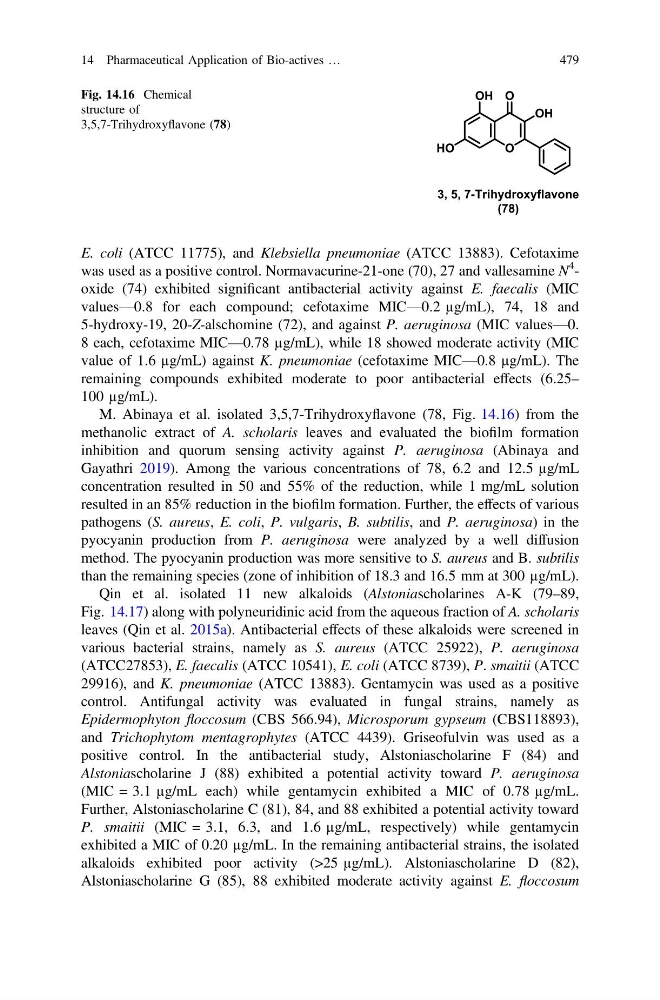
M. Abinaya et al. isolated 3,5,7-Trihydroxyflavone (78, Fig. 14.16) from the
methanolic extract of A. scholaris leaves and evaluated the biofilm formation
inhibition and quorum sensing activity against P. aeruginosa (Abinaya and
Gayathri 2019). Among the various concentrations of 78, 6.2 and 12.5 µg/mL
concentration resulted in 50 and 55% of the reduction, while 1 mg/mL solution
resulted in an 85% reduction in the biofilm formation. Further, the effects of various
pathogens (S. aureus, E. coli, P. vulgaris, B. subtilis, and P. aeruginosa) in the
pyocyanin production from P. aeruginosa were analyzed by a well diffusion
method. The pyocyanin production was more sensitive to S. aureus and B. subtilis
than the remaining species (zone of inhibition of 18.3 and 16.5 mm at 300 µg/mL).
Qin et al. isolated 11 new alkaloids (Alstoniascholarines A-K (79–89,
Fig. 14.17) along with polyneuridinic acid from the aqueous fraction of A. scholaris
leaves (Qin et al. 2015a). Antibacterial effects of these alkaloids were screened in
various bacterial strains, namely as S. aureus (ATCC 25922), P. aeruginosa
(ATCC27853), E. faecalis (ATCC 10541), E. coli (ATCC 8739), P. smaitii (ATCC
29916), and K. pneumoniae (ATCC 13883). Gentamycin was used as a positive
control. Antifungal activity was evaluated in fungal strains, namely as
Epidermophyton floccosum (CBS 566.94), Microsporum gypseum (CBS118893),
and Trichophytom mentagrophytes (ATCC 4439). Griseofulvin was used as a
positive control. In the antibacterial study, Alstoniascholarine F (84) and
Alstoniascholarine J (88) exhibited a potential activity toward P. aeruginosa
(MIC = 3.1 µg/mL each) while gentamycin exhibited a MIC of 0.78 µg/mL.
Further, Alstoniascholarine C (81), 84, and 88 exhibited a potential activity toward
P. smaitii (MIC = 3.1, 6.3, and 1.6 µg/mL, respectively) while gentamycin
exhibited a MIC of 0.20 µg/mL. In the remaining antibacterial strains, the isolated
alkaloids exhibited poor activity (>25 µg/mL). Alstoniascholarine D (82),
Alstoniascholarine G (85), 88 exhibited moderate activity against E. floccosum
3, 5, 7-Trihydroxyflavone
(78)
O
O
OH
HO
OH
Fig. 14.16 Chemical
structure of
3,5,7-Trihydroxyflavone (78)
14 Pharmaceutical Application of Bio-actives …
479
was used as a positive control. Normavacurine-21-one (70), 27 and vallesamine N
4 -
oxide (74) exhibited significant antibacterial activity against E. faecalis (MIC
values—0.8 for each compound; cefotaxime MIC—0.2 µg/mL), 74, 18 and
5-hydroxy-19, 20-Z-alschomine (72), and against P. aeruginosa (MIC values—0.
8 each, cefotaxime MIC—0.78 µg/mL), while 18 showed moderate activity (MIC
value of 1.6 µg/mL) against K. pneumoniae (cefotaxime MIC—0.8 µg/mL). The
remaining compounds exhibited moderate to poor antibacterial effects (6.25–
100 µg/mL).
M. Abinaya et al. isolated 3,5,7-Trihydroxyflavone (78, Fig. 14.16) from the
methanolic extract of A. scholaris leaves and evaluated the biofilm formation
inhibition and quorum sensing activity against P. aeruginosa (Abinaya and
Gayathri 2019). Among the various concentrations of 78, 6.2 and 12.5 µg/mL
concentration resulted in 50 and 55% of the reduction, while 1 mg/mL solution
resulted in an 85% reduction in the biofilm formation. Further, the effects of various
pathogens (S. aureus, E. coli, P. vulgaris, B. subtilis, and P. aeruginosa) in the
pyocyanin production from P. aeruginosa were analyzed by a well diffusion
method. The pyocyanin production was more sensitive to S. aureus and B. subtilis
than the remaining species (zone of inhibition of 18.3 and 16.5 mm at 300 µg/mL).
Qin et al. isolated 11 new alkaloids (Alstoniascholarines A-K (79–89,
Fig. 14.17) along with polyneuridinic acid from the aqueous fraction of A. scholaris
leaves (Qin et al. 2015a). Antibacterial effects of these alkaloids were screened in
various bacterial strains, namely as S. aureus (ATCC 25922), P. aeruginosa
(ATCC27853), E. faecalis (ATCC 10541), E. coli (ATCC 8739), P. smaitii (ATCC
29916), and K. pneumoniae (ATCC 13883). Gentamycin was used as a positive
control. Antifungal activity was evaluated in fungal strains, namely as
Epidermophyton floccosum (CBS 566.94), Microsporum gypseum (CBS118893),
and Trichophytom mentagrophytes (ATCC 4439). Griseofulvin was used as a
positive control. In the antibacterial study, Alstoniascholarine F (84) and
Alstoniascholarine J (88) exhibited a potential activity toward P. aeruginosa
(MIC = 3.1 µg/mL each) while gentamycin exhibited a MIC of 0.78 µg/mL.
Further, Alstoniascholarine C (81), 84, and 88 exhibited a potential activity toward
P. smaitii (MIC = 3.1, 6.3, and 1.6 µg/mL, respectively) while gentamycin
exhibited a MIC of 0.20 µg/mL. In the remaining antibacterial strains, the isolated
alkaloids exhibited poor activity (>25 µg/mL). Alstoniascholarine D (82),
Alstoniascholarine G (85), 88 exhibited moderate activity against E. floccosum
3, 5, 7-Trihydroxyflavone
(78)
O
O
OH
HO
OH
Fig. 14.16 Chemical
structure of
3,5,7-Trihydroxyflavone (78)
14 Pharmaceutical Application of Bio-actives …
479