

electron system by growing the gradient across the cytoplasmic membrane is
essential for its antibacterial action (Knowles and Roller 2001). Carvacrol not only
inhibited bacterial cell growth but also induces cell death through increased
depolarization of cell membrane which leads to elevated rapid oxidizing burst in
E. coli. Cellular DNA, protein, and K
+ were released from cells, which have been
triggered by carvacrol. On treatment with carvacrol, there is a decrease in the
protein expression levels of inflammation, such as TNF-a and COX-2 (Khan et al.
2020)]. Phosphate ion leakage took place in Staphylococcus aureus and
P. aeruginosa cells, which were treated with carvacrol containing oregano essential oil (Friedman et al. 2004; Lambert et al. 2001). Carvacrol also showed antifungal activity that may act through the membrane and cell wall disruption. An
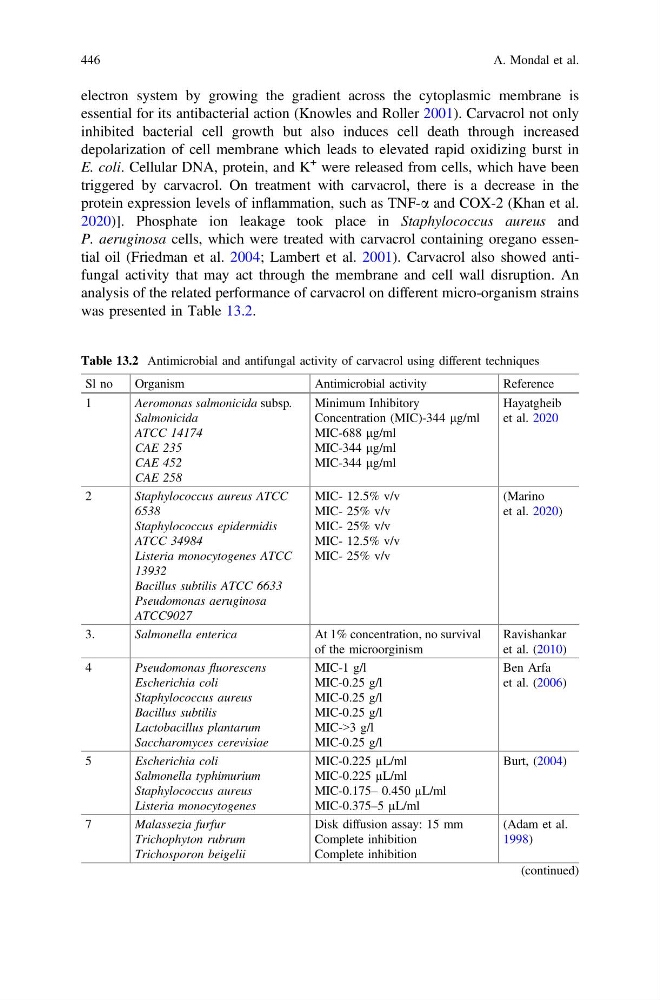
analysis of the related performance of carvacrol on different micro-organism strains
was presented in Table 13.2.
Table 13.2 Antimicrobial and antifungal activity of carvacrol using different techniques
Sl no
Organism
Antimicrobial activity
Reference
1
Aeromonas salmonicida subsp.
Salmonicida
ATCC 14174
CAE 235
CAE 452
CAE 258
Minimum Inhibitory
Concentration (MIC)-344 lg/ml
MIC-688 lg/ml
MIC-344 lg/ml
MIC-344 lg/ml
Hayatgheib
et al. 2020
2
Staphylococcus aureus ATCC
6538
Staphylococcus epidermidis
ATCC 34984
Listeria monocytogenes ATCC
13932
Bacillus subtilis ATCC 6633
Pseudomonas aeruginosa
ATCC9027
MIC- 12.5% v/v
MIC- 25% v/v
MIC- 25% v/v
MIC- 12.5% v/v
MIC- 25% v/v
(Marino
et al. 2020)
3.
Salmonella enterica
At 1% concentration, no survival
of the microorginism
Ravishankar
et al. (2010)
4
Pseudomonas fluorescens
Escherichia coli
Staphylococcus aureus
Bacillus subtilis
Lactobacillus plantarum
Saccharomyces cerevisiae
MIC-1 g/l
MIC-0.25 g/l
MIC-0.25 g/l
MIC-0.25 g/l
MIC-˃3 g/l
MIC-0.25 g/l
Ben Arfa
et al. (2006)
5
Escherichia coli
Salmonella typhimurium
Staphylococcus aureus
Listeria monocytogenes
MIC-0.225 µL/ml
MIC-0.225 µL/ml
MIC-0.175– 0.450 µL/ml
MIC-0.375–5 µL/ml
Burt, (2004)
7
Malassezia furfur
Trichophyton rubrum
Trichosporon beigelii
Disk diffusion assay: 15 mm
Complete inhibition
Complete inhibition
(Adam et al.
1998)
(continued)
446
A. Mondal et al.
essential for its antibacterial action (Knowles and Roller 2001). Carvacrol not only
inhibited bacterial cell growth but also induces cell death through increased
depolarization of cell membrane which leads to elevated rapid oxidizing burst in
E. coli. Cellular DNA, protein, and K
+ were released from cells, which have been
triggered by carvacrol. On treatment with carvacrol, there is a decrease in the
protein expression levels of inflammation, such as TNF-a and COX-2 (Khan et al.
2020)]. Phosphate ion leakage took place in Staphylococcus aureus and
P. aeruginosa cells, which were treated with carvacrol containing oregano essential oil (Friedman et al. 2004; Lambert et al. 2001). Carvacrol also showed antifungal activity that may act through the membrane and cell wall disruption. An
analysis of the related performance of carvacrol on different micro-organism strains
was presented in Table 13.2.
Table 13.2 Antimicrobial and antifungal activity of carvacrol using different techniques
Sl no
Organism
Antimicrobial activity
Reference
1
Aeromonas salmonicida subsp.
Salmonicida
ATCC 14174
CAE 235
CAE 452
CAE 258
Minimum Inhibitory
Concentration (MIC)-344 lg/ml
MIC-688 lg/ml
MIC-344 lg/ml
MIC-344 lg/ml
Hayatgheib
et al. 2020
2
Staphylococcus aureus ATCC
6538
Staphylococcus epidermidis
ATCC 34984
Listeria monocytogenes ATCC
13932
Bacillus subtilis ATCC 6633
Pseudomonas aeruginosa
ATCC9027
MIC- 12.5% v/v
MIC- 25% v/v
MIC- 25% v/v
MIC- 12.5% v/v
MIC- 25% v/v
(Marino
et al. 2020)
3.
Salmonella enterica
At 1% concentration, no survival
of the microorginism
Ravishankar
et al. (2010)
4
Pseudomonas fluorescens
Escherichia coli
Staphylococcus aureus
Bacillus subtilis
Lactobacillus plantarum
Saccharomyces cerevisiae
MIC-1 g/l
MIC-0.25 g/l
MIC-0.25 g/l
MIC-0.25 g/l
MIC-˃3 g/l
MIC-0.25 g/l
Ben Arfa
et al. (2006)
5
Escherichia coli
Salmonella typhimurium
Staphylococcus aureus
Listeria monocytogenes
MIC-0.225 µL/ml
MIC-0.225 µL/ml
MIC-0.175– 0.450 µL/ml
MIC-0.375–5 µL/ml
Burt, (2004)
7
Malassezia furfur
Trichophyton rubrum
Trichosporon beigelii
Disk diffusion assay: 15 mm
Complete inhibition
Complete inhibition
(Adam et al.
1998)
(continued)
446
A. Mondal et al.