

and twirling activities at the same time longitudinal gliding motility was not
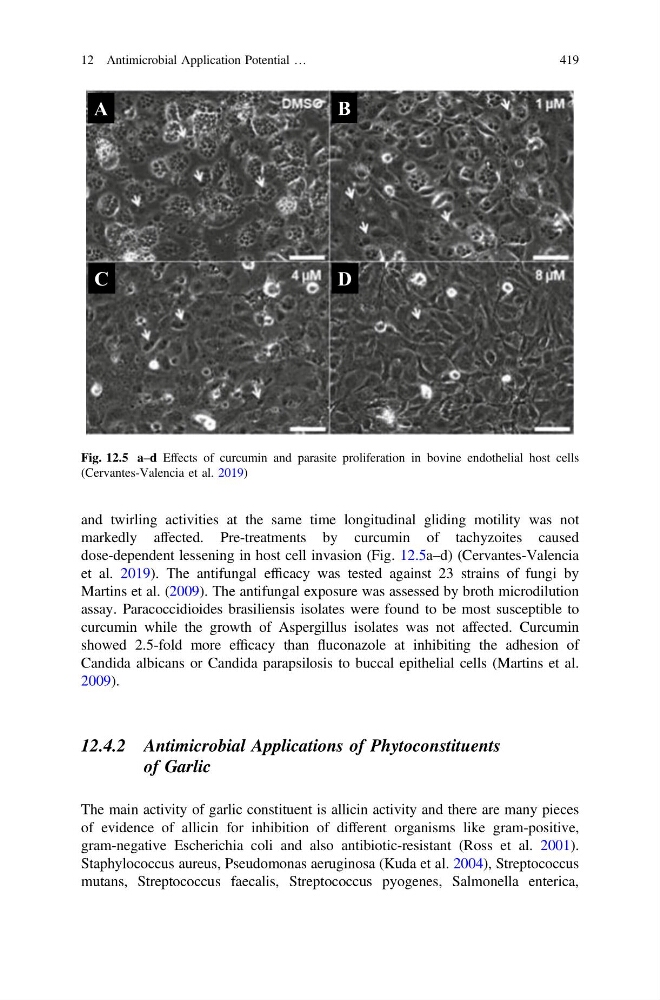
markedly affected. Pre-treatments by curcumin of tachyzoites caused
dose-dependent lessening in host cell invasion (Fig. 12.5a–d) (Cervantes-Valencia
et al. 2019). The antifungal efficacy was tested against 23 strains of fungi by
Martins et al. (2009). The antifungal exposure was assessed by broth microdilution
assay. Paracoccidioides brasiliensis isolates were found to be most susceptible to
curcumin while the growth of Aspergillus isolates was not affected. Curcumin
showed 2.5-fold more efficacy than fluconazole at inhibiting the adhesion of
Candida albicans or Candida parapsilosis to buccal epithelial cells (Martins et al.
2009).
12.4.2 Antimicrobial Applications of Phytoconstituents
of Garlic
The main activity of garlic constituent is allicin activity and there are many pieces
of evidence of allicin for inhibition of different organisms like gram-positive,
gram-negative Escherichia coli and also antibiotic-resistant (Ross et al. 2001).
Staphylococcus aureus, Pseudomonas aeruginosa (Kuda et al. 2004), Streptococcus
mutans, Streptococcus faecalis, Streptococcus pyogenes, Salmonella enterica,
A
B
C
D
Fig. 12.5 a–d Effects of curcumin and parasite proliferation in bovine endothelial host cells
(Cervantes-Valencia et al. 2019)
12 Antimicrobial Application Potential …
419
markedly affected. Pre-treatments by curcumin of tachyzoites caused
dose-dependent lessening in host cell invasion (Fig. 12.5a–d) (Cervantes-Valencia
et al. 2019). The antifungal efficacy was tested against 23 strains of fungi by
Martins et al. (2009). The antifungal exposure was assessed by broth microdilution
assay. Paracoccidioides brasiliensis isolates were found to be most susceptible to
curcumin while the growth of Aspergillus isolates was not affected. Curcumin
showed 2.5-fold more efficacy than fluconazole at inhibiting the adhesion of
Candida albicans or Candida parapsilosis to buccal epithelial cells (Martins et al.
2009).
12.4.2 Antimicrobial Applications of Phytoconstituents
of Garlic
The main activity of garlic constituent is allicin activity and there are many pieces
of evidence of allicin for inhibition of different organisms like gram-positive,
gram-negative Escherichia coli and also antibiotic-resistant (Ross et al. 2001).
Staphylococcus aureus, Pseudomonas aeruginosa (Kuda et al. 2004), Streptococcus
mutans, Streptococcus faecalis, Streptococcus pyogenes, Salmonella enterica,
A
B
C
D
Fig. 12.5 a–d Effects of curcumin and parasite proliferation in bovine endothelial host cells
(Cervantes-Valencia et al. 2019)
12 Antimicrobial Application Potential …
419