

and antifungal activity for Candida albicans (Chavan et al. 2016). The garlic and its
constituents have been described to impede various strains of microbes such
as Aeromonas, Aerobacter, Bacillus, Clostridium, Citrobacter, Citrella, Escherichia,
Enterobacter, Klebsiella, Leuconostoc, Lactobacillus, Micrococcus, Mycobacterium,
Proteus, Providencia, Pseudomonas, Salmonella, Serratia, Shigella, Staphylococcus,
Streptococcus, and Vibrio (Sivam 2001). The constituents of garlic can be blended
with antibiotics to synergize the antimicrobial effect. Consequently, the level of
toxins reduces and prevents their production due to the bactericidal activity of garlic
(Karim et al. 2011). The allicin reacts with the multiple enzymes having thiol
groups such as thioredoxin reductase, alcohol dehydrogenase, and RNA polymerase, which can affect the metabolism of cysteine proteinase engaged in the
virulence of Entamoeba histolytica (Ankri and Mirelman 1999) and in amoeba
parasite, allicin hinder the cysteine proteinases by interacting with thioredoxin
reductases and alcohol dehydrogenases. A study reported that allicin showed
antimicrobial activity owing to the inhibition of RNA synthesis. Though, the protein syntheses and DNA are also inhibited partially, signifying that RNA is the chief
target of allicin. The primary aim of allicin to target RNA then partially inhibits
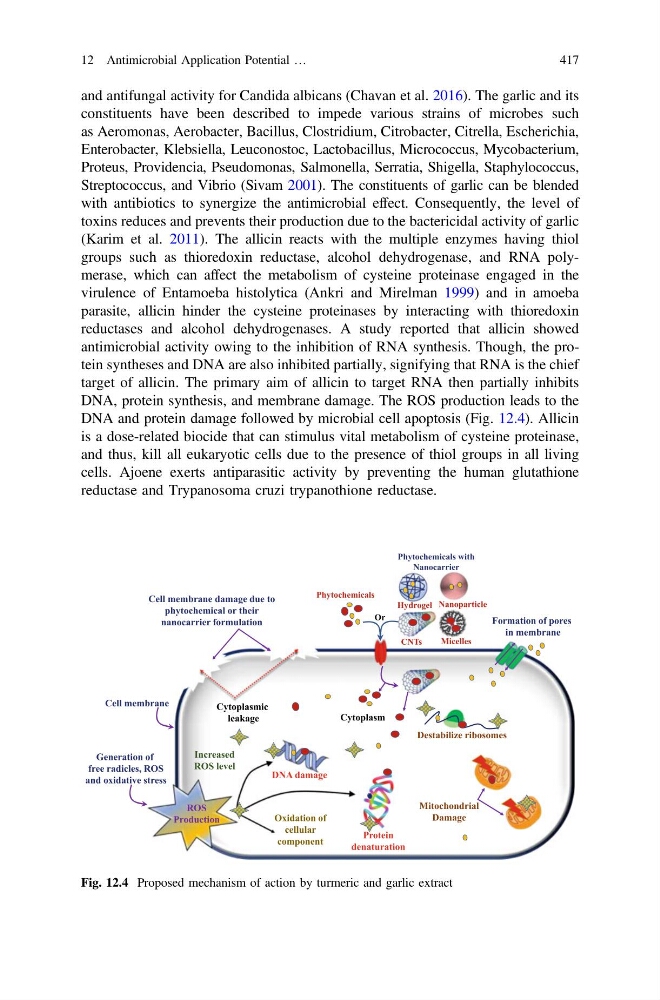
DNA, protein synthesis, and membrane damage. The ROS production leads to the
DNA and protein damage followed by microbial cell apoptosis (Fig. 12.4). Allicin
is a dose-related biocide that can stimulus vital metabolism of cysteine proteinase,
and thus, kill all eukaryotic cells due to the presence of thiol groups in all living
cells. Ajoene exerts antiparasitic activity by preventing the human glutathione
reductase and Trypanosoma cruzi trypanothione reductase.
ROS
Production
Generation of
free radicles, ROS
and oxidative stress
DNA damage
Protein
denaturation
Cell membrane damage due to
phytochemical or their
nanocarrier formulation
Cytoplasm
Cytoplasmic
leakage
Formation of pores
in membrane
Oxidation of
cellular
component
Destabilize ribosomes
Increased
ROS level
Mitochondrial
Damage
Cell membrane
Phytochemicals
Phytochemicals with
Nanocarrier
Or
CNTs
Hydrogel Nanoparticle
Micelles
Fig. 12.4 Proposed mechanism of action by turmeric and garlic extract
12 Antimicrobial Application Potential …
417
constituents have been described to impede various strains of microbes such
as Aeromonas, Aerobacter, Bacillus, Clostridium, Citrobacter, Citrella, Escherichia,
Enterobacter, Klebsiella, Leuconostoc, Lactobacillus, Micrococcus, Mycobacterium,
Proteus, Providencia, Pseudomonas, Salmonella, Serratia, Shigella, Staphylococcus,
Streptococcus, and Vibrio (Sivam 2001). The constituents of garlic can be blended
with antibiotics to synergize the antimicrobial effect. Consequently, the level of
toxins reduces and prevents their production due to the bactericidal activity of garlic
(Karim et al. 2011). The allicin reacts with the multiple enzymes having thiol
groups such as thioredoxin reductase, alcohol dehydrogenase, and RNA polymerase, which can affect the metabolism of cysteine proteinase engaged in the
virulence of Entamoeba histolytica (Ankri and Mirelman 1999) and in amoeba
parasite, allicin hinder the cysteine proteinases by interacting with thioredoxin
reductases and alcohol dehydrogenases. A study reported that allicin showed
antimicrobial activity owing to the inhibition of RNA synthesis. Though, the protein syntheses and DNA are also inhibited partially, signifying that RNA is the chief
target of allicin. The primary aim of allicin to target RNA then partially inhibits
DNA, protein synthesis, and membrane damage. The ROS production leads to the
DNA and protein damage followed by microbial cell apoptosis (Fig. 12.4). Allicin
is a dose-related biocide that can stimulus vital metabolism of cysteine proteinase,
and thus, kill all eukaryotic cells due to the presence of thiol groups in all living
cells. Ajoene exerts antiparasitic activity by preventing the human glutathione
reductase and Trypanosoma cruzi trypanothione reductase.
ROS
Production
Generation of
free radicles, ROS
and oxidative stress
DNA damage
Protein
denaturation
Cell membrane damage due to
phytochemical or their
nanocarrier formulation
Cytoplasm
Cytoplasmic
leakage
Formation of pores
in membrane
Oxidation of
cellular
component
Destabilize ribosomes
Increased
ROS level
Mitochondrial
Damage
Cell membrane
Phytochemicals
Phytochemicals with
Nanocarrier
Or
CNTs
Hydrogel Nanoparticle
Micelles
Fig. 12.4 Proposed mechanism of action by turmeric and garlic extract
12 Antimicrobial Application Potential …
417