

important lignans include Taxus baccata linn., Podophyllum hexandrum,
Schisandra chinensis, Linum usitatissimum, and S. marianum. It is reported that
taxiresinol and lariciresinol are known as flavonoid lignins whereas isolariciresinol
and demethyl-isolariciresinol called as dibenzyl butane lignans, all these lignans
show anti-ulcerogenic activity. Taxiresinol, and demethyl-isolariciresinol exhibit
antifungal property. Podophyllotoxin is reported as an anticancer agent.
Schisandrin A, B, C show hepatoprotective activity. They are also used as
antioxidants, tonifier, anti-fatigue anti-inflammatory agents. Silymarin is useful for
liver protection and shows lipid-lowering activity. Lignan obtained from linseed is
reported to reduce colon and mammary cancer (Cunha et al. 2012).
Various structural nuclei of lignans are given below (Cunha et al. 2012).
The biosynthesis of different phenolic compounds from shikimic acid is shown
in the schematic diagram (Fig. 10.20).
10.5 Terpenes and Terpenoids
Terpenes and terpenoids comprise one of the largest group of secondary plant
metabolites. The term “terpene” is originated from the word “turpentine”, meaning
resin. Terpene represents hydrocarbon (C 5 H 8 ) n and terpenoids comprise hydrocarbon and their oxygenated products (Perveen 2018). They are also known as
volatile oils or ethereal oils. Most of these compounds are employed in the application of the pharmaceutical industry as pharmaceutical dosage forms or flavoring
agents and as perfumes in cosmetic and perfumery industries. Many of these
compounds are used as insect repellants, fungicides, as well as waterproofing
substances. They mediate electron transport processes in respiration and photosynthesis. They are also used for the treatment of various diseases (Perveen 2018;
Lalonde 2005).
Terpenoids are soluble in ether, alcohol, and lipid solvents and basically
insoluble in water. They are generally lighter than water and high refractive index.
They are mostly optically active either dextrorotatory or levorotatory. These
compounds are obtained from the duct, cell, trichomes, and lysigenous or
schizogenous glands. They are generally found in the families of Umbelliferae,
Labiatae, Myrtaceae, Zingiberaceae, Lauraceae, Rutaceae, and Piperaceae (Perveen
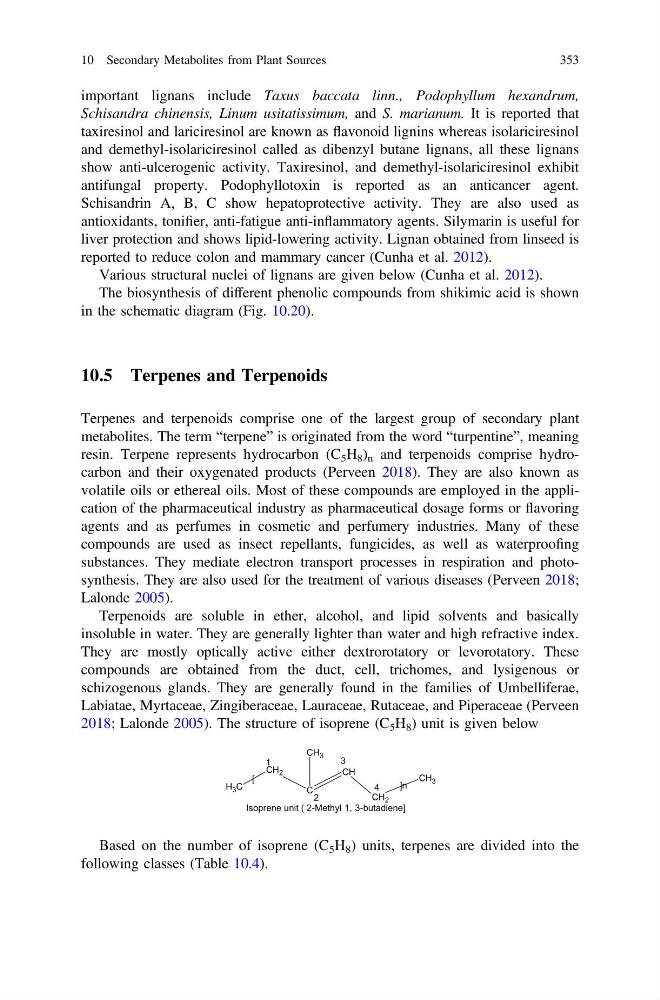
2018; Lalonde 2005). The structure of isoprene (C 5 H 8 ) unit is given below
Based on the number of isoprene (C 5 H 8 ) units, terpenes are divided into the
following classes (Table 10.4).
CH 2
C
CH
CH 3
CH 2
CH 3
C
H 3
[
]n
Isoprene unit ( 2-Methyl 1, 3-butadiene]
1
2
3
4
10 Secondary Metabolites from Plant Sources
353
Schisandra chinensis, Linum usitatissimum, and S. marianum. It is reported that
taxiresinol and lariciresinol are known as flavonoid lignins whereas isolariciresinol
and demethyl-isolariciresinol called as dibenzyl butane lignans, all these lignans
show anti-ulcerogenic activity. Taxiresinol, and demethyl-isolariciresinol exhibit
antifungal property. Podophyllotoxin is reported as an anticancer agent.
Schisandrin A, B, C show hepatoprotective activity. They are also used as
antioxidants, tonifier, anti-fatigue anti-inflammatory agents. Silymarin is useful for
liver protection and shows lipid-lowering activity. Lignan obtained from linseed is
reported to reduce colon and mammary cancer (Cunha et al. 2012).
Various structural nuclei of lignans are given below (Cunha et al. 2012).
The biosynthesis of different phenolic compounds from shikimic acid is shown
in the schematic diagram (Fig. 10.20).
10.5 Terpenes and Terpenoids
Terpenes and terpenoids comprise one of the largest group of secondary plant
metabolites. The term “terpene” is originated from the word “turpentine”, meaning
resin. Terpene represents hydrocarbon (C 5 H 8 ) n and terpenoids comprise hydrocarbon and their oxygenated products (Perveen 2018). They are also known as
volatile oils or ethereal oils. Most of these compounds are employed in the application of the pharmaceutical industry as pharmaceutical dosage forms or flavoring
agents and as perfumes in cosmetic and perfumery industries. Many of these
compounds are used as insect repellants, fungicides, as well as waterproofing
substances. They mediate electron transport processes in respiration and photosynthesis. They are also used for the treatment of various diseases (Perveen 2018;
Lalonde 2005).
Terpenoids are soluble in ether, alcohol, and lipid solvents and basically
insoluble in water. They are generally lighter than water and high refractive index.
They are mostly optically active either dextrorotatory or levorotatory. These
compounds are obtained from the duct, cell, trichomes, and lysigenous or
schizogenous glands. They are generally found in the families of Umbelliferae,
Labiatae, Myrtaceae, Zingiberaceae, Lauraceae, Rutaceae, and Piperaceae (Perveen
2018; Lalonde 2005). The structure of isoprene (C 5 H 8 ) unit is given below
Based on the number of isoprene (C 5 H 8 ) units, terpenes are divided into the
following classes (Table 10.4).
CH 2
C
CH
CH 3
CH 2
CH 3
C
H 3
[
]n
Isoprene unit ( 2-Methyl 1, 3-butadiene]
1
2
3
4
10 Secondary Metabolites from Plant Sources
353