

in arbutin, a glycoside (Fig. 10.12). The well-known glycoside coniferin and many
related substances derived from phenolic cinnamic alcohols are considered as an
ingredient for the biosynthesis of lignin (Evans 2009; Hoffmann 2003).
Simple phenolic substances show various pharmacological activities such as the
urinary tract infection exhibited by arbutin (Zbigniew et al. 2014), as well as
anti-inflammatory action shown by salicylates (Amann and Peskar 2002). It is
popular that all phenols at low concentrations act as antimicrobial. In fact, phenol
was considered as the first antiseptic used in surgical operation (Pelczar et al. 1988).
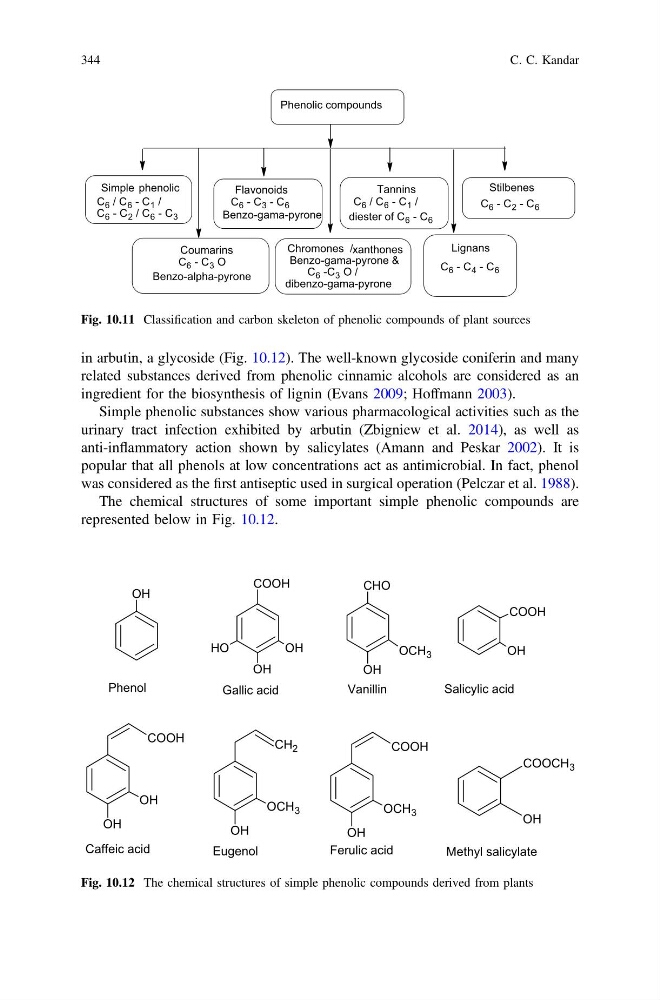
The chemical structures of some important simple phenolic compounds are
represented below in Fig. 10.12.
Simple phenolic
Coumarins
Flavonoids
Tannins
Lignans
Stilbenes
Chromones /xanthones
Phenolic compounds
C 6 / C 6 - C 1 /
C 6 - C 2 / C 6 - C 3
C 6 - C 3 - C 6
Benzo-gama-pyrone
C 6 - C 3 O
Benzo-alpha-pyrone
C 6 / C 6 - C 1 /
diester of C 6 - C 6
Benzo-gama-pyrone &
C 6 -C 3 O /
dibenzo-gama-pyrone
C 6 - C 4 - C 6
C 6 - C 2 - C 6
Fig. 10.11 Classification and carbon skeleton of phenolic compounds of plant sources
OH
OH
OH
O
H
COOH
CHO
OH
OCH 3
COOH
OH
Phenol
Gallic acid
Vanillin
Salicylic acid
OH
OCH 3
COOH
Ferulic acid
OH
OH
COOH
Caffeic acid
OH
OCH 3
CH 2
Eugenol
COOCH 3
OH
Methyl salicylate
Fig. 10.12 The chemical structures of simple phenolic compounds derived from plants
344
C. C. Kandar
related substances derived from phenolic cinnamic alcohols are considered as an
ingredient for the biosynthesis of lignin (Evans 2009; Hoffmann 2003).
Simple phenolic substances show various pharmacological activities such as the
urinary tract infection exhibited by arbutin (Zbigniew et al. 2014), as well as
anti-inflammatory action shown by salicylates (Amann and Peskar 2002). It is
popular that all phenols at low concentrations act as antimicrobial. In fact, phenol
was considered as the first antiseptic used in surgical operation (Pelczar et al. 1988).
The chemical structures of some important simple phenolic compounds are
represented below in Fig. 10.12.
Simple phenolic
Coumarins
Flavonoids
Tannins
Lignans
Stilbenes
Chromones /xanthones
Phenolic compounds
C 6 / C 6 - C 1 /
C 6 - C 2 / C 6 - C 3
C 6 - C 3 - C 6
Benzo-gama-pyrone
C 6 - C 3 O
Benzo-alpha-pyrone
C 6 / C 6 - C 1 /
diester of C 6 - C 6
Benzo-gama-pyrone &
C 6 -C 3 O /
dibenzo-gama-pyrone
C 6 - C 4 - C 6
C 6 - C 2 - C 6
Fig. 10.11 Classification and carbon skeleton of phenolic compounds of plant sources
OH
OH
OH
O
H
COOH
CHO
OH
OCH 3
COOH
OH
Phenol
Gallic acid
Vanillin
Salicylic acid
OH
OCH 3
COOH
Ferulic acid
OH
OH
COOH
Caffeic acid
OH
OCH 3
CH 2
Eugenol
COOCH 3
OH
Methyl salicylate
Fig. 10.12 The chemical structures of simple phenolic compounds derived from plants
344
C. C. Kandar