

M td of S pt : Firstly, plant species (ps) will be collected from any region of the
forest. Then the collected ps will be authenticated by the help of botanist and kept in
a hot air oven and shade dryer for removing the moisture (Xiang et al. 2011). Then
the dry plant material will be cut into small pieces and powdered by the help of a
mixer grinder or ball mill. Then the powder material will be weight and extraction
process will be done by the various solvent system (Tolstikov et al. 2003). Now
extract materials will be diluted with Me OH or EtOH and transferred into a various
conical flask. Then the 24–30 kV electronic Vt g 50 mbar pressure, and 50um fused
silica capillary will be used in extract material for processed the C.e technique
(Sugimoto et al. 2012). At the end of the process, the compound will be detected by
the help of UV detector at 190–600 nm (Ward et al. 2007).
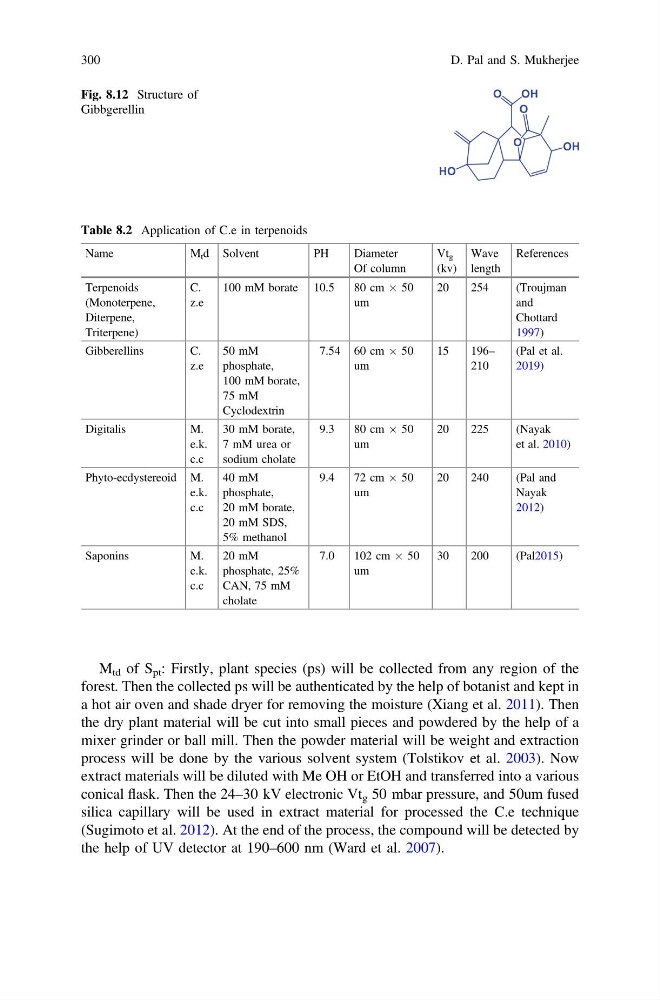
Fig. 8.12 Structure of
Gibbgerellin
Table 8.2 Application of C.e in terpenoids
Name
M t d Solvent
PH
Diameter
Of column
Vt g
(kv)
Wave
length
References
Terpenoids
(Monoterpene,
Diterpene,
Triterpene)
C.
z.e
100 mM borate 10.5
80 cm  50
um
20
254
(Troujman
and
Chottard
1997)
Gibberellins
C.
z.e
50 mM
phosphate,
100 mM borate,
75 mM
Cyclodextrin
7.54 60 cm  50
um
15
196–
210
(Pal et al.
2019)
Digitalis
M.
e.k.
c.c
30 mM borate,
7 mM urea or
sodium cholate
9.3
80 cm  50
um
20
225
(Nayak
et al. 2010)
Phyto-ecdystereoid M.
e.k.
c.c
40 mM
phosphate,
20 mM borate,
20 mM SDS,
5% methanol
9.4
72 cm  50
um
20
240
(Pal and
Nayak
2012)
Saponins
M.
e.k.
c.c
20 mM
phosphate, 25%
CAN, 75 mM
cholate
7.0
102 cm  50
um
30
200
(Pal2015)
300
D. Pal and S. Mukherjee
forest. Then the collected ps will be authenticated by the help of botanist and kept in
a hot air oven and shade dryer for removing the moisture (Xiang et al. 2011). Then
the dry plant material will be cut into small pieces and powdered by the help of a
mixer grinder or ball mill. Then the powder material will be weight and extraction
process will be done by the various solvent system (Tolstikov et al. 2003). Now
extract materials will be diluted with Me OH or EtOH and transferred into a various
conical flask. Then the 24–30 kV electronic Vt g 50 mbar pressure, and 50um fused
silica capillary will be used in extract material for processed the C.e technique
(Sugimoto et al. 2012). At the end of the process, the compound will be detected by
the help of UV detector at 190–600 nm (Ward et al. 2007).
Fig. 8.12 Structure of
Gibbgerellin
Table 8.2 Application of C.e in terpenoids
Name
M t d Solvent
PH
Diameter
Of column
Vt g
(kv)
Wave
length
References
Terpenoids
(Monoterpene,
Diterpene,
Triterpene)
C.
z.e
100 mM borate 10.5
80 cm  50
um
20
254
(Troujman
and
Chottard
1997)
Gibberellins
C.
z.e
50 mM
phosphate,
100 mM borate,
75 mM
Cyclodextrin
7.54 60 cm  50
um
15
196–
210
(Pal et al.
2019)
Digitalis
M.
e.k.
c.c
30 mM borate,
7 mM urea or
sodium cholate
9.3
80 cm  50
um
20
225
(Nayak
et al. 2010)
Phyto-ecdystereoid M.
e.k.
c.c
40 mM
phosphate,
20 mM borate,
20 mM SDS,
5% methanol
9.4
72 cm  50
um
20
240
(Pal and
Nayak
2012)
Saponins
M.
e.k.
c.c
20 mM
phosphate, 25%
CAN, 75 mM
cholate
7.0
102 cm  50
um
30
200
(Pal2015)
300
D. Pal and S. Mukherjee