

8.5.3.2 Di-Tps
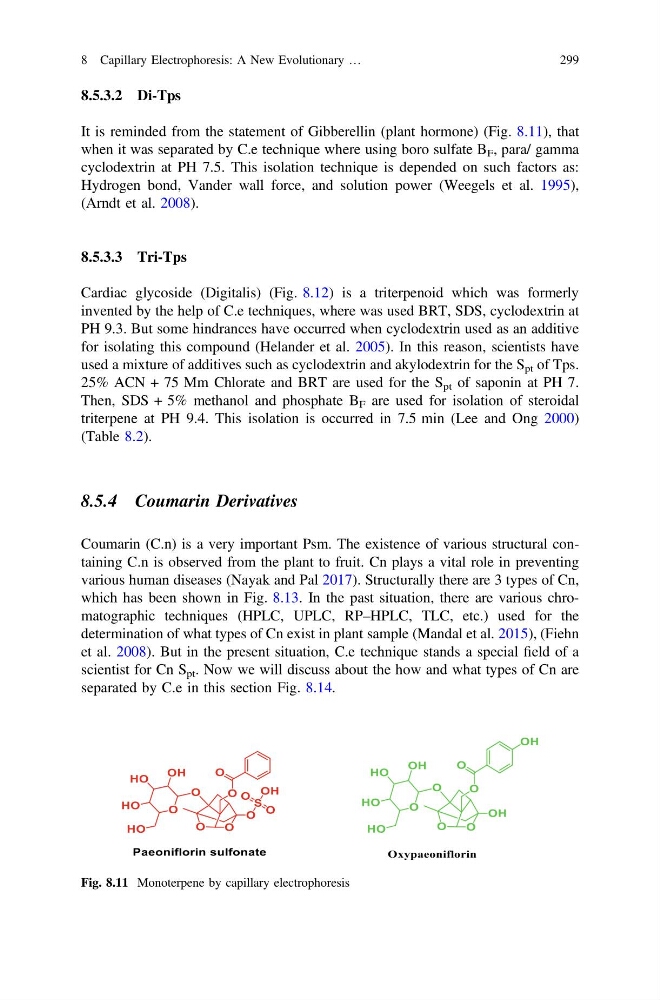
It is reminded from the statement of Gibberellin (plant hormone) (Fig. 8.11), that
when it was separated by C.e technique where using boro sulfate B F , para/ gamma
cyclodextrin at PH 7.5. This isolation technique is depended on such factors as:
Hydrogen bond, Vander wall force, and solution power (Weegels et al. 1995),
(Arndt et al. 2008).
8.5.3.3 Tri-Tps
Cardiac glycoside (Digitalis) (Fig. 8.12) is a triterpenoid which was formerly
invented by the help of C.e techniques, where was used BRT, SDS, cyclodextrin at
PH 9.3. But some hindrances have occurred when cyclodextrin used as an additive
for isolating this compound (Helander et al. 2005). In this reason, scientists have
used a mixture of additives such as cyclodextrin and akylodextrin for the S pt of Tps.
25% ACN + 75 Mm Chlorate and BRT are used for the S pt of saponin at PH 7.
Then, SDS + 5% methanol and phosphate B F are used for isolation of steroidal
triterpene at PH 9.4. This isolation is occurred in 7.5 min (Lee and Ong 2000)
(Table 8.2).
8.5.4 Coumarin Derivatives
Coumarin (C.n) is a very important Psm. The existence of various structural containing C.n is observed from the plant to fruit. Cn plays a vital role in preventing
various human diseases (Nayak and Pal 2017). Structurally there are 3 types of Cn,
which has been shown in Fig. 8.13. In the past situation, there are various chromatographic techniques (HPLC, UPLC, RP–HPLC, TLC, etc.) used for the
determination of what types of Cn exist in plant sample (Mandal et al. 2015), (Fiehn
et al. 2008). But in the present situation, C.e technique stands a special field of a
scientist for Cn S pt . Now we will discuss about the how and what types of Cn are
separated by C.e in this section Fig. 8.14.
Fig. 8.11 Monoterpene by capillary electrophoresis
8 Capillary Electrophoresis: A New Evolutionary …
299
It is reminded from the statement of Gibberellin (plant hormone) (Fig. 8.11), that
when it was separated by C.e technique where using boro sulfate B F , para/ gamma
cyclodextrin at PH 7.5. This isolation technique is depended on such factors as:
Hydrogen bond, Vander wall force, and solution power (Weegels et al. 1995),
(Arndt et al. 2008).
8.5.3.3 Tri-Tps
Cardiac glycoside (Digitalis) (Fig. 8.12) is a triterpenoid which was formerly
invented by the help of C.e techniques, where was used BRT, SDS, cyclodextrin at
PH 9.3. But some hindrances have occurred when cyclodextrin used as an additive
for isolating this compound (Helander et al. 2005). In this reason, scientists have
used a mixture of additives such as cyclodextrin and akylodextrin for the S pt of Tps.
25% ACN + 75 Mm Chlorate and BRT are used for the S pt of saponin at PH 7.
Then, SDS + 5% methanol and phosphate B F are used for isolation of steroidal
triterpene at PH 9.4. This isolation is occurred in 7.5 min (Lee and Ong 2000)
(Table 8.2).
8.5.4 Coumarin Derivatives
Coumarin (C.n) is a very important Psm. The existence of various structural containing C.n is observed from the plant to fruit. Cn plays a vital role in preventing
various human diseases (Nayak and Pal 2017). Structurally there are 3 types of Cn,
which has been shown in Fig. 8.13. In the past situation, there are various chromatographic techniques (HPLC, UPLC, RP–HPLC, TLC, etc.) used for the
determination of what types of Cn exist in plant sample (Mandal et al. 2015), (Fiehn
et al. 2008). But in the present situation, C.e technique stands a special field of a
scientist for Cn S pt . Now we will discuss about the how and what types of Cn are
separated by C.e in this section Fig. 8.14.
Fig. 8.11 Monoterpene by capillary electrophoresis
8 Capillary Electrophoresis: A New Evolutionary …
299