

Lens culinaris, Canavalia ensiformis, Ricinus communis, Viscum album, Phaseolus
vulgaris, and Phytolacca americana challenged mitosis, inhibited protein synthesis,
bind to the lymphocytes, and agglutinate malignant cells. Certain lectins having
interferon-inducing properties were isolated from Viscum album and Urtica dioica
(Peumans et al. 1984). Not only lectins but also proteins capable to induce interferons were isolated and analyzed from Artemisia princeps. N-Glycosidase that
recognizes a conserved stem-loop structure in 23S/25S/28S rRNA and irreversibly
block protein translation is known as Ribosome- inactivating proteins (RIPs). RIPs
have been reported from over 50 plant species including (Cucurbitaceae) (Zhang and
Halaweish 2007), (Euphorbiaceae) (Wu et al. 2015), and (Poaceae) (Loss-Morais
et al. 2013). RIPs extracted from Trichosanthes kirilowii (Trichosanthin) was found
to decrease the retroviral protein and RNA levels in acutely infected T lymphoblast
and monocyte/macrophage (Shaw et al. 2005). Other known RIPs are isolated from
plants such as Cucurbita pepo, Ecballium elaterium, Bryonia cretica, etc. Saponins
derived from the plant Quillaja saponaria of the family (Rosaceae) are potent
immunoadjuvants. Quil A, a purified form of Quillaja extract, is used in many
veterinary vaccines (e.g., rabies, and foot and mouth disease), but its adverse
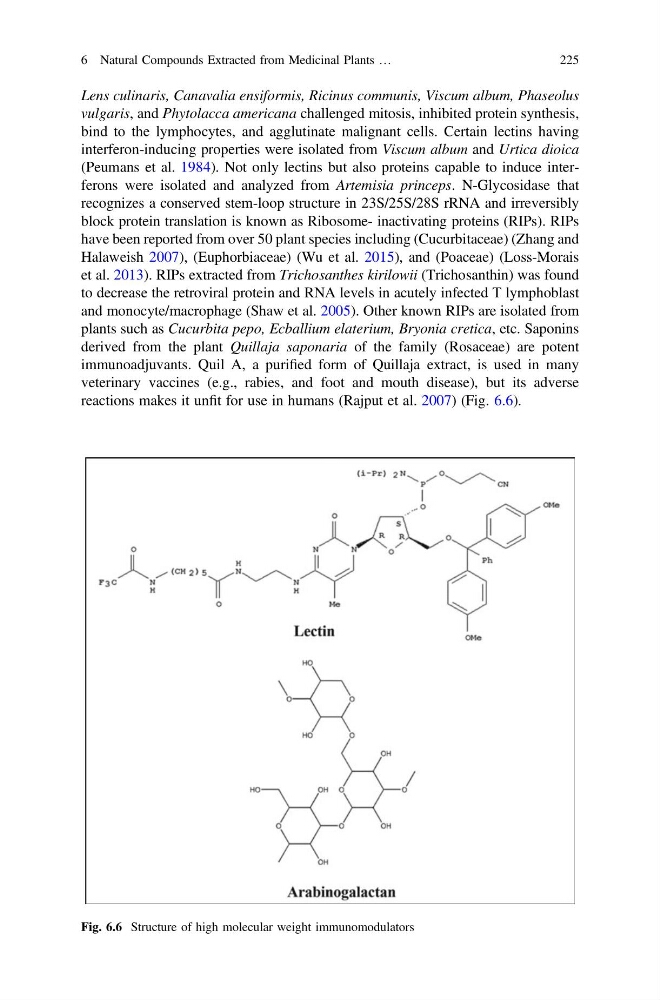
reactions makes it unfit for use in humans (Rajput et al. 2007) (Fig. 6.6).
Fig. 6.6 Structure of high molecular weight immunomodulators
6 Natural Compounds Extracted from Medicinal Plants …
225
vulgaris, and Phytolacca americana challenged mitosis, inhibited protein synthesis,
bind to the lymphocytes, and agglutinate malignant cells. Certain lectins having
interferon-inducing properties were isolated from Viscum album and Urtica dioica
(Peumans et al. 1984). Not only lectins but also proteins capable to induce interferons were isolated and analyzed from Artemisia princeps. N-Glycosidase that
recognizes a conserved stem-loop structure in 23S/25S/28S rRNA and irreversibly
block protein translation is known as Ribosome- inactivating proteins (RIPs). RIPs
have been reported from over 50 plant species including (Cucurbitaceae) (Zhang and
Halaweish 2007), (Euphorbiaceae) (Wu et al. 2015), and (Poaceae) (Loss-Morais
et al. 2013). RIPs extracted from Trichosanthes kirilowii (Trichosanthin) was found
to decrease the retroviral protein and RNA levels in acutely infected T lymphoblast
and monocyte/macrophage (Shaw et al. 2005). Other known RIPs are isolated from
plants such as Cucurbita pepo, Ecballium elaterium, Bryonia cretica, etc. Saponins
derived from the plant Quillaja saponaria of the family (Rosaceae) are potent
immunoadjuvants. Quil A, a purified form of Quillaja extract, is used in many
veterinary vaccines (e.g., rabies, and foot and mouth disease), but its adverse
reactions makes it unfit for use in humans (Rajput et al. 2007) (Fig. 6.6).
Fig. 6.6 Structure of high molecular weight immunomodulators
6 Natural Compounds Extracted from Medicinal Plants …
225