

signaling system to maintain nutrient homeostasis. Low availability of nutrients in
the soil is detected by roots, and in response, chemical signaling and chain reactions
are produced. Plants employ signaling players as phytohormones, reactive oxygen
species (ROS), sugars, and transcription factors to maintain nutrients homeostasis
within the plant (Nath and Tuteja 2016; Isah 2019).
Nutrient deficiency can produce metabolic responses that cause an increased
accumulation of secondary metabolites. Natural bioactive compounds are sought in
bioproduction processes and improvement of nutritional quality of vegetables and
fruits, therefore a nutrient deficiency of specific macro or micronutrients may be an
alternative. However, this stress can cause a decrease in crop yields (Hawkesford
et al. 2012). To produce secondary metabolites of interest without a considerable
loss of growth and biomass, it is necessary to generate eustress in the plant
(El-Nakhel et al. 2019). Currently, nutritional eustress is a strategy used in protected
production systems, where soilless crops allow greater control of nutrient supply
through nutrient solutions.
Nitrogen is a macronutrient constituent of primary metabolites (e.g., protein,
peptides, amino acids, and nucleic acids), phytohormones and secondary metabolites. Plants can uptake nitrogen as nitrate and ammonium (mineral form) (Isah
2019). Research has shown an inverse relationship between low nitrogen availability and the synthesis of phenolic compounds. According to this hypothesis, low
nitrogen availability increases synthesis of metabolites that contain C, H, and O in
their structure. Therefore, terpenes and phenolic compounds synthesis will be
favored. On the contrary, metabolites that contain N in its structure such as,
alkaloids, nonprotein amino acids, and cyanogenic compounds, will decrease its
synthesis (Nath and Tuteja 2016). For example, growing lettuce (Lactuca sativa)
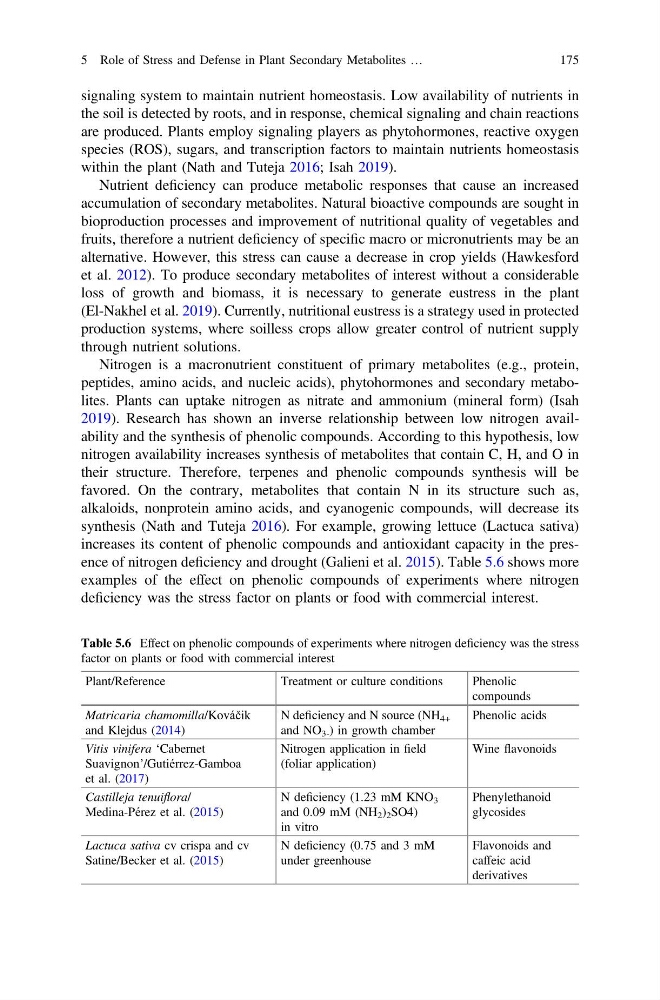
increases its content of phenolic compounds and antioxidant capacity in the presence of nitrogen deficiency and drought (Galieni et al. 2015). Table 5.6 shows more
examples of the effect on phenolic compounds of experiments where nitrogen
deficiency was the stress factor on plants or food with commercial interest.
Table 5.6 Effect on phenolic compounds of experiments where nitrogen deficiency was the stress
factor on plants or food with commercial interest
Plant/Reference
Treatment or culture conditions
Phenolic
compounds
Matricaria chamomilla/Kováčik
and Klejdus (2014)
N deficiency and N source (NH 4+
and NO 3- ) in growth chamber
Phenolic acids
Vitis vinifera ‘Cabernet
Suavignon’/Gutiérrez-Gamboa
et al. (2017)
Nitrogen application in field
(foliar application)
Wine flavonoids
Castilleja tenuiflora/
Medina-Pérez et al. (2015)
N deficiency (1.23 mM KNO 3
and 0.09 mM (NH 2 ) 2 SO4)
in vitro
Phenylethanoid
glycosides
Lactuca sativa cv crispa and cv
Satine/Becker et al. (2015)
N deficiency (0.75 and 3 mM
under greenhouse
Flavonoids and
caffeic acid
derivatives
5 Role of Stress and Defense in Plant Secondary Metabolites …
175
the soil is detected by roots, and in response, chemical signaling and chain reactions
are produced. Plants employ signaling players as phytohormones, reactive oxygen
species (ROS), sugars, and transcription factors to maintain nutrients homeostasis
within the plant (Nath and Tuteja 2016; Isah 2019).
Nutrient deficiency can produce metabolic responses that cause an increased
accumulation of secondary metabolites. Natural bioactive compounds are sought in
bioproduction processes and improvement of nutritional quality of vegetables and
fruits, therefore a nutrient deficiency of specific macro or micronutrients may be an
alternative. However, this stress can cause a decrease in crop yields (Hawkesford
et al. 2012). To produce secondary metabolites of interest without a considerable
loss of growth and biomass, it is necessary to generate eustress in the plant
(El-Nakhel et al. 2019). Currently, nutritional eustress is a strategy used in protected
production systems, where soilless crops allow greater control of nutrient supply
through nutrient solutions.
Nitrogen is a macronutrient constituent of primary metabolites (e.g., protein,
peptides, amino acids, and nucleic acids), phytohormones and secondary metabolites. Plants can uptake nitrogen as nitrate and ammonium (mineral form) (Isah
2019). Research has shown an inverse relationship between low nitrogen availability and the synthesis of phenolic compounds. According to this hypothesis, low
nitrogen availability increases synthesis of metabolites that contain C, H, and O in
their structure. Therefore, terpenes and phenolic compounds synthesis will be
favored. On the contrary, metabolites that contain N in its structure such as,
alkaloids, nonprotein amino acids, and cyanogenic compounds, will decrease its
synthesis (Nath and Tuteja 2016). For example, growing lettuce (Lactuca sativa)
increases its content of phenolic compounds and antioxidant capacity in the presence of nitrogen deficiency and drought (Galieni et al. 2015). Table 5.6 shows more
examples of the effect on phenolic compounds of experiments where nitrogen
deficiency was the stress factor on plants or food with commercial interest.
Table 5.6 Effect on phenolic compounds of experiments where nitrogen deficiency was the stress
factor on plants or food with commercial interest
Plant/Reference
Treatment or culture conditions
Phenolic
compounds
Matricaria chamomilla/Kováčik
and Klejdus (2014)
N deficiency and N source (NH 4+
and NO 3- ) in growth chamber
Phenolic acids
Vitis vinifera ‘Cabernet
Suavignon’/Gutiérrez-Gamboa
et al. (2017)
Nitrogen application in field
(foliar application)
Wine flavonoids
Castilleja tenuiflora/
Medina-Pérez et al. (2015)
N deficiency (1.23 mM KNO 3
and 0.09 mM (NH 2 ) 2 SO4)
in vitro
Phenylethanoid
glycosides
Lactuca sativa cv crispa and cv
Satine/Becker et al. (2015)
N deficiency (0.75 and 3 mM
under greenhouse
Flavonoids and
caffeic acid
derivatives
5 Role of Stress and Defense in Plant Secondary Metabolites …
175