

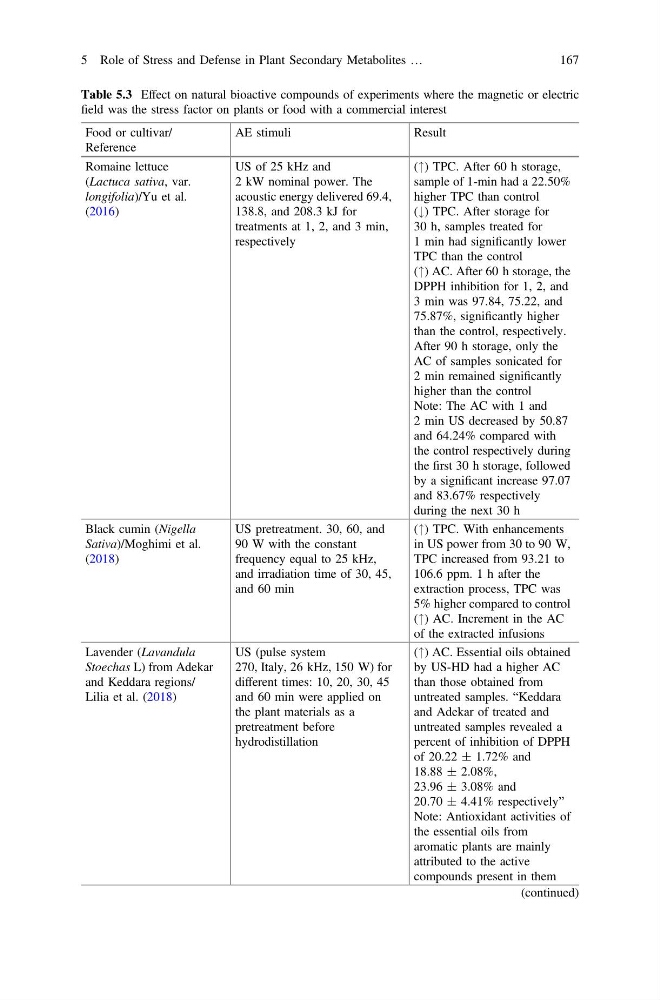
Table 5.3 Effect on natural bioactive compounds of experiments where the magnetic or electric
field was the stress factor on plants or food with a commercial interest
Food or cultivar/
Reference
AE stimuli
Result
Romaine lettuce
(Lactuca sativa, var.
longifolia)/Yu et al.
(2016)
US of 25 kHz and
2 kW nominal power. The
acoustic energy delivered 69.4,
138.8, and 208.3 kJ for
treatments at 1, 2, and 3 min,
respectively
(") TPC. After 60 h storage,
sample of 1-min had a 22.50%
higher TPC than control
(#) TPC. After storage for
30 h, samples treated for
1 min had significantly lower
TPC than the control
(") AC. After 60 h storage, the
DPPH inhibition for 1, 2, and
3 min was 97.84, 75.22, and
75.87%, significantly higher
than the control, respectively.
After 90 h storage, only the
AC of samples sonicated for
2 min remained significantly
higher than the control
Note: The AC with 1 and
2 min US decreased by 50.87
and 64.24% compared with
the control respectively during
the first 30 h storage, followed
by a significant increase 97.07
and 83.67% respectively
during the next 30 h
Black cumin (Nigella
Sativa)/Moghimi et al.
(2018)
US pretreatment. 30, 60, and
90 W with the constant
frequency equal to 25 kHz,
and irradiation time of 30, 45,
and 60 min
(") TPC. With enhancements
in US power from 30 to 90 W,
TPC increased from 93.21 to
106.6 ppm. 1 h after the
extraction process, TPC was
5% higher compared to control
(") AC. Increment in the AC
of the extracted infusions
Lavender (Lavandula
Stoechas L) from Adekar
and Keddara regions/
Lilia et al. (2018)
US (pulse system
270, Italy, 26 kHz, 150 W) for
different times: 10, 20, 30, 45
and 60 min were applied on
the plant materials as a
pretreatment before
hydrodistillation
(") AC. Essential oils obtained
by US-HD had a higher AC
than those obtained from
untreated samples. “Keddara
and Adekar of treated and
untreated samples revealed a
percent of inhibition of DPPH
of 20.22 ± 1.72% and
18.88 ± 2.08%,
23.96 ± 3.08% and
20.70 ± 4.41% respectively”
Note: Antioxidant activities of
the essential oils from
aromatic plants are mainly
attributed to the active
compounds present in them
(continued)
5 Role of Stress and Defense in Plant Secondary Metabolites …
167
field was the stress factor on plants or food with a commercial interest
Food or cultivar/
Reference
AE stimuli
Result
Romaine lettuce
(Lactuca sativa, var.
longifolia)/Yu et al.
(2016)
US of 25 kHz and
2 kW nominal power. The
acoustic energy delivered 69.4,
138.8, and 208.3 kJ for
treatments at 1, 2, and 3 min,
respectively
(") TPC. After 60 h storage,
sample of 1-min had a 22.50%
higher TPC than control
(#) TPC. After storage for
30 h, samples treated for
1 min had significantly lower
TPC than the control
(") AC. After 60 h storage, the
DPPH inhibition for 1, 2, and
3 min was 97.84, 75.22, and
75.87%, significantly higher
than the control, respectively.
After 90 h storage, only the
AC of samples sonicated for
2 min remained significantly
higher than the control
Note: The AC with 1 and
2 min US decreased by 50.87
and 64.24% compared with
the control respectively during
the first 30 h storage, followed
by a significant increase 97.07
and 83.67% respectively
during the next 30 h
Black cumin (Nigella
Sativa)/Moghimi et al.
(2018)
US pretreatment. 30, 60, and
90 W with the constant
frequency equal to 25 kHz,
and irradiation time of 30, 45,
and 60 min
(") TPC. With enhancements
in US power from 30 to 90 W,
TPC increased from 93.21 to
106.6 ppm. 1 h after the
extraction process, TPC was
5% higher compared to control
(") AC. Increment in the AC
of the extracted infusions
Lavender (Lavandula
Stoechas L) from Adekar
and Keddara regions/
Lilia et al. (2018)
US (pulse system
270, Italy, 26 kHz, 150 W) for
different times: 10, 20, 30, 45
and 60 min were applied on
the plant materials as a
pretreatment before
hydrodistillation
(") AC. Essential oils obtained
by US-HD had a higher AC
than those obtained from
untreated samples. “Keddara
and Adekar of treated and
untreated samples revealed a
percent of inhibition of DPPH
of 20.22 ± 1.72% and
18.88 ± 2.08%,
23.96 ± 3.08% and
20.70 ± 4.41% respectively”
Note: Antioxidant activities of
the essential oils from
aromatic plants are mainly
attributed to the active
compounds present in them
(continued)
5 Role of Stress and Defense in Plant Secondary Metabolites …
167