

stress conditions (Radhakrishnan 2019). The effect on secondary metabolites production has been scarcely studied; presenting an opportunity area in this field.
Electrostatic fields (EF) has also been used in the horticultural industry. Most of
the applications of this technology are for germination and seedlings improvement
due to its importance in the supply chain. For example, drought resistance and
removal of free radicals in maize seedlings with electric field intensity 200 kV/m,
pulse width 80 ms and frequency 1 Hz were analyzed by He et al. (2017), where
the growth of root, the ability of self-organization, and the respiration metabolism
of root cells was improved. Another example with potato tubers subjected to pulsed
electric field (PEF) through a treatment voltage across the potatoes of 5 kV and a
discharge capacitance of 450 pF prior to planting had an increase in the yield of 22–
29% (Gachovska et al. 2015). In the same way, winter wheat seeds increased the
germination energy up to 32.41% and weight up to 23.8% under PEF
(Starodubtseva et al. 2018). In the experiment of Yan et al. (2017), PEF through a
high-voltage pulse power supply and arc electrode was studied on cotton seeds
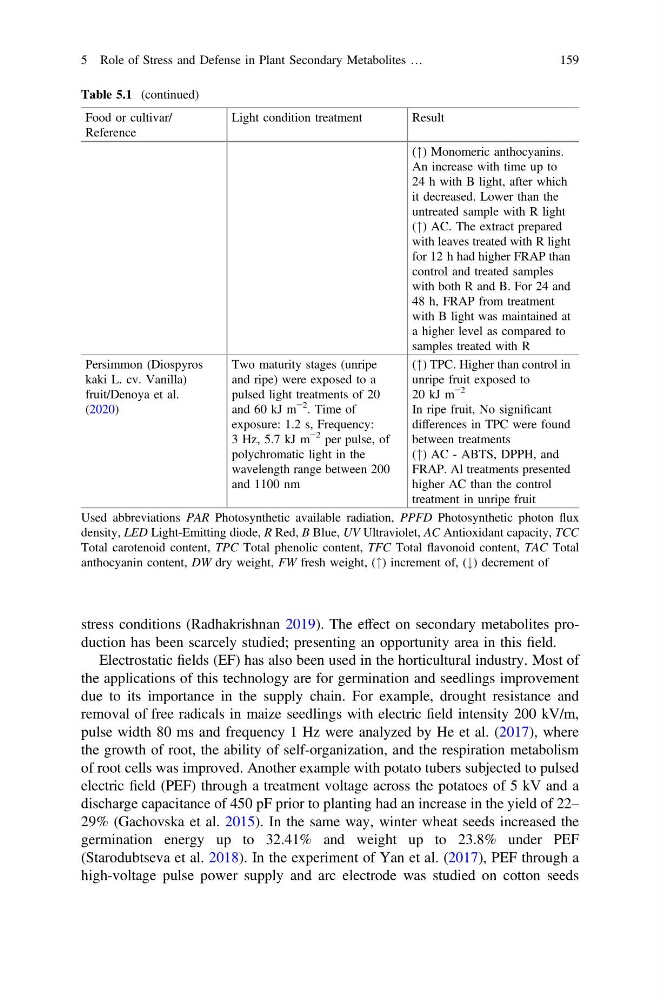
Table 5.1 (continued)
Food or cultivar/
Reference
Light condition treatment
Result
(") Monomeric anthocyanins.
An increase with time up to
24 h with B light, after which
it decreased. Lower than the
untreated sample with R light
(") AC. The extract prepared
with leaves treated with R light
for 12 h had higher FRAP than
control and treated samples
with both R and B. For 24 and
48 h, FRAP from treatment
with B light was maintained at
a higher level as compared to
samples treated with R
Persimmon (Diospyros
kaki L. cv. Vanilla)
fruit/Denoya et al.
(2020)
Two maturity stages (unripe
and ripe) were exposed to a
pulsed light treatments of 20
and 60 kJ m
−2
. Time of
exposure: 1.2 s, Frequency:
3 Hz, 5.7 kJ m
−2 per pulse, of
polychromatic light in the
wavelength range between 200
and 1100 nm
(") TPC. Higher than control in
unripe fruit exposed to
20 kJ m
−2
In ripe fruit, No significant
differences in TPC were found
between treatments
(") AC - ABTS, DPPH, and
FRAP. Al treatments presented
higher AC than the control
treatment in unripe fruit
Used abbreviations PAR Photosynthetic available radiation, PPFD Photosynthetic photon flux
density, LED Light-Emitting diode, R Red, B Blue, UV Ultraviolet, AC Antioxidant capacity, TCC
Total carotenoid content, TPC Total phenolic content, TFC Total flavonoid content, TAC Total
anthocyanin content, DW dry weight, FW fresh weight, (") increment of, (#) decrement of
5 Role of Stress and Defense in Plant Secondary Metabolites …
159
Electrostatic fields (EF) has also been used in the horticultural industry. Most of
the applications of this technology are for germination and seedlings improvement
due to its importance in the supply chain. For example, drought resistance and
removal of free radicals in maize seedlings with electric field intensity 200 kV/m,
pulse width 80 ms and frequency 1 Hz were analyzed by He et al. (2017), where
the growth of root, the ability of self-organization, and the respiration metabolism
of root cells was improved. Another example with potato tubers subjected to pulsed
electric field (PEF) through a treatment voltage across the potatoes of 5 kV and a
discharge capacitance of 450 pF prior to planting had an increase in the yield of 22–
29% (Gachovska et al. 2015). In the same way, winter wheat seeds increased the
germination energy up to 32.41% and weight up to 23.8% under PEF
(Starodubtseva et al. 2018). In the experiment of Yan et al. (2017), PEF through a
high-voltage pulse power supply and arc electrode was studied on cotton seeds
Table 5.1 (continued)
Food or cultivar/
Reference
Light condition treatment
Result
(") Monomeric anthocyanins.
An increase with time up to
24 h with B light, after which
it decreased. Lower than the
untreated sample with R light
(") AC. The extract prepared
with leaves treated with R light
for 12 h had higher FRAP than
control and treated samples
with both R and B. For 24 and
48 h, FRAP from treatment
with B light was maintained at
a higher level as compared to
samples treated with R
Persimmon (Diospyros
kaki L. cv. Vanilla)
fruit/Denoya et al.
(2020)
Two maturity stages (unripe
and ripe) were exposed to a
pulsed light treatments of 20
and 60 kJ m
−2
. Time of
exposure: 1.2 s, Frequency:
3 Hz, 5.7 kJ m
−2 per pulse, of
polychromatic light in the
wavelength range between 200
and 1100 nm
(") TPC. Higher than control in
unripe fruit exposed to
20 kJ m
−2
In ripe fruit, No significant
differences in TPC were found
between treatments
(") AC - ABTS, DPPH, and
FRAP. Al treatments presented
higher AC than the control
treatment in unripe fruit
Used abbreviations PAR Photosynthetic available radiation, PPFD Photosynthetic photon flux
density, LED Light-Emitting diode, R Red, B Blue, UV Ultraviolet, AC Antioxidant capacity, TCC
Total carotenoid content, TPC Total phenolic content, TFC Total flavonoid content, TAC Total
anthocyanin content, DW dry weight, FW fresh weight, (") increment of, (#) decrement of
5 Role of Stress and Defense in Plant Secondary Metabolites …
159