

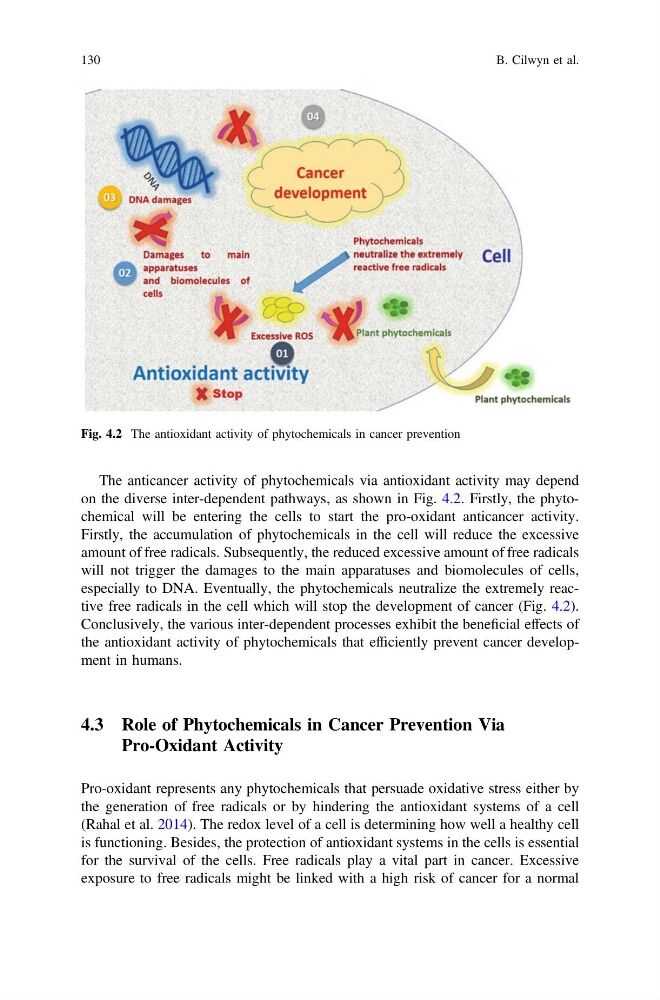
The anticancer activity of phytochemicals via antioxidant activity may depend
on the diverse inter-dependent pathways, as shown in Fig. 4.2. Firstly, the phytochemical will be entering the cells to start the pro-oxidant anticancer activity.
Firstly, the accumulation of phytochemicals in the cell will reduce the excessive
amount of free radicals. Subsequently, the reduced excessive amount of free radicals
will not trigger the damages to the main apparatuses and biomolecules of cells,
especially to DNA. Eventually, the phytochemicals neutralize the extremely reactive free radicals in the cell which will stop the development of cancer (Fig. 4.2).
Conclusively, the various inter-dependent processes exhibit the beneficial effects of
the antioxidant activity of phytochemicals that efficiently prevent cancer development in humans.
4.3 Role of Phytochemicals in Cancer Prevention Via
Pro-Oxidant Activity
Pro-oxidant represents any phytochemicals that persuade oxidative stress either by
the generation of free radicals or by hindering the antioxidant systems of a cell
(Rahal et al. 2014). The redox level of a cell is determining how well a healthy cell
is functioning. Besides, the protection of antioxidant systems in the cells is essential
for the survival of the cells. Free radicals play a vital part in cancer. Excessive
exposure to free radicals might be linked with a high risk of cancer for a normal
Fig. 4.2 The antioxidant activity of phytochemicals in cancer prevention
130
B. Cilwyn et al.
on the diverse inter-dependent pathways, as shown in Fig. 4.2. Firstly, the phytochemical will be entering the cells to start the pro-oxidant anticancer activity.
Firstly, the accumulation of phytochemicals in the cell will reduce the excessive
amount of free radicals. Subsequently, the reduced excessive amount of free radicals
will not trigger the damages to the main apparatuses and biomolecules of cells,
especially to DNA. Eventually, the phytochemicals neutralize the extremely reactive free radicals in the cell which will stop the development of cancer (Fig. 4.2).
Conclusively, the various inter-dependent processes exhibit the beneficial effects of
the antioxidant activity of phytochemicals that efficiently prevent cancer development in humans.
4.3 Role of Phytochemicals in Cancer Prevention Via
Pro-Oxidant Activity
Pro-oxidant represents any phytochemicals that persuade oxidative stress either by
the generation of free radicals or by hindering the antioxidant systems of a cell
(Rahal et al. 2014). The redox level of a cell is determining how well a healthy cell
is functioning. Besides, the protection of antioxidant systems in the cells is essential
for the survival of the cells. Free radicals play a vital part in cancer. Excessive
exposure to free radicals might be linked with a high risk of cancer for a normal
Fig. 4.2 The antioxidant activity of phytochemicals in cancer prevention
130
B. Cilwyn et al.