

Recent Operational Improvements of Hematite Plant …
871
Photograph 5 Sample condition
One vessel was renewed in August 2012 and another one was renewed in August
2015. As a result, the opportunity loss of zinc leach residue treatment by repairing
the leaching autoclaves was eliminated.
Improvement of Cake-Washing Operation
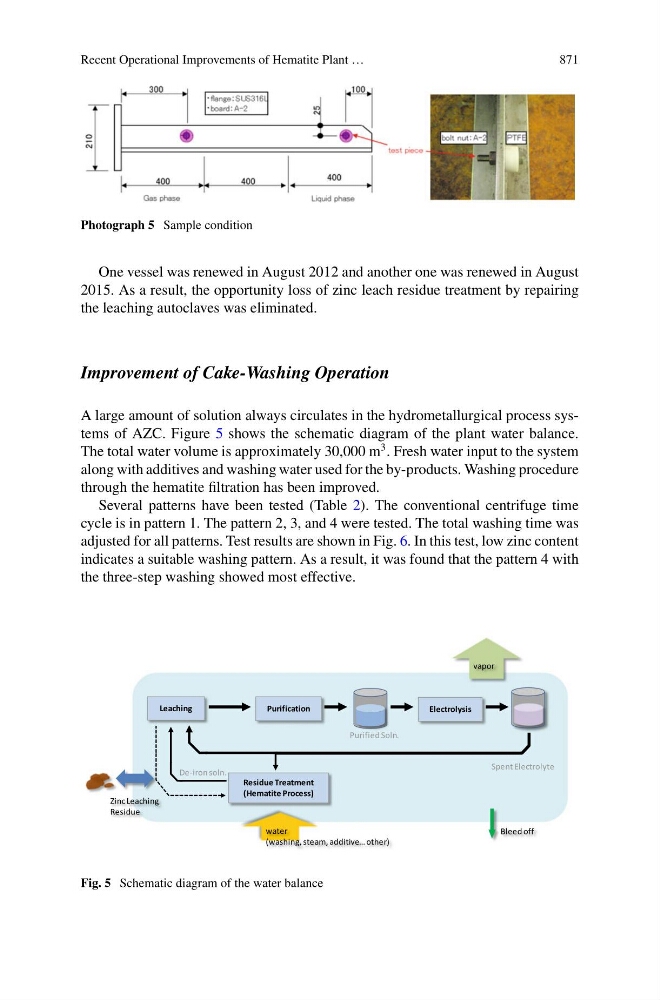
A large amount of solution always circulates in the hydrometallurgical process systems of AZC. Figure 5 shows the schematic diagram of the plant water balance.
The total water volume is approximately 30,000 m
3 . Fresh water input to the system
along with additives and washing water used for the by-products. Washing procedure
through the hematite filtration has been improved.
Several patterns have been tested (Table 2). The conventional centrifuge time
cycle is in pattern 1. The pattern 2, 3, and 4 were tested. The total washing time was
adjusted for all patterns. Test results are shown in Fig. 6. In this test, low zinc content
indicates a suitable washing pattern. As a result, it was found that the pattern 4 with
the three-step washing showed most effective.
Leaching
Purification
Electrolysis
Residue Treatment
(Hematite Process)
vapor
Zinc Leaching
Residue
De-iron soln.
Spent Electrolyte
Purified Soln.
water
(washing, steam, additive… other)
Bleed off
Fig. 5 Schematic diagram of the water balance