

818
T. Kerry et al.
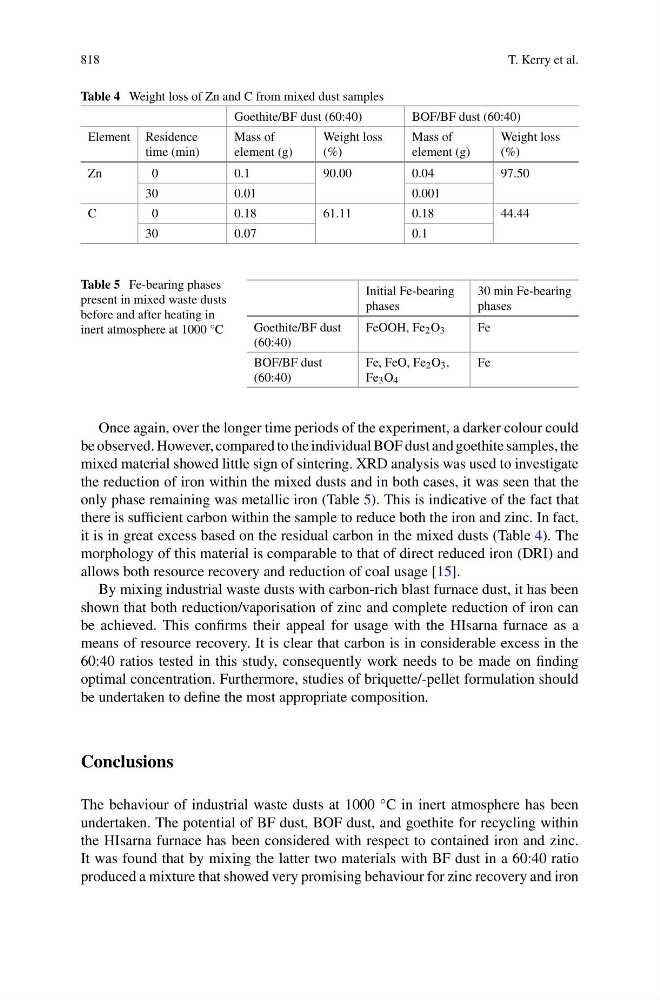
Table 4 Weight loss of Zn and C from mixed dust samples
Goethite/BF dust (60:40)
BOF/BF dust (60:40)
Element Residence
time (min)
Mass of
element (g)
Weight loss
(%)
Mass of
element (g)
Weight loss
(%)
Zn
0
0.1
90.00
0.04
97.50
30
0.01
0.001
C
0
0.18
61.11
0.18
44.44
30
0.07
0.1
Table 5 Fe-bearing phases
present in mixed waste dusts
before and after heating in
inert atmosphere at 1000 °C
Initial Fe-bearing
phases
30 min Fe-bearing
phases
Goethite/BF dust
(60:40)
FeOOH, Fe 2 O 3
Fe
BOF/BF dust
(60:40)
Fe, FeO, Fe 2 O 3 ,
Fe 3 O 4
Fe
Once again, over the longer time periods of the experiment, a darker colour could
be observed. However, compared to the individual BOF dust and goethite samples, the
mixed material showed little sign of sintering. XRD analysis was used to investigate
the reduction of iron within the mixed dusts and in both cases, it was seen that the
only phase remaining was metallic iron (Table 5). This is indicative of the fact that
there is sufficient carbon within the sample to reduce both the iron and zinc. In fact,
it is in great excess based on the residual carbon in the mixed dusts (Table 4). The
morphology of this material is comparable to that of direct reduced iron (DRI) and
allows both resource recovery and reduction of coal usage [15].
By mixing industrial waste dusts with carbon-rich blast furnace dust, it has been
shown that both reduction/vaporisation of zinc and complete reduction of iron can
be achieved. This confirms their appeal for usage with the HIsarna furnace as a
means of resource recovery. It is clear that carbon is in considerable excess in the
60:40 ratios tested in this study, consequently work needs to be made on finding
optimal concentration. Furthermore, studies of briquette/-pellet formulation should
be undertaken to define the most appropriate composition.
Conclusions
The behaviour of industrial waste dusts at 1000 °C in inert atmosphere has been
undertaken. The potential of BF dust, BOF dust, and goethite for recycling within
the HIsarna furnace has been considered with respect to contained iron and zinc.
It was found that by mixing the latter two materials with BF dust in a 60:40 ratio
produced a mixture that showed very promising behaviour for zinc recovery and iron