

Technologies for Treatment of Zinc-Containing …
807
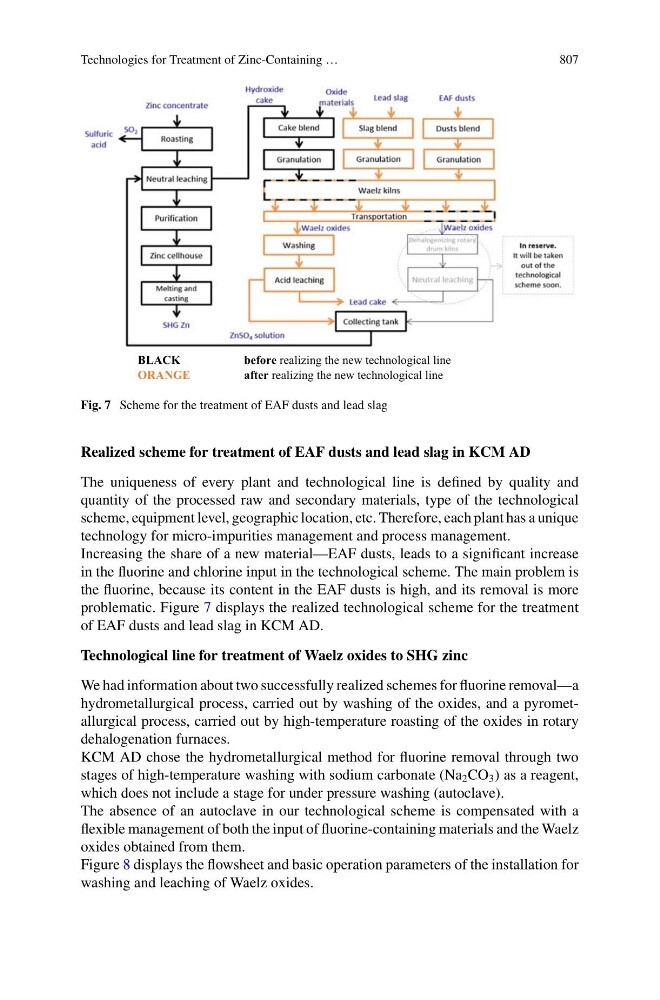
BLACK
before realizing the new technological line
ORANGE
after realizing the new technological line
Fig. 7 Scheme for the treatment of EAF dusts and lead slag
Realized scheme for treatment of EAF dusts and lead slag in KCM AD
The uniqueness of every plant and technological line is defined by quality and
quantity of the processed raw and secondary materials, type of the technological
scheme, equipment level, geographic location, etc. Therefore, each plant has a unique
technology for micro-impurities management and process management.
Increasing the share of a new material—EAF dusts, leads to a significant increase
in the fluorine and chlorine input in the technological scheme. The main problem is
the fluorine, because its content in the EAF dusts is high, and its removal is more
problematic. Figure 7 displays the realized technological scheme for the treatment
of EAF dusts and lead slag in KCM AD.
Technological line for treatment of Waelz oxides to SHG zinc
We had information about two successfully realized schemes for fluorine removal—a
hydrometallurgical process, carried out by washing of the oxides, and a pyrometallurgical process, carried out by high-temperature roasting of the oxides in rotary
dehalogenation furnaces.
KCM AD chose the hydrometallurgical method for fluorine removal through two
stages of high-temperature washing with sodium carbonate (Na 2 CO 3 ) as a reagent,
which does not include a stage for under pressure washing (autoclave).
The absence of an autoclave in our technological scheme is compensated with a
flexible management of both the input of fluorine-containing materials and the Waelz
oxides obtained from them.
Figure 8 displays the flowsheet and basic operation parameters of the installation for
washing and leaching of Waelz oxides.