

The EZINEX ® Process for Secondary Zinc Bearing Materials
793
1.1
1.2
1.3
1.4
10
100
1000
10000
Anodic potential (VSCE)
Anodic current density (A/m2)
Anodic polarisation curves
Cl- 200 g/l - Temperature = 53 °C - pH = 6.20
Na = 127 gIl
Na = 77 gIl
NH4 + = 40 g/l
Na = 102 gIl
NH 4 +
= 20 g/l
Na = 52 gIl
NH 4 +
= 60 g/l
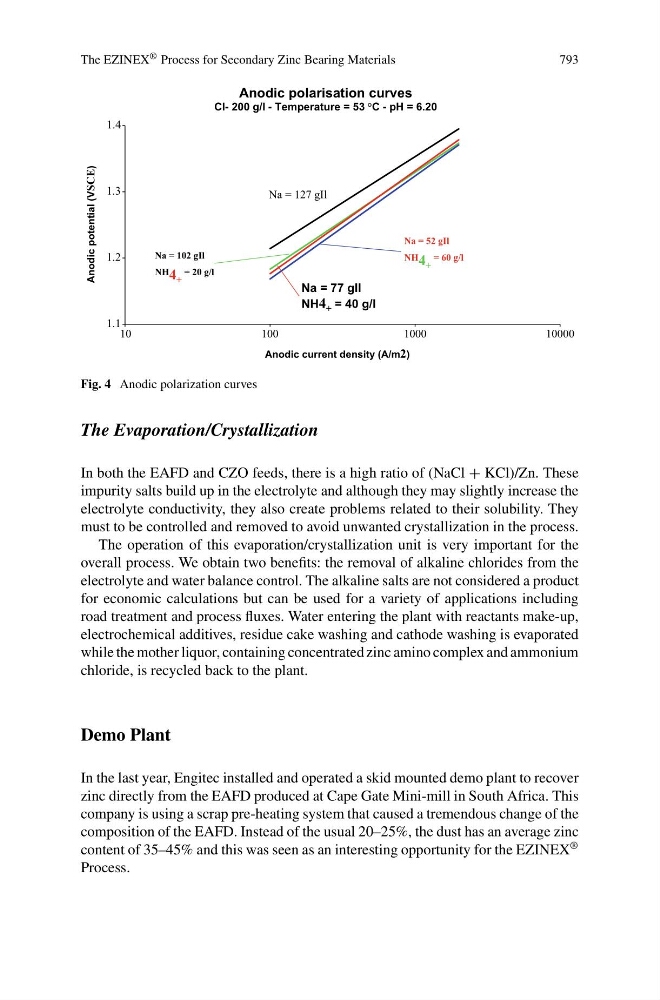
Fig. 4 Anodic polarization curves
The Evaporation/Crystallization
In both the EAFD and CZO feeds, there is a high ratio of (NaCl + KCl)/Zn. These
impurity salts build up in the electrolyte and although they may slightly increase the
electrolyte conductivity, they also create problems related to their solubility. They
must to be controlled and removed to avoid unwanted crystallization in the process.
The operation of this evaporation/crystallization unit is very important for the
overall process. We obtain two benefits: the removal of alkaline chlorides from the
electrolyte and water balance control. The alkaline salts are not considered a product
for economic calculations but can be used for a variety of applications including
road treatment and process fluxes. Water entering the plant with reactants make-up,
electrochemical additives, residue cake washing and cathode washing is evaporated
while the mother liquor, containing concentrated zinc amino complex and ammonium
chloride, is recycled back to the plant.
Demo Plant
In the last year, Engitec installed and operated a skid mounted demo plant to recover
zinc directly from the EAFD produced at Cape Gate Mini-mill in South Africa. This
company is using a scrap pre-heating system that caused a tremendous change of the
composition of the EAFD. Instead of the usual 20–25%, the dust has an average zinc
content of 35–45% and this was seen as an interesting opportunity for the EZINEX
®
Process.