

778
T. Ellis et al.
the aid of real-time X-ray imaging, technology has gone into commercial production
following tests that show it doubles the cycling life of lead batteries.
Pb batteries offer a unique cross section of performance, cost, and sustainability.
These advantages are accessed because of the very materials that make up lead batteries, mainly lead, plastic, and electrolyte. However, performance enhancement in
lead batteries must keep pace with the added requirements demanded by an increasingly energy storage dependent world. RSRT’s view of this issue is the best way to
change how lead batteries perform is to start from the very beginning: lead.
Experimental Program for Batteries
The role of common elements found in lead alloys on the growth and crystal habit of
the many species (PbSO 4 and PbO 2 for instance) in Pb batteries is not understood.
Each element has an effect, and we are studying how each can benefit or limit the
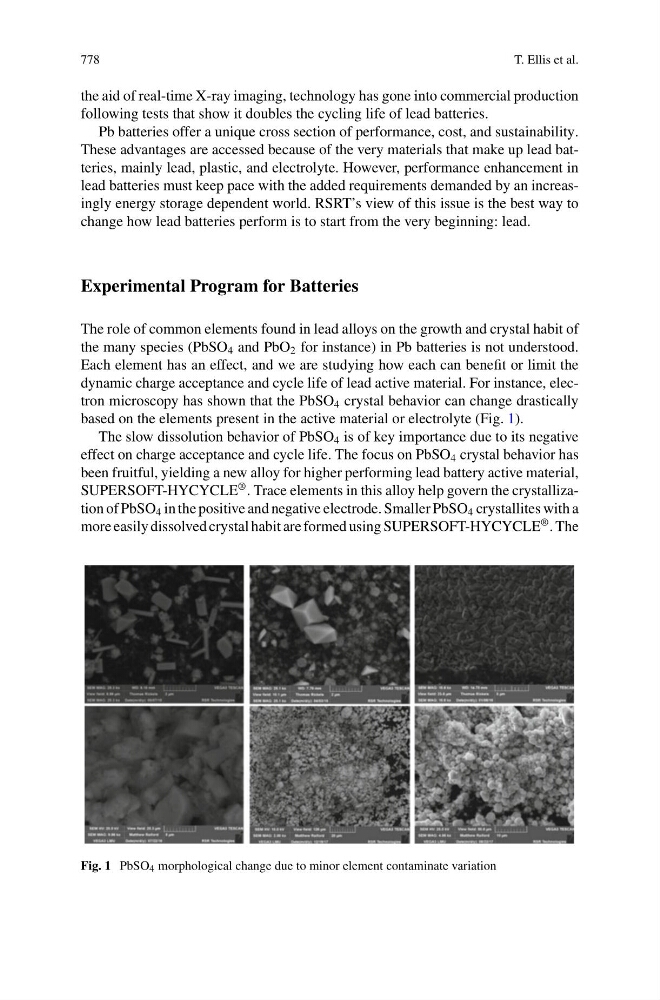
dynamic charge acceptance and cycle life of lead active material. For instance, electron microscopy has shown that the PbSO 4 crystal behavior can change drastically
based on the elements present in the active material or electrolyte (Fig. 1).
The slow dissolution behavior of PbSO 4 is of key importance due to its negative
effect on charge acceptance and cycle life. The focus on PbSO 4 crystal behavior has
been fruitful, yielding a new alloy for higher performing lead battery active material,
SUPERSOFT-HYCYCLE
® . Trace elements in this alloy help govern the crystallization of PbSO 4 in the positive and negative electrode. Smaller PbSO 4 crystallites with a
more easily dissolved crystal habit are formed using SUPERSOFT-HYCYCLE
® . The
Fig. 1 PbSO 4 morphological change due to minor element contaminate variation