

768
A. Fraser and J.-M. Deschênes
suitable for long-term, durable readability. In this paper, we are presenting the results
of a laser marking solution that is suitable to mark either lead or zinc ingots. The
marking time to produce the identifier is optimized for both lead and zinc, and the
depth of focus is precisely measured. The details of the implementation of a laser
marking system into an in-line machine are also explained.
Laser Marking Process
Laser marking of metals like lead and zinc allows generating a high contrast identifier
and black marking on white background. We used the experimental setup shown in
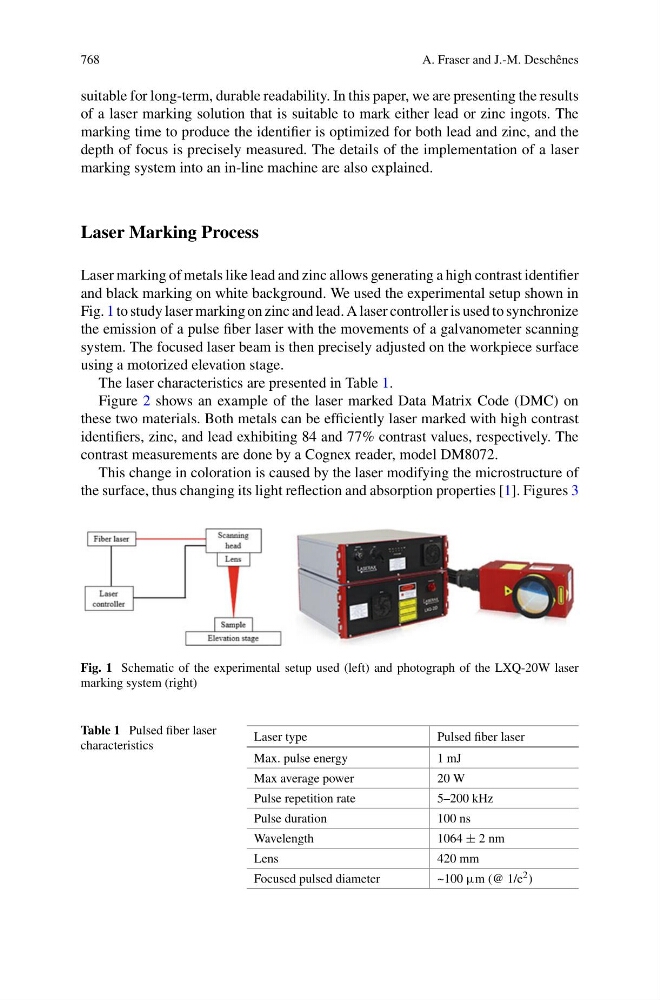
Fig. 1 to study laser marking on zinc and lead. A laser controller is used to synchronize
the emission of a pulse fiber laser with the movements of a galvanometer scanning
system. The focused laser beam is then precisely adjusted on the workpiece surface
using a motorized elevation stage.
The laser characteristics are presented in Table 1.
Figure 2 shows an example of the laser marked Data Matrix Code (DMC) on
these two materials. Both metals can be efficiently laser marked with high contrast
identifiers, zinc, and lead exhibiting 84 and 77% contrast values, respectively. The
contrast measurements are done by a Cognex reader, model DM8072.
This change in coloration is caused by the laser modifying the microstructure of
the surface, thus changing its light reflection and absorption properties [1]. Figures 3
Fig. 1 Schematic of the experimental setup used (left) and photograph of the LXQ-20W laser
marking system (right)
Table 1 Pulsed fiber laser
characteristics
Laser type
Pulsed fiber laser
Max. pulse energy
1 mJ
Max average power
20 W
Pulse repetition rate
5–200 kHz
Pulse duration
100 ns
Wavelength
1064 ± 2 nm
Lens
420 mm
Focused pulsed diameter
~100 µm (@ 1/e 2 )