

Tin Treatment in Kosaka Lead Smelting
765
Table 4 Operating
conditions of tin
electrowinning
Current density
100 A/m 2
Current efficiency
80–90%
Electrolyte temperature
60–80 °C
Electrolyte composition Sn
30–50 g/L
Next, antimony is excluded by feeding Na 2 S. The main mechanism seems to be
also substitution, but in antimony case, sulfur addition is necessary to accelerate the
reaction. Remaining lead also consumes sulfur, so Na 2 S addition is conducted after
lead is removed. Precipitated impurities are separated by filtration.
Electrowinning and Casting
After filtration, the electrolyte is sent to electrowinning cells. Table 4 shows operating
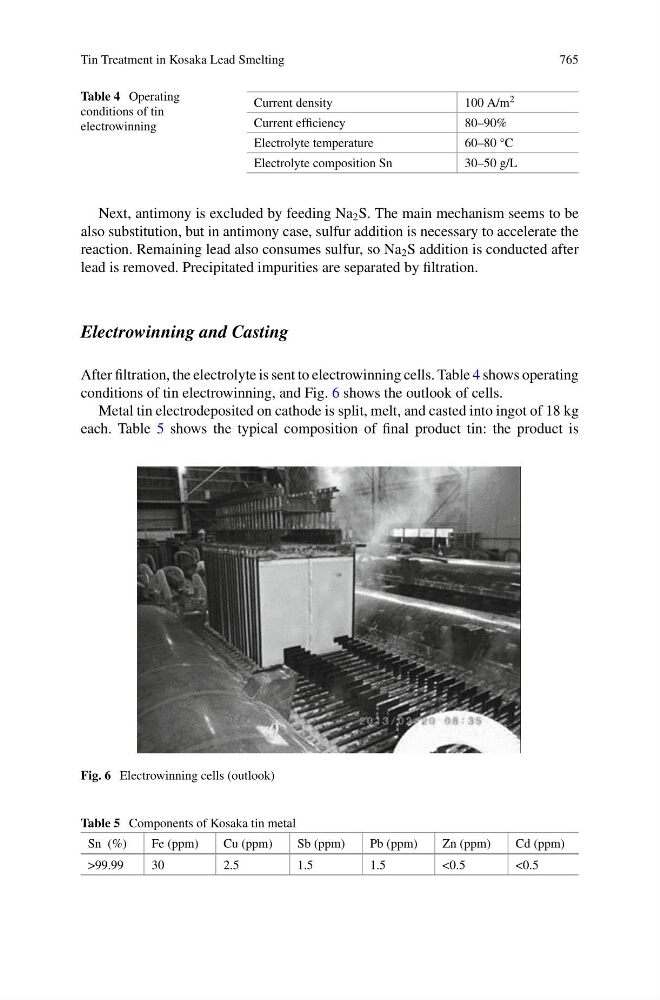
conditions of tin electrowinning, and Fig. 6 shows the outlook of cells.
Metal tin electrodeposited on cathode is split, melt, and casted into ingot of 18 kg
each. Table 5 shows the typical composition of final product tin: the product is
Fig. 6 Electrowinning cells (outlook)
Table 5 Components of Kosaka tin metal
Sn (%)
Fe (ppm)
Cu (ppm)
Sb (ppm)
Pb (ppm)
Zn (ppm)
Cd (ppm)
>99.99
30
2.5
1.5
1.5
<0.5
<0.5