

Processing of Polymetallic Materials Requires Flexible and …
751
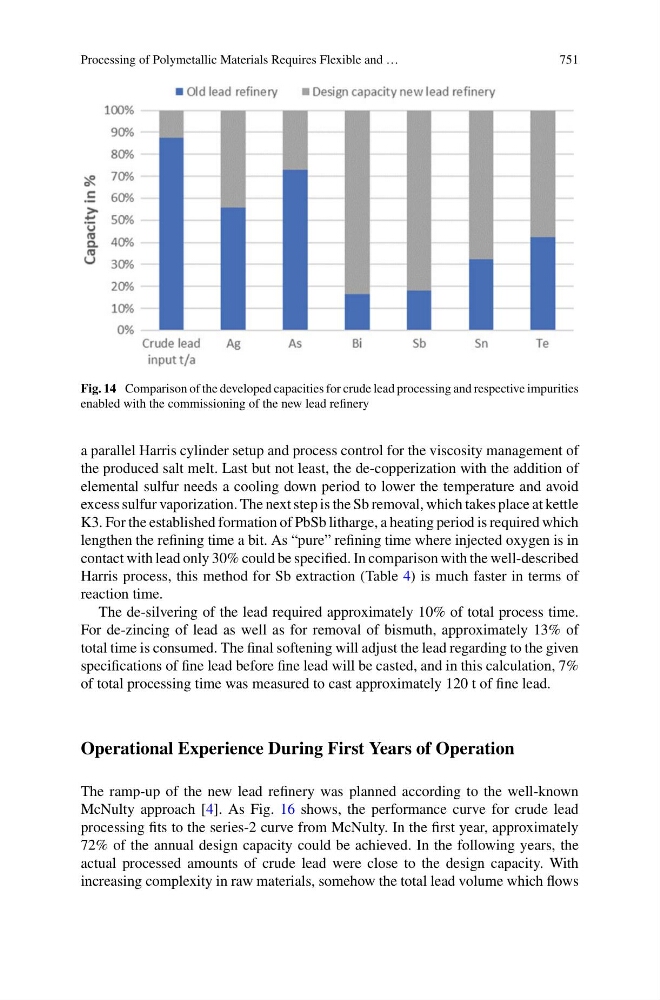
Fig. 14 Comparison of the developed capacities for crude lead processing and respective impurities
enabled with the commissioning of the new lead refinery
a parallel Harris cylinder setup and process control for the viscosity management of
the produced salt melt. Last but not least, the de-copperization with the addition of
elemental sulfur needs a cooling down period to lower the temperature and avoid
excess sulfur vaporization. The next step is the Sb removal, which takes place at kettle
K3. For the established formation of PbSb litharge, a heating period is required which
lengthen the refining time a bit. As “pure” refining time where injected oxygen is in
contact with lead only 30% could be specified. In comparison with the well-described
Harris process, this method for Sb extraction (Table 4) is much faster in terms of
reaction time.
The de-silvering of the lead required approximately 10% of total process time.
For de-zincing of lead as well as for removal of bismuth, approximately 13% of
total time is consumed. The final softening will adjust the lead regarding to the given
specifications of fine lead before fine lead will be casted, and in this calculation, 7%
of total processing time was measured to cast approximately 120 t of fine lead.
Operational Experience During First Years of Operation
The ramp-up of the new lead refinery was planned according to the well-known
McNulty approach [4]. As Fig. 16 shows, the performance curve for crude lead
processing fits to the series-2 curve from McNulty. In the first year, approximately
72% of the annual design capacity could be achieved. In the following years, the
actual processed amounts of crude lead were close to the design capacity. With
increasing complexity in raw materials, somehow the total lead volume which flows