

750
C. Zschiesche and I. Bauer
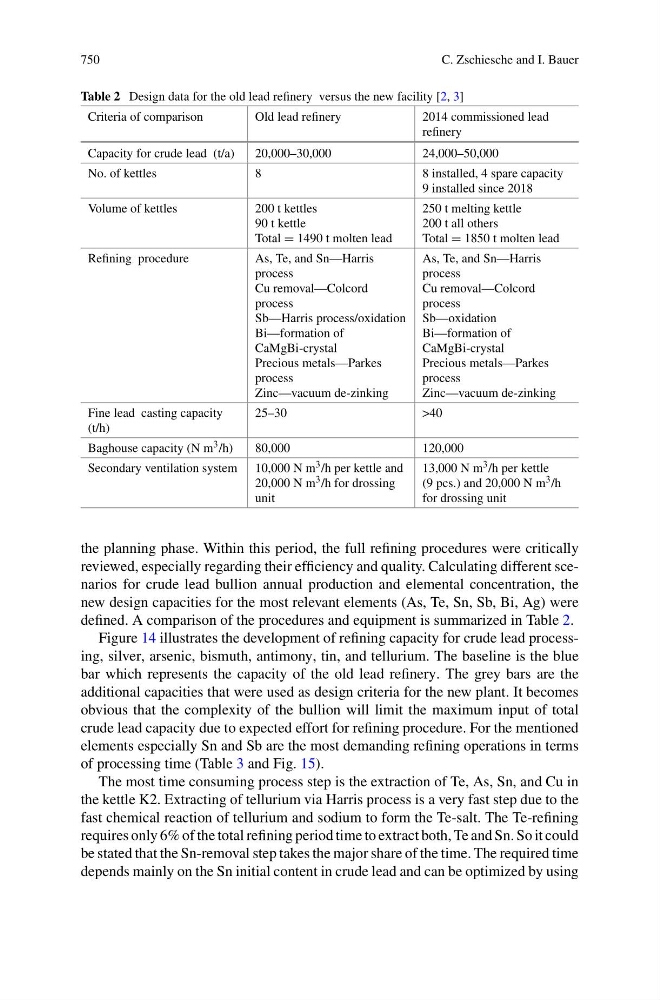
Table 2 Design data for the old lead refinery versus the new facility [2, 3]
Criteria of comparison
Old lead refinery
2014 commissioned lead
refinery
Capacity for crude lead (t/a)
20,000–30,000
24,000–50,000
No. of kettles
8
8 installed, 4 spare capacity
9 installed since 2018
Volume of kettles
200 t kettles
90 t kettle
Total = 1490 t molten lead
250 t melting kettle
200 t all others
Total = 1850 t molten lead
Refining procedure
As, Te, and Sn—Harris
process
Cu removal—Colcord
process
Sb—Harris process/oxidation
Bi—formation of
CaMgBi-crystal
Precious metals—Parkes
process
Zinc—vacuum de-zinking
As, Te, and Sn—Harris
process
Cu removal—Colcord
process
Sb—oxidation
Bi—formation of
CaMgBi-crystal
Precious metals—Parkes
process
Zinc—vacuum de-zinking
Fine lead casting capacity
(t/h)
25–30
>40
Baghouse capacity (N m 3 /h)
80,000
120,000
Secondary ventilation system 10,000 N m 3 /h per kettle and
20,000 N m 3 /h for drossing
unit
13,000 N m 3 /h per kettle
(9 pcs.) and 20,000 N m 3 /h
for drossing unit
the planning phase. Within this period, the full refining procedures were critically
reviewed, especially regarding their efficiency and quality. Calculating different scenarios for crude lead bullion annual production and elemental concentration, the
new design capacities for the most relevant elements (As, Te, Sn, Sb, Bi, Ag) were
defined. A comparison of the procedures and equipment is summarized in Table 2.
Figure 14 illustrates the development of refining capacity for crude lead processing, silver, arsenic, bismuth, antimony, tin, and tellurium. The baseline is the blue
bar which represents the capacity of the old lead refinery. The grey bars are the
additional capacities that were used as design criteria for the new plant. It becomes
obvious that the complexity of the bullion will limit the maximum input of total
crude lead capacity due to expected effort for refining procedure. For the mentioned
elements especially Sn and Sb are the most demanding refining operations in terms
of processing time (Table 3 and Fig. 15).
The most time consuming process step is the extraction of Te, As, Sn, and Cu in
the kettle K2. Extracting of tellurium via Harris process is a very fast step due to the
fast chemical reaction of tellurium and sodium to form the Te-salt. The Te-refining
requires only 6% of the total refining period time to extract both, Te and Sn. So it could
be stated that the Sn-removal step takes the major share of the time. The required time
depends mainly on the Sn initial content in crude lead and can be optimized by using