

744
C. Zschiesche and I. Bauer
and convection at the furnaces and pipes and the cooling effect by air getting into
the plant at the openings were considered.
The goal of these simulations was the identification of a ventilation concept which
provides a temperature range of 17–28 °C at the working area during the whole year.
It has to be mentioned that in Hamburg the minimum temperature in winter was
assumed with −12 °C and a maximum temperature for summer was considered
with 32 °C. For this high peak in summer, which is statistically only the case for
less than 10 days per year, the ambient air could not be cooled sufficiently with the
foreseen technical measures which demand organizational measures, e.g. gate open,
time restriction for permanent workspace, cold beverages).
For an average outside temperature of 18 °C (summer), an adequate temperature
can be achieved by opening the gates and the windows in the working area floor and
in the ground level. The ridge turret is used for the controlled emission of gas from
the plant.
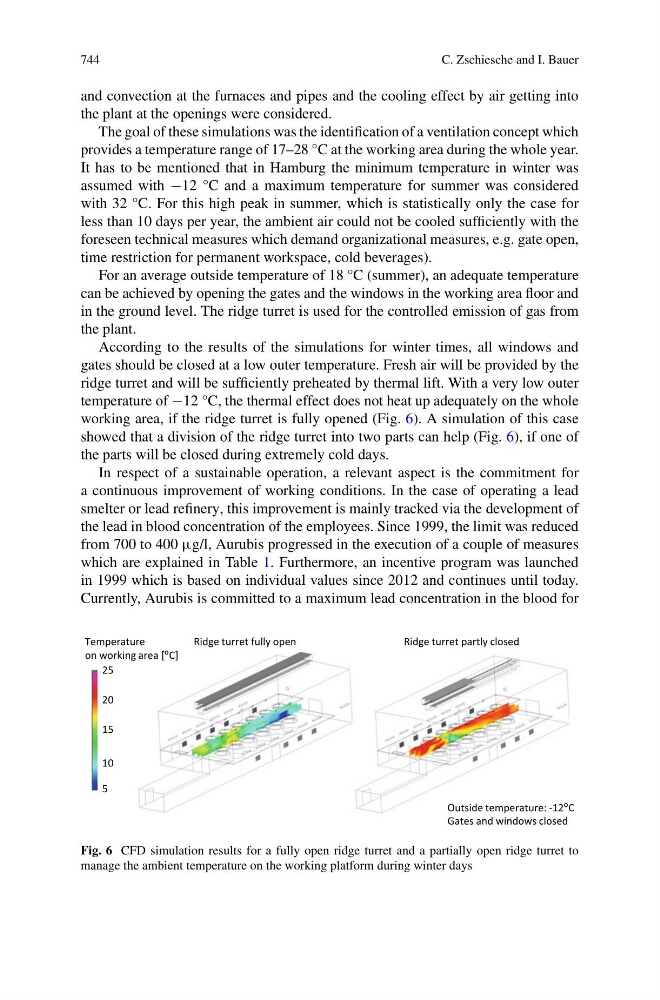
According to the results of the simulations for winter times, all windows and
gates should be closed at a low outer temperature. Fresh air will be provided by the
ridge turret and will be sufficiently preheated by thermal lift. With a very low outer
temperature of −12 °C, the thermal effect does not heat up adequately on the whole
working area, if the ridge turret is fully opened (Fig. 6). A simulation of this case
showed that a division of the ridge turret into two parts can help (Fig. 6), if one of
the parts will be closed during extremely cold days.
In respect of a sustainable operation, a relevant aspect is the commitment for
a continuous improvement of working conditions. In the case of operating a lead
smelter or lead refinery, this improvement is mainly tracked via the development of
the lead in blood concentration of the employees. Since 1999, the limit was reduced
from 700 to 400 µg/l, Aurubis progressed in the execution of a couple of measures
which are explained in Table 1. Furthermore, an incentive program was launched
in 1999 which is based on individual values since 2012 and continues until today.
Currently, Aurubis is committed to a maximum lead concentration in the blood for
Ridge turret fully open
Ridge turret partly closed
Temperature
on working area [ºC]
25
20
5
10
15
Outside temperature: -12ºC
Gates and windows closed
Fig. 6 CFD simulation results for a fully open ridge turret and a partially open ridge turret to
manage the ambient temperature on the working platform during winter days