

712
T. Liao et al.
20
30
40
50
60
70
80
0
20
40
60
80
100
(a)
Removal percentage of As (%)
10
20
30
40
50
60
0
20
40
60
80
100
(b)
Removal percentage of As (%)
Time (min)
6
7
8
9
10
11
12
0
20
40
60
80
100
(c)
Removal percentage of As (%)
pH
4
5
6
7
8
9
1 0
0
20
40
60
80
100
(d)
Removal percentage of As (%)
The ratio of Fe/As
ºC
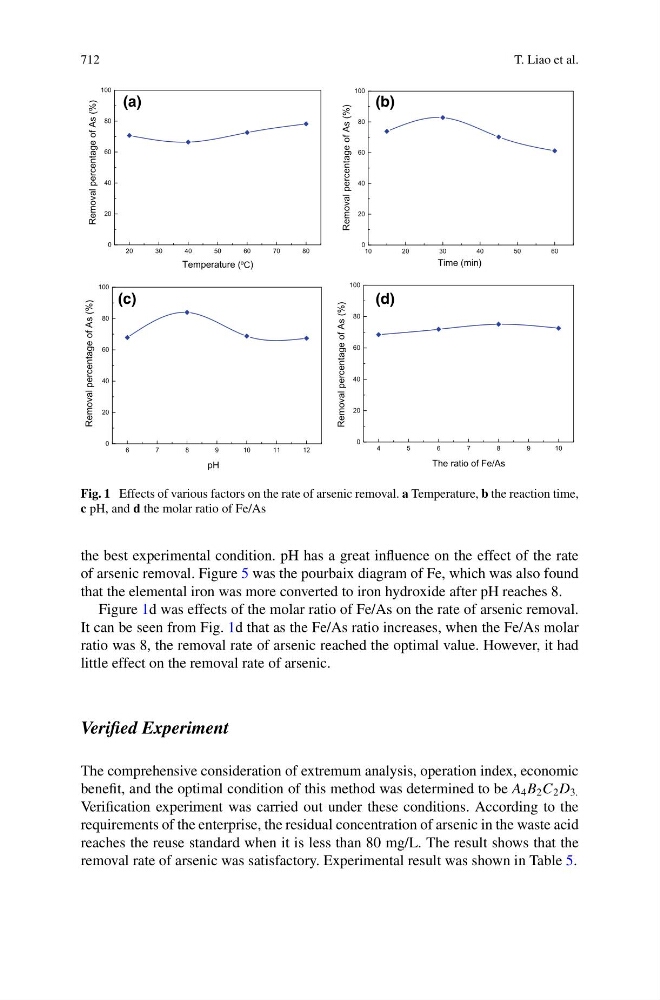
Fig. 1 Effects of various factors on the rate of arsenic removal. a Temperature, b the reaction time,
c pH, and d the molar ratio of Fe/As
the best experimental condition. pH has a great influence on the effect of the rate
of arsenic removal. Figure 5 was the pourbaix diagram of Fe, which was also found
that the elemental iron was more converted to iron hydroxide after pH reaches 8.
Figure 1d was effects of the molar ratio of Fe/As on the rate of arsenic removal.
It can be seen from Fig. 1d that as the Fe/As ratio increases, when the Fe/As molar
ratio was 8, the removal rate of arsenic reached the optimal value. However, it had
little effect on the removal rate of arsenic.
Verified Experiment
The comprehensive consideration of extremum analysis, operation index, economic
benefit, and the optimal condition of this method was determined to be A 4 B 2 C 2 D 3.
Verification experiment was carried out under these conditions. According to the
requirements of the enterprise, the residual concentration of arsenic in the waste acid
reaches the reuse standard when it is less than 80 mg/L. The result shows that the
removal rate of arsenic was satisfactory. Experimental result was shown in Table 5.