

704
J. Dahlstrom et al.
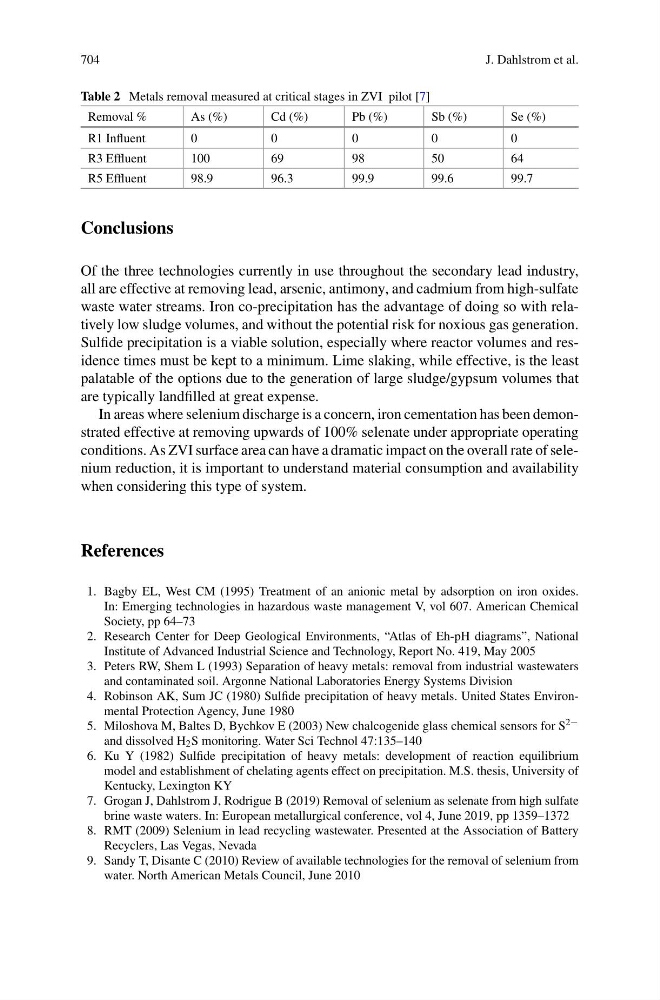
Table 2 Metals removal measured at critical stages in ZVI pilot [7]
Removal %
As (%)
Cd (%)
Pb (%)
Sb (%)
Se (%)
R1 Influent
0
0
0
0
0
R3 Effluent
100
69
98
50
64
R5 Effluent
98.9
96.3
99.9
99.6
99.7
Conclusions
Of the three technologies currently in use throughout the secondary lead industry,
all are effective at removing lead, arsenic, antimony, and cadmium from high-sulfate
waste water streams. Iron co-precipitation has the advantage of doing so with relatively low sludge volumes, and without the potential risk for noxious gas generation.
Sulfide precipitation is a viable solution, especially where reactor volumes and residence times must be kept to a minimum. Lime slaking, while effective, is the least
palatable of the options due to the generation of large sludge/gypsum volumes that
are typically landfilled at great expense.
In areas where selenium discharge is a concern, iron cementation has been demonstrated effective at removing upwards of 100% selenate under appropriate operating
conditions. As ZVI surface area can have a dramatic impact on the overall rate of selenium reduction, it is important to understand material consumption and availability
when considering this type of system.
References
1. Bagby EL, West CM (1995) Treatment of an anionic metal by adsorption on iron oxides.
In: Emerging technologies in hazardous waste management V, vol 607. American Chemical
Society, pp 64–73
2. Research Center for Deep Geological Environments, “Atlas of Eh-pH diagrams”, National
Institute of Advanced Industrial Science and Technology, Report No. 419, May 2005
3. Peters RW, Shem L (1993) Separation of heavy metals: removal from industrial wastewaters
and contaminated soil. Argonne National Laboratories Energy Systems Division
4. Robinson AK, Sum JC (1980) Sulfide precipitation of heavy metals. United States Environmental Protection Agency, June 1980
5. Miloshova M, Baltes D, Bychkov E (2003) New chalcogenide glass chemical sensors for S 2−
and dissolved H 2 S monitoring. Water Sci Technol 47:135–140
6. Ku Y (1982) Sulfide precipitation of heavy metals: development of reaction equilibrium
model and establishment of chelating agents effect on precipitation. M.S. thesis, University of
Kentucky, Lexington KY
7. Grogan J, Dahlstrom J, Rodrigue B (2019) Removal of selenium as selenate from high sulfate
brine waste waters. In: European metallurgical conference, vol 4, June 2019, pp 1359–1372
8. RMT (2009) Selenium in lead recycling wastewater. Presented at the Association of Battery
Recyclers, Las Vegas, Nevada
9. Sandy T, Disante C (2010) Review of available technologies for the removal of selenium from
water. North American Metals Council, June 2010