

678
L. Zheng et al.
of zinc powder to form Zn(OH) 2 , which will cover the zinc powder surface, inhibiting the discharge of cobalt and germanium ions and the diffusion of Zn
2+ ions from
the surface of zinc powder to the bulk of the solution. For this reason, the removal
of cobalt and germanium is restrained.
Effect of Oxidation of Zinc Powder on Purification
of High-Cobalt Zinc Sulfate Solution
In the acidic zinc sulfate solution, the zinc oxide film on the surface of the zinc
powder can consume hydrogen ions in the solution, thereby changing the physicochemical properties of the solution. As the amount of zinc oxide increases, the
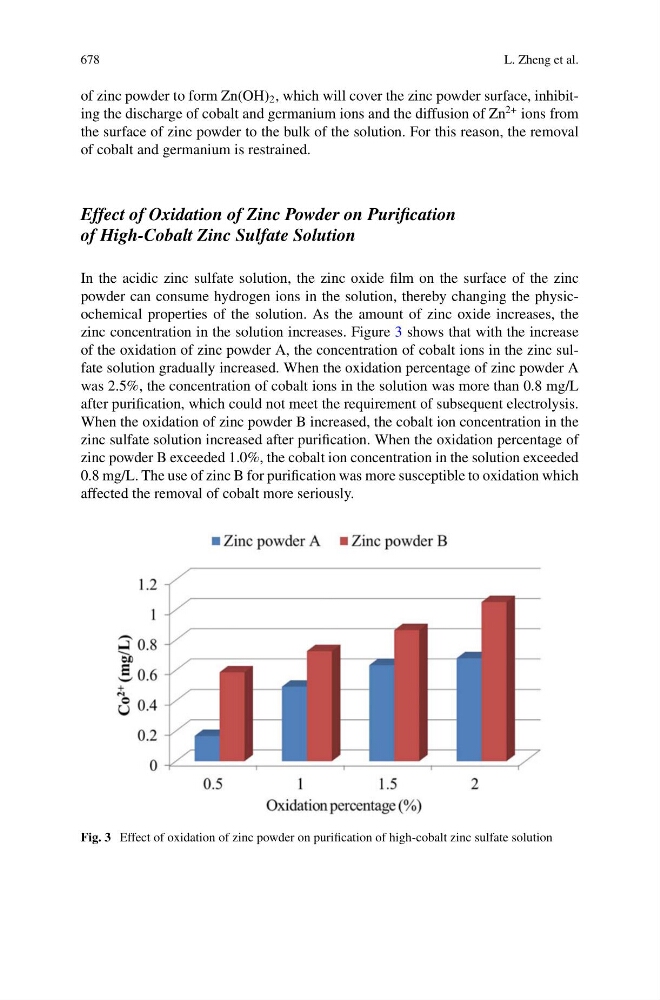
zinc concentration in the solution increases. Figure 3 shows that with the increase
of the oxidation of zinc powder A, the concentration of cobalt ions in the zinc sulfate solution gradually increased. When the oxidation percentage of zinc powder A
was 2.5%, the concentration of cobalt ions in the solution was more than 0.8 mg/L
after purification, which could not meet the requirement of subsequent electrolysis.
When the oxidation of zinc powder B increased, the cobalt ion concentration in the
zinc sulfate solution increased after purification. When the oxidation percentage of
zinc powder B exceeded 1.0%, the cobalt ion concentration in the solution exceeded
0.8 mg/L. The use of zinc B for purification was more susceptible to oxidation which
affected the removal of cobalt more seriously.
Fig. 3 Effect of oxidation of zinc powder on purification of high-cobalt zinc sulfate solution