

668
T. Ebner et al.
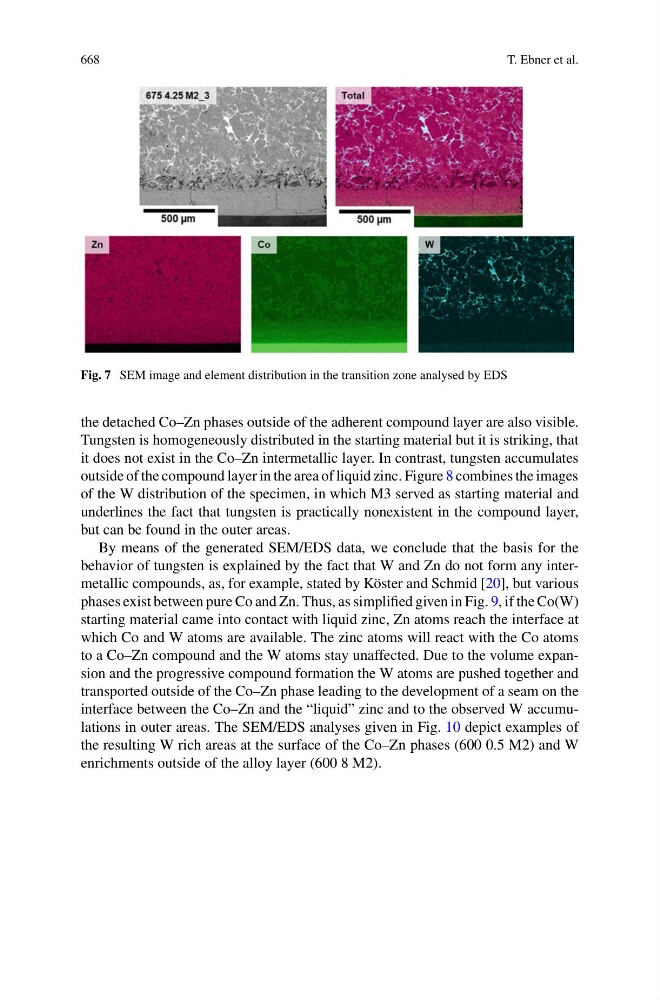
Fig. 7 SEM image and element distribution in the transition zone analysed by EDS
the detached Co–Zn phases outside of the adherent compound layer are also visible.
Tungsten is homogeneously distributed in the starting material but it is striking, that
it does not exist in the Co–Zn intermetallic layer. In contrast, tungsten accumulates
outside of the compound layer in the area of liquid zinc. Figure 8 combines the images
of the W distribution of the specimen, in which M3 served as starting material and
underlines the fact that tungsten is practically nonexistent in the compound layer,
but can be found in the outer areas.
By means of the generated SEM/EDS data, we conclude that the basis for the
behavior of tungsten is explained by the fact that W and Zn do not form any intermetallic compounds, as, for example, stated by Köster and Schmid [20], but various
phases exist between pure Co and Zn. Thus, as simplified given in Fig. 9, if the Co(W)
starting material came into contact with liquid zinc, Zn atoms reach the interface at
which Co and W atoms are available. The zinc atoms will react with the Co atoms
to a Co–Zn compound and the W atoms stay unaffected. Due to the volume expansion and the progressive compound formation the W atoms are pushed together and
transported outside of the Co–Zn phase leading to the development of a seam on the
interface between the Co–Zn and the “liquid” zinc and to the observed W accumulations in outer areas. The SEM/EDS analyses given in Fig. 10 depict examples of
the resulting W rich areas at the surface of the Co–Zn phases (600 0.5 M2) and W
enrichments outside of the alloy layer (600 8 M2).