

636
W. Zhang et al.
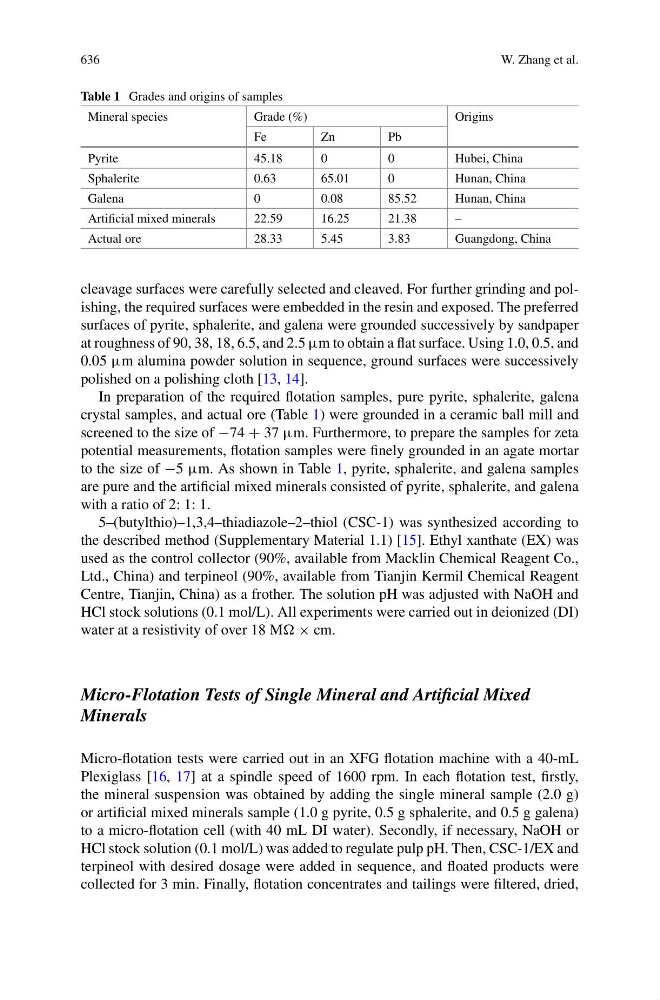
Table 1 Grades and origins of samples
Mineral species
Grade (%)
Origins
Fe
Zn
Pb
Pyrite
45.18
0
0
Hubei, China
Sphalerite
0.63
65.01
0
Hunan, China
Galena
0
0.08
85.52
Hunan, China
Artificial mixed minerals
22.59
16.25
21.38
–
Actual ore
28.33
5.45
3.83
Guangdong, China
cleavage surfaces were carefully selected and cleaved. For further grinding and polishing, the required surfaces were embedded in the resin and exposed. The preferred
surfaces of pyrite, sphalerite, and galena were grounded successively by sandpaper
at roughness of 90, 38, 18, 6.5, and 2.5 μm to obtain a flat surface. Using 1.0, 0.5, and
0.05 μm alumina powder solution in sequence, ground surfaces were successively
polished on a polishing cloth [13, 14].
In preparation of the required flotation samples, pure pyrite, sphalerite, galena
crystal samples, and actual ore (Table 1) were grounded in a ceramic ball mill and
screened to the size of −74 + 37 μm. Furthermore, to prepare the samples for zeta
potential measurements, flotation samples were finely grounded in an agate mortar
to the size of −5 μm. As shown in Table 1, pyrite, sphalerite, and galena samples
are pure and the artificial mixed minerals consisted of pyrite, sphalerite, and galena
with a ratio of 2: 1: 1.
5–(butylthio)–1,3,4–thiadiazole–2–thiol (CSC-1) was synthesized according to
the described method (Supplementary Material 1.1) [15]. Ethyl xanthate (EX) was
used as the control collector (90%, available from Macklin Chemical Reagent Co.,
Ltd., China) and terpineol (90%, available from Tianjin Kermil Chemical Reagent
Centre, Tianjin, China) as a frother. The solution pH was adjusted with NaOH and
HCl stock solutions (0.1 mol/L). All experiments were carried out in deionized (DI)
water at a resistivity of over 18 M × cm.
Micro-Flotation Tests of Single Mineral and Artificial Mixed
Minerals
Micro-flotation tests were carried out in an XFG flotation machine with a 40-mL
Plexiglass [16, 17] at a spindle speed of 1600 rpm. In each flotation test, firstly,
the mineral suspension was obtained by adding the single mineral sample (2.0 g)
or artificial mixed minerals sample (1.0 g pyrite, 0.5 g sphalerite, and 0.5 g galena)
to a micro-flotation cell (with 40 mL DI water). Secondly, if necessary, NaOH or
HCl stock solution (0.1 mol/L) was added to regulate pulp pH. Then, CSC-1/EX and
terpineol with desired dosage were added in sequence, and floated products were
collected for 3 min. Finally, flotation concentrates and tailings were filtered, dried,
W. Zhang et al.
Table 1 Grades and origins of samples
Mineral species
Grade (%)
Origins
Fe
Zn
Pb
Pyrite
45.18
0
0
Hubei, China
Sphalerite
0.63
65.01
0
Hunan, China
Galena
0
0.08
85.52
Hunan, China
Artificial mixed minerals
22.59
16.25
21.38
–
Actual ore
28.33
5.45
3.83
Guangdong, China
cleavage surfaces were carefully selected and cleaved. For further grinding and polishing, the required surfaces were embedded in the resin and exposed. The preferred
surfaces of pyrite, sphalerite, and galena were grounded successively by sandpaper
at roughness of 90, 38, 18, 6.5, and 2.5 μm to obtain a flat surface. Using 1.0, 0.5, and
0.05 μm alumina powder solution in sequence, ground surfaces were successively
polished on a polishing cloth [13, 14].
In preparation of the required flotation samples, pure pyrite, sphalerite, galena
crystal samples, and actual ore (Table 1) were grounded in a ceramic ball mill and
screened to the size of −74 + 37 μm. Furthermore, to prepare the samples for zeta
potential measurements, flotation samples were finely grounded in an agate mortar
to the size of −5 μm. As shown in Table 1, pyrite, sphalerite, and galena samples
are pure and the artificial mixed minerals consisted of pyrite, sphalerite, and galena
with a ratio of 2: 1: 1.
5–(butylthio)–1,3,4–thiadiazole–2–thiol (CSC-1) was synthesized according to
the described method (Supplementary Material 1.1) [15]. Ethyl xanthate (EX) was
used as the control collector (90%, available from Macklin Chemical Reagent Co.,
Ltd., China) and terpineol (90%, available from Tianjin Kermil Chemical Reagent
Centre, Tianjin, China) as a frother. The solution pH was adjusted with NaOH and
HCl stock solutions (0.1 mol/L). All experiments were carried out in deionized (DI)
water at a resistivity of over 18 M × cm.
Micro-Flotation Tests of Single Mineral and Artificial Mixed
Minerals
Micro-flotation tests were carried out in an XFG flotation machine with a 40-mL
Plexiglass [16, 17] at a spindle speed of 1600 rpm. In each flotation test, firstly,
the mineral suspension was obtained by adding the single mineral sample (2.0 g)
or artificial mixed minerals sample (1.0 g pyrite, 0.5 g sphalerite, and 0.5 g galena)
to a micro-flotation cell (with 40 mL DI water). Secondly, if necessary, NaOH or
HCl stock solution (0.1 mol/L) was added to regulate pulp pH. Then, CSC-1/EX and
terpineol with desired dosage were added in sequence, and floated products were
collected for 3 min. Finally, flotation concentrates and tailings were filtered, dried,